
- Posts: 88
- Thank you received: 0
Avy Hazard and Decision Making (from Cement Basin post)
- GerryH
- [GerryH]
-
 Topic Author
- Offline
- Junior Member
-

Less
More
28 Dec 2011 15:52 - 04 Jan 2012 15:14 #97648
by GerryH
Avy Hazard and Decision Making (from Cement Basin post) was created by GerryH
EDIT by Marcus -- this is a split off topic from the Cement Basin post
here
.
**************
Nice images, nice day, nice terrain, nice snow......but am I missing something here? Leeward slope, over a foot of wind transported snow, rotten, breakable crust beneath the wind transported, and short slopes yo yo'd in what appears to be a 25 to 35 degree range. And then a pit dug (before or after making the 'to ski it' decision?), at 35 degrees, with a CT 7, maybe Q1 quality. With some sun, perhaps some warming, snow settling, soft slab forming if not already a bit wind compacted? Safe travel practice employed? - hard to tell from picture angles.
The point is, are my friend (who alerted me to the post) and I the only two of the 670 readers of this post, who up to this time have read this post and wondered a bit about the decision making process leading to this story? No one else has posted wondering. I hope not. It is probably perfectly explainable, I just don't have all the info. Just thinking. Gerry
**************
Nice images, nice day, nice terrain, nice snow......but am I missing something here? Leeward slope, over a foot of wind transported snow, rotten, breakable crust beneath the wind transported, and short slopes yo yo'd in what appears to be a 25 to 35 degree range. And then a pit dug (before or after making the 'to ski it' decision?), at 35 degrees, with a CT 7, maybe Q1 quality. With some sun, perhaps some warming, snow settling, soft slab forming if not already a bit wind compacted? Safe travel practice employed? - hard to tell from picture angles.
The point is, are my friend (who alerted me to the post) and I the only two of the 670 readers of this post, who up to this time have read this post and wondered a bit about the decision making process leading to this story? No one else has posted wondering. I hope not. It is probably perfectly explainable, I just don't have all the info. Just thinking. Gerry
Last edit: 04 Jan 2012 15:14 by Marcus.
Please Log in or Create an account to join the conversation.
- Pete A
- [Bud]
-
- Offline
- Senior Member
-

Less
More
- Posts: 431
- Thank you received: 0
28 Dec 2011 17:15 #97651
by Pete A
Replied by Pete A on topic Re: Avy Hazard and Decision Making (from Cement Basin post)
Hi Gerry,
I'm happy to provide some additional info. I probably should've provided some more details from the get-go so that folks would have a better idea of what we were skiing and our decision process...
I did the tap test on a column after our first lap. On our first lap we stuck to very mellow terrain...most of the terrain was less than 25 degrees... the only real exception being that I was actually looking for something steeper so I could do some kind of test, and mid-way through our first lap, when the other skiers were in a safe spot, I did ski cut and stomp a couple very short 35 degree rolls to see if I could get the new snow to move...I didn't get any whoomps, shooting cracks, just a little sluffing.
Before we started our first run, and on our skin up through Bullion, we poked around and looked at the snowpack, and I dug a few hasty pits but because we weren't near a steep pitch, any kind of tap test info would've been skewed (at least thats been my experience in the past trying to assign a tap failure number to a slope that has a rather shallow angle). We figured given what we'd seen from the snowpack on the way up, and what we saw at the top of our first run, it was perfectly reasonably to ski something way less than prime angle and take a closer look at the snowpack when we found something steeper.
I had to veer out of our skin track which was set on a fairly mellow pitch to find a short 35 degree roll to dig the pit on so that we could get a more accurate read on how the crust and new snow was behaving. Given what we found, we continued lapping the mellower pitches we had already skied and deliberately avoided moving into some lines that had a continuous steep pitch.
As for the sun....it was dumb luck that we started our first lap and I snapped some pics right when the sun came out...my guess is that we had sunshine for about 20 minutes before it was overcast the rest of the day. The sun didn't make any obvious changes to the snow we were skiing (it certainly might've effected it some, but not that we could tell)...the snow was still rather light on our second lap when the sky was overcast.
Though the sun was certainly on my mind, and if we had been on a direct south exposure (we were on an east facing slope), its certainly possible that the brief shot of sun we got would've been enough to cause the new snow to become more cohesive and have some slabby instead of sluffy behavior.
Hopefully that helps clear things up. If you think we were behaving recklessly, I'm always welcome to hear constructive criticism.
I'm happy to provide some additional info. I probably should've provided some more details from the get-go so that folks would have a better idea of what we were skiing and our decision process...
I did the tap test on a column after our first lap. On our first lap we stuck to very mellow terrain...most of the terrain was less than 25 degrees... the only real exception being that I was actually looking for something steeper so I could do some kind of test, and mid-way through our first lap, when the other skiers were in a safe spot, I did ski cut and stomp a couple very short 35 degree rolls to see if I could get the new snow to move...I didn't get any whoomps, shooting cracks, just a little sluffing.
Before we started our first run, and on our skin up through Bullion, we poked around and looked at the snowpack, and I dug a few hasty pits but because we weren't near a steep pitch, any kind of tap test info would've been skewed (at least thats been my experience in the past trying to assign a tap failure number to a slope that has a rather shallow angle). We figured given what we'd seen from the snowpack on the way up, and what we saw at the top of our first run, it was perfectly reasonably to ski something way less than prime angle and take a closer look at the snowpack when we found something steeper.
I had to veer out of our skin track which was set on a fairly mellow pitch to find a short 35 degree roll to dig the pit on so that we could get a more accurate read on how the crust and new snow was behaving. Given what we found, we continued lapping the mellower pitches we had already skied and deliberately avoided moving into some lines that had a continuous steep pitch.
As for the sun....it was dumb luck that we started our first lap and I snapped some pics right when the sun came out...my guess is that we had sunshine for about 20 minutes before it was overcast the rest of the day. The sun didn't make any obvious changes to the snow we were skiing (it certainly might've effected it some, but not that we could tell)...the snow was still rather light on our second lap when the sky was overcast.
Though the sun was certainly on my mind, and if we had been on a direct south exposure (we were on an east facing slope), its certainly possible that the brief shot of sun we got would've been enough to cause the new snow to become more cohesive and have some slabby instead of sluffy behavior.
Hopefully that helps clear things up. If you think we were behaving recklessly, I'm always welcome to hear constructive criticism.
Please Log in or Create an account to join the conversation.
- Eli3
- [Eli3]
-
- Offline
- Junior Member
-
Less
More
- Posts: 69
- Thank you received: 0
28 Dec 2011 17:52 #97654
by Eli3
Replied by Eli3 on topic Re: Avy Hazard and Decision Making (from Cement Basin post)
I think biggest surprise for me for the day was seeing so many tracks down the hourglass - hard crust with 8-10" of wind effected snow on a 35-40 degree lee slope that has a history of avy accidents. With such undulating terrain into the narrow portion of the run, we assumed a pit to be pretty worthless since so many aspects are touched on the way down. We did the mellower slope to skiers left and did not see any cracking, but from the poor bonding we saw on the south side of east peak skinning up (skinning above the skin track caused 8" slab to brake loose in multiple areas), we avoided the hourglass.... I guess things were bonded better than we thought!
I was very surprised at the moderate danger predicted by NWAC too - there was lots of wind transport & loading after it stopped raining.
I was very surprised at the moderate danger predicted by NWAC too - there was lots of wind transport & loading after it stopped raining.
Please Log in or Create an account to join the conversation.
- GerryH
- [GerryH]
-
Topic Author
- Offline
- Junior Member
-
Less
More
- Posts: 88
- Thank you received: 0
28 Dec 2011 19:57 #97657
by GerryH
Replied by GerryH on topic Re: Avy Hazard and Decision Making (from Cement Basin post)
Thanks so much, Pete, and to your crew. I hope everyone can revisit both your original and your recent update post, because together they paint the kind of picture we all want to emulate.
Maintaining good group communications, having your antenna up and being observant your entire trip, maintaining individual and group consciousness, having a plan, sticking to it while choosing the right terrain, safely testing the snowpack, all are so critical to staying safe while still getting the goods.
I don't hold myself up as an expert to judge others, but have and am investing a lot of time in avalanche education - as both a student and instructor. And am sometimes outspoken in my opinions. I think those of us fortunate enough to have gained a lot of avalanche experience, and education, have a responsibility to those at the beginning of their backcountry experiences, to share our knowledge - as others did for us. And it was in that spirit that I offered up my comments. Sometimes taking a few extra sentences of explanation can dispel that ski film bravado of just jumping into it and letting it rip, when in fact those ski stars have their heli hovering just out of camera sight and a crew of avy rescue professionals & first aiders on standbye - just in case. So I'd say your turns were very well earned. Thanks! Gerry
Maintaining good group communications, having your antenna up and being observant your entire trip, maintaining individual and group consciousness, having a plan, sticking to it while choosing the right terrain, safely testing the snowpack, all are so critical to staying safe while still getting the goods.
I don't hold myself up as an expert to judge others, but have and am investing a lot of time in avalanche education - as both a student and instructor. And am sometimes outspoken in my opinions. I think those of us fortunate enough to have gained a lot of avalanche experience, and education, have a responsibility to those at the beginning of their backcountry experiences, to share our knowledge - as others did for us. And it was in that spirit that I offered up my comments. Sometimes taking a few extra sentences of explanation can dispel that ski film bravado of just jumping into it and letting it rip, when in fact those ski stars have their heli hovering just out of camera sight and a crew of avy rescue professionals & first aiders on standbye - just in case. So I'd say your turns were very well earned. Thanks! Gerry
Please Log in or Create an account to join the conversation.
- Amar Andalkar
- [andalkar]
-
- Offline
- Premium Member
-

Less
More
- Posts: 635
- Thank you received: 0
28 Dec 2011 20:39 - 04 Jan 2012 15:14 #97661
by Amar Andalkar
Replied by Amar Andalkar on topic Re: Avy Hazard and Decision Making (from Cement Basin post)
Well, if we're going to analyze the avy hazard and decision-making here, might as well link to the available forecasts and data for reference:
Danger rose for all zones near and west of the Cascade crest:
http://www.nwac.us/dangerrose/preview/2043/
NWAC avy forecast from Sunday, Dec 25, the latest available before this trip: www.nwac.us/archive/sabsea_2011-12-25-1115.html
The updated avy forecast on Dec 26 did not increase the hazard rating either, the key statement perhaps being that "no avalanches were reported upon control work at Stevens Pass or Crystal Mountain Monday morning": www.nwac.us/archive/sabsea_2011-12-26-1236.html
Weather summary: On Dec 25, the Crystal Mountain area had unexpectedly received the most snowfall of any location in the Cascades, with 9" new reported by the ski area and 7" new showing on the Green Valley NWAC telemetry -- no other measurement site had more than 5-6" new that day, with most closer to 2" new. The new snow at Crystal had fallen from 11am to 8pm during moderately strong W and NW winds, see telemetry below. Field reports verified that 9" new snow amount on flat protected slopes, such as in Bullion Basin.
I skied several runs on the same slopes and other neighboring slopes with another group that day, and thought that the avalanche danger was Low-to-Moderate at most. It was certainly not Considerable (meaning "Natural avalanches possible; human-triggered avalanches likely.") in any location or aspect that we skinned or skied. Natural avalanches did not appear to be possible, and human-triggered avalanches appeared to be very unlikely.
I think the reason for the relatively low-ish hazard was that the deeper areas of new snow (wherever the wind had transported the snow) felt generally cohesionless, not slabby, and the only slightly slabby areas were the wind-hammered slopes which had much less new snow atop the crust. There's not much avy hazard when the so-called slabs are 2-4" deep maximum, and have no fracture energy or propagation whatsoever. Not sure about where someone saw those 8" slabs beside the skin track up the SW side of East Peak -- we skinned up the same skin track and saw only 2-4" deep mini-slabs (like 1 ski-length in size) beside the skin track in a couple spots, even those only on the iciest sections of smooth old sun crust.
We started the day by breaking trail into Bullion Basin and up Point 6479 (Bullion Peak ?) via its N face and NW ridge. Conditions felt totally stable underfoot while putting in the skin track, even on every steep roll on the open face and ridge, nothing was slabby or sliding. We skied down the N face (an obvious big avy slope) in very stable conditions. Slight slabbiness right near the summit where the new snow was wind-hammered and thin (0-4"), but that was just a breakable windcrust that was not sliding anywhere. Then again cohesionless and not slabby or wind-affected at all just a bit lower as soon as the snow got deep enough (say 6-8") to be fun skiing.
When the sun came out at the end of that run (around 11:30am), we decided to head up the SW side of East Peak just to get out of the very cold shade and enjoy the sunshine. We were just planning to ski the SW side, but decided to ski the steeper NE and ENE aspects (30-40 degrees) from the summit of East Peak only after seeing a handful of ski tracks having already descended safely down this aspect (another obvious big avy slope). We found excellent stable powder with absolutely nothing sliding or moving, and quite deep, generally 9-12" deep all the way down to the flats at 5900 ft. Nice enough to ski 2 runs down there. We dug no pits.
Regarding sun and warming: at this time of year, the sun can really only affect steep S-facing slopes due to its very low angle and limited range of azimuth. All other aspects and slope angles get very minimal insolation even on a totally sunny day -- they are almost immune. Despite the sun being out for a while this day (full sun for maybe 20-30 minutes, partial filtered sun for maybe 2-3 hours), even the steep S and SW facing slope from the summit of East Peak showed almost no signs of sun effect. When we finally skied back down at sunset, there was no breakable sun crust, just very nice stable powder once we dropped below the thin wind-hammered areas up high. So other slopes (everything not steep S-facing) obviously had zero sun effect this day. There was very little warming during the day, and the next incoming storm did not arrive until late afternoon, with very light snowfall beginning near 4pm (too light to show up on telemetry).
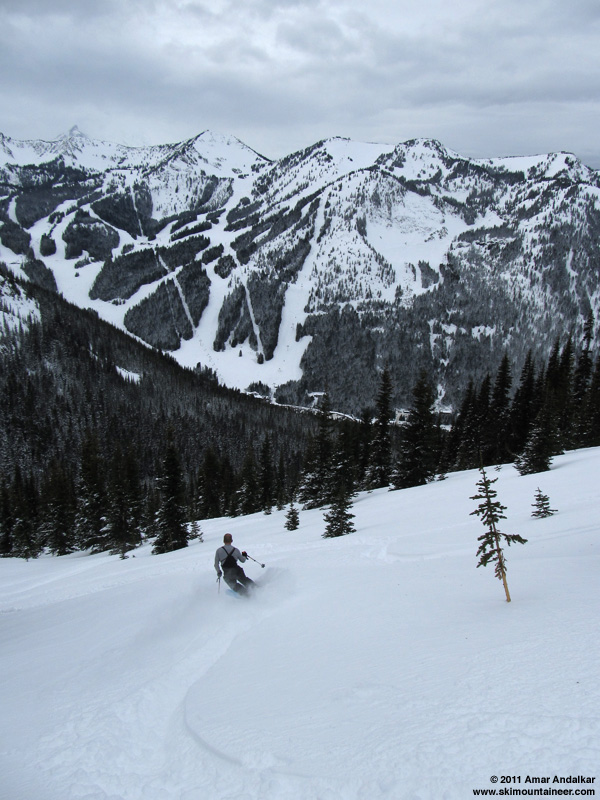
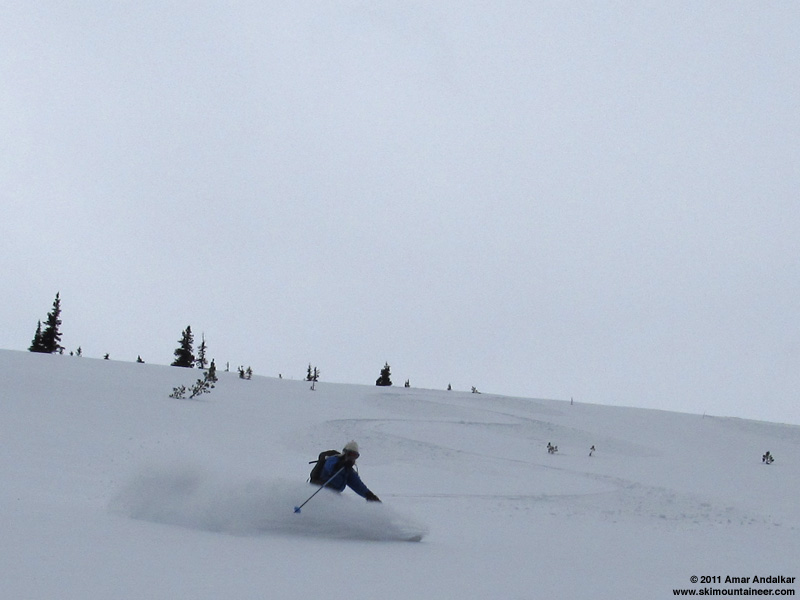
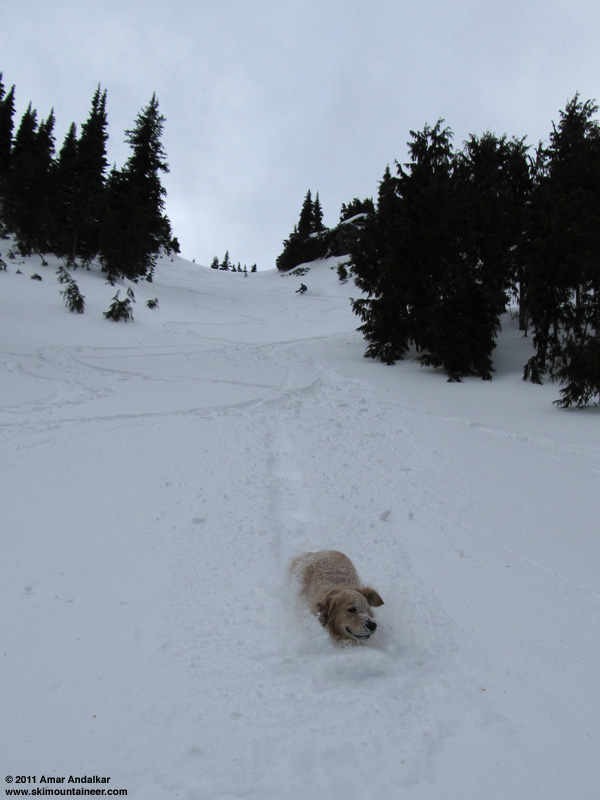
Some photos of our day:
N aspect:
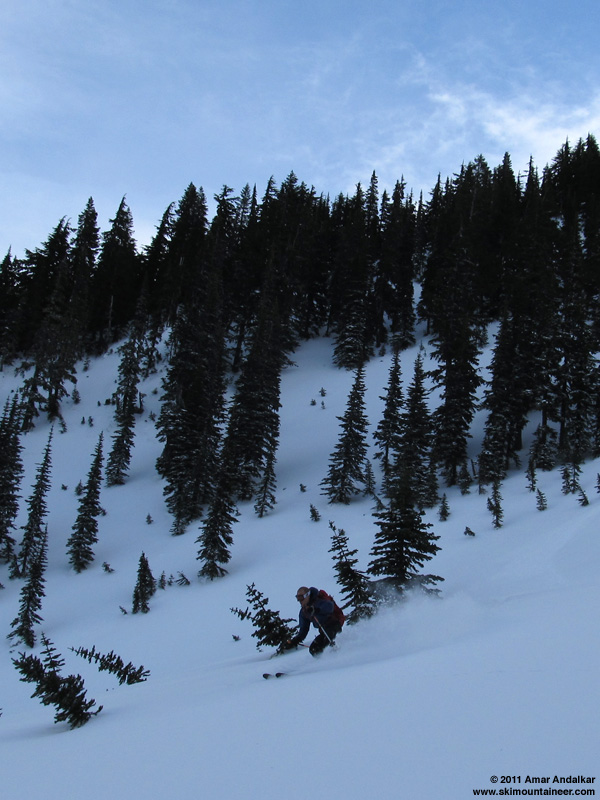
SW aspect:
ENE aspect:
[size=small]
Northwest Weather and Avalanche Center Northwest Weather and Avalanche Center
Crystal Mountain Ski Area, Washington Green Valley, Crystal Mountain Ski Area
MM/DD Hour Temp Temp RH RH Wind Wind Wind Wind Hour Total 24 Hr Total MM/DD Hour Temp 24 Hr Total
PST F F % % Min Avg Max Dir Prec. Prec. Snow Snow PST F Snow Snow
6830' 4570' 6830' 4570' 6830' 6830' 6830' 6830' 4570' 4570' 4570' 4570' 6230' 6230' 6230'
12 25 500 35 43 44 47 10 24 44 200 0 0 0 32 12 25 500 35 0 43
12 25 600 34 44 50 41 14 28 56 228 0 0 0 32 12 25 600 34 0 43
12 25 700 32 41 53 46 13 30 53 191 0 0 0 33 12 25 700 32 0 42
12 25 800 31 42 55 41 13 34 59 190 0 0 0 33 12 25 800 32 0 42
12 25 900 30 42 52 39 13 35 63 210 0 0 0 33 12 25 900 31 0 42
12 25 1000 29 41 54 39 15 34 65 212 0 0 0 33 12 25 1000 29 0 42
12 25 1100 24 33 99 95 11 29 64 206 .03 .03 0 31 12 25 1100 24 0 37
12 25 1200 24 32 99 96 13 31 55 234 .08 .11 1 33 12 25 1200 24 0 43
12 25 1300 24 32 98 97 8 21 44 287 .05 .16 47 33 12 25 1300 23 1 43
12 25 1400 24 31 99 97 4 14 30 272 .03 .19 47 33 12 25 1400 23 1 43
12 25 1500 22 30 99 99 7 21 52 215 .11 .3 3 35 12 25 1500 22 3 45
12 25 1600 21 29 98 99 11 29 53 263 .07 .37 47 238 12 25 1600 20 4 44
12 25 1700 20 28 98 99 10 28 56 274 .09 .46 4 37 12 25 1700 19 5 47
12 25 1800 18 26 97 99 11 28 50 190 .09 .55 5 39 12 25 1800 17 7 50
12 25 1900 18 26 97 98 11 26 48 262 .04 .59 5 38 12 25 1900 16 7 49
12 25 2000 17 26 97 98 7 22 42 268 .02 .61 5 38 12 25 2000 16 7 48
12 25 2100 16 25 96 97 13 21 30 291 0 .61 5 38 12 25 2100 15 8 51
12 25 2200 15 23 96 97 7 16 25 308 0 .61 5 38 12 25 2200 14 7 51
12 25 2300 16 22 96 97 8 17 28 278 0 .61 5 37 12 25 2300 13 7 51
12 26 0 16 22 96 96 5 15 26 276 0 .61 5 37 12 26 0 13 7 50
12 26 100 14 21 96 97 6 18 27 273 0 .61 5 37 12 26 100 12 7 50
12 26 200 15 21 96 96 10 21 30 289 0 .61 5 37 12 26 200 12 7 51
12 26 300 15 20 96 95 8 14 23 270 0 .61 5 38 12 26 300 12 7 50
12 26 400 15 20 96 96 6 11 16 164 0 .61 5 38 12 26 400 12 7 49
12 26 500 15 21 97 97 3 9 20 242 0 0 5 38 12 26 500 14 7 50
12 26 600 16 23 97 97 4 11 19 203 0 0 5 38 12 26 600 15 7 50
12 26 700 18 24 94 97 4 9 14 206 0 0 5 38 12 26 700 15 7 50
12 26 800 19 25 96 97 1 7 14 142 0 0 0 38 12 26 800 18 7 50
12 26 900 20 25 95 96 4 12 22 151 0 0 0 38 12 26 900 17 7 50
12 26 1000 20 25 90 94 7 21 37 189 0 0 0 38 12 26 1000 18 7 50
12 26 1100 22 27 72 90 18 30 42 184 0 0 0 38 12 26 1100 20 7 49
12 26 1200 22 27 72 94 6 18 40 150 0 0 0 38 12 26 1200 22 7 49
12 26 1300 21 29 62 87 3 15 33 194 0 0 0 38 12 26 1300 22 7 48
12 26 1400 21 28 68 86 3 18 37 204 0 0 0 37 12 26 1400 21 7 49
12 26 1500 21 28 85 94 2 8 22 164 0 0 0 37 12 26 1500 19 6 49
12 26 1600 20 27 90 95 0 4 12 194 0 0 0 38 12 26 1600 18 6 49
12 26 1700 18 26 95 91 4 11 20 198 0 0 0 38 12 26 1700 17 6 49
12 26 1800 18 26 95 93 6 19 37 207 0 0 0 38 12 26 1800 19 6 49
[/size]
Danger rose for all zones near and west of the Cascade crest:
http://www.nwac.us/dangerrose/preview/2043/
NWAC avy forecast from Sunday, Dec 25, the latest available before this trip: www.nwac.us/archive/sabsea_2011-12-25-1115.html
The updated avy forecast on Dec 26 did not increase the hazard rating either, the key statement perhaps being that "no avalanches were reported upon control work at Stevens Pass or Crystal Mountain Monday morning": www.nwac.us/archive/sabsea_2011-12-26-1236.html
Weather summary: On Dec 25, the Crystal Mountain area had unexpectedly received the most snowfall of any location in the Cascades, with 9" new reported by the ski area and 7" new showing on the Green Valley NWAC telemetry -- no other measurement site had more than 5-6" new that day, with most closer to 2" new. The new snow at Crystal had fallen from 11am to 8pm during moderately strong W and NW winds, see telemetry below. Field reports verified that 9" new snow amount on flat protected slopes, such as in Bullion Basin.
I skied several runs on the same slopes and other neighboring slopes with another group that day, and thought that the avalanche danger was Low-to-Moderate at most. It was certainly not Considerable (meaning "Natural avalanches possible; human-triggered avalanches likely.") in any location or aspect that we skinned or skied. Natural avalanches did not appear to be possible, and human-triggered avalanches appeared to be very unlikely.
I think the reason for the relatively low-ish hazard was that the deeper areas of new snow (wherever the wind had transported the snow) felt generally cohesionless, not slabby, and the only slightly slabby areas were the wind-hammered slopes which had much less new snow atop the crust. There's not much avy hazard when the so-called slabs are 2-4" deep maximum, and have no fracture energy or propagation whatsoever. Not sure about where someone saw those 8" slabs beside the skin track up the SW side of East Peak -- we skinned up the same skin track and saw only 2-4" deep mini-slabs (like 1 ski-length in size) beside the skin track in a couple spots, even those only on the iciest sections of smooth old sun crust.
We started the day by breaking trail into Bullion Basin and up Point 6479 (Bullion Peak ?) via its N face and NW ridge. Conditions felt totally stable underfoot while putting in the skin track, even on every steep roll on the open face and ridge, nothing was slabby or sliding. We skied down the N face (an obvious big avy slope) in very stable conditions. Slight slabbiness right near the summit where the new snow was wind-hammered and thin (0-4"), but that was just a breakable windcrust that was not sliding anywhere. Then again cohesionless and not slabby or wind-affected at all just a bit lower as soon as the snow got deep enough (say 6-8") to be fun skiing.
When the sun came out at the end of that run (around 11:30am), we decided to head up the SW side of East Peak just to get out of the very cold shade and enjoy the sunshine. We were just planning to ski the SW side, but decided to ski the steeper NE and ENE aspects (30-40 degrees) from the summit of East Peak only after seeing a handful of ski tracks having already descended safely down this aspect (another obvious big avy slope). We found excellent stable powder with absolutely nothing sliding or moving, and quite deep, generally 9-12" deep all the way down to the flats at 5900 ft. Nice enough to ski 2 runs down there. We dug no pits.
Regarding sun and warming: at this time of year, the sun can really only affect steep S-facing slopes due to its very low angle and limited range of azimuth. All other aspects and slope angles get very minimal insolation even on a totally sunny day -- they are almost immune. Despite the sun being out for a while this day (full sun for maybe 20-30 minutes, partial filtered sun for maybe 2-3 hours), even the steep S and SW facing slope from the summit of East Peak showed almost no signs of sun effect. When we finally skied back down at sunset, there was no breakable sun crust, just very nice stable powder once we dropped below the thin wind-hammered areas up high. So other slopes (everything not steep S-facing) obviously had zero sun effect this day. There was very little warming during the day, and the next incoming storm did not arrive until late afternoon, with very light snowfall beginning near 4pm (too light to show up on telemetry).
Some photos of our day:
N aspect:
SW aspect:
ENE aspect:
[size=small]
Northwest Weather and Avalanche Center Northwest Weather and Avalanche Center
Crystal Mountain Ski Area, Washington Green Valley, Crystal Mountain Ski Area
MM/DD Hour Temp Temp RH RH Wind Wind Wind Wind Hour Total 24 Hr Total MM/DD Hour Temp 24 Hr Total
PST F F % % Min Avg Max Dir Prec. Prec. Snow Snow PST F Snow Snow
6830' 4570' 6830' 4570' 6830' 6830' 6830' 6830' 4570' 4570' 4570' 4570' 6230' 6230' 6230'
12 25 500 35 43 44 47 10 24 44 200 0 0 0 32 12 25 500 35 0 43
12 25 600 34 44 50 41 14 28 56 228 0 0 0 32 12 25 600 34 0 43
12 25 700 32 41 53 46 13 30 53 191 0 0 0 33 12 25 700 32 0 42
12 25 800 31 42 55 41 13 34 59 190 0 0 0 33 12 25 800 32 0 42
12 25 900 30 42 52 39 13 35 63 210 0 0 0 33 12 25 900 31 0 42
12 25 1000 29 41 54 39 15 34 65 212 0 0 0 33 12 25 1000 29 0 42
12 25 1100 24 33 99 95 11 29 64 206 .03 .03 0 31 12 25 1100 24 0 37
12 25 1200 24 32 99 96 13 31 55 234 .08 .11 1 33 12 25 1200 24 0 43
12 25 1300 24 32 98 97 8 21 44 287 .05 .16 47 33 12 25 1300 23 1 43
12 25 1400 24 31 99 97 4 14 30 272 .03 .19 47 33 12 25 1400 23 1 43
12 25 1500 22 30 99 99 7 21 52 215 .11 .3 3 35 12 25 1500 22 3 45
12 25 1600 21 29 98 99 11 29 53 263 .07 .37 47 238 12 25 1600 20 4 44
12 25 1700 20 28 98 99 10 28 56 274 .09 .46 4 37 12 25 1700 19 5 47
12 25 1800 18 26 97 99 11 28 50 190 .09 .55 5 39 12 25 1800 17 7 50
12 25 1900 18 26 97 98 11 26 48 262 .04 .59 5 38 12 25 1900 16 7 49
12 25 2000 17 26 97 98 7 22 42 268 .02 .61 5 38 12 25 2000 16 7 48
12 25 2100 16 25 96 97 13 21 30 291 0 .61 5 38 12 25 2100 15 8 51
12 25 2200 15 23 96 97 7 16 25 308 0 .61 5 38 12 25 2200 14 7 51
12 25 2300 16 22 96 97 8 17 28 278 0 .61 5 37 12 25 2300 13 7 51
12 26 0 16 22 96 96 5 15 26 276 0 .61 5 37 12 26 0 13 7 50
12 26 100 14 21 96 97 6 18 27 273 0 .61 5 37 12 26 100 12 7 50
12 26 200 15 21 96 96 10 21 30 289 0 .61 5 37 12 26 200 12 7 51
12 26 300 15 20 96 95 8 14 23 270 0 .61 5 38 12 26 300 12 7 50
12 26 400 15 20 96 96 6 11 16 164 0 .61 5 38 12 26 400 12 7 49
12 26 500 15 21 97 97 3 9 20 242 0 0 5 38 12 26 500 14 7 50
12 26 600 16 23 97 97 4 11 19 203 0 0 5 38 12 26 600 15 7 50
12 26 700 18 24 94 97 4 9 14 206 0 0 5 38 12 26 700 15 7 50
12 26 800 19 25 96 97 1 7 14 142 0 0 0 38 12 26 800 18 7 50
12 26 900 20 25 95 96 4 12 22 151 0 0 0 38 12 26 900 17 7 50
12 26 1000 20 25 90 94 7 21 37 189 0 0 0 38 12 26 1000 18 7 50
12 26 1100 22 27 72 90 18 30 42 184 0 0 0 38 12 26 1100 20 7 49
12 26 1200 22 27 72 94 6 18 40 150 0 0 0 38 12 26 1200 22 7 49
12 26 1300 21 29 62 87 3 15 33 194 0 0 0 38 12 26 1300 22 7 48
12 26 1400 21 28 68 86 3 18 37 204 0 0 0 37 12 26 1400 21 7 49
12 26 1500 21 28 85 94 2 8 22 164 0 0 0 37 12 26 1500 19 6 49
12 26 1600 20 27 90 95 0 4 12 194 0 0 0 38 12 26 1600 18 6 49
12 26 1700 18 26 95 91 4 11 20 198 0 0 0 38 12 26 1700 17 6 49
12 26 1800 18 26 95 93 6 19 37 207 0 0 0 38 12 26 1800 19 6 49
[/size]
Last edit: 04 Jan 2012 15:14 by Marcus.
Please Log in or Create an account to join the conversation.
- Zap
- [Zap]
-
- Offline
- Platinum Member
-

Less
More
- Posts: 1212
- Thank you received: 3
28 Dec 2011 21:26 #97664
by Zap
Replied by Zap on topic Re: Avy Hazard and Decision Making (from Cement Basin post)
Amar, I love the last photo with a great "face shot" . 
Please Log in or Create an account to join the conversation.
- GerryH
- [GerryH]
-
Topic Author
- Offline
- Junior Member
-
Less
More
- Posts: 88
- Thank you received: 0
28 Dec 2011 23:56 #97670
by GerryH
Replied by GerryH on topic Re: Avy Hazard and Decision Making (from Cement Basin post)
OK Amar I'll bite. But first, nice report, good analysis, as we've come to respect and expect from you. Excepting maybe your rationale for skiing off the East Peak? "We were just planning to ski the SW side, but decided to ski the steeper NE and ENE aspects (30-40 degrees) from the summit of East Peak only after seeing a handful of ski tracks having already descended safely down this aspect (another obvious big avy slope)." Seeing tracks leading down an avy slope isn't any kind of assurance or insurance that it won't slide when it's shred again, right? Having dug no pits, could you be assured it wasn't different than the north face of Bullion? Granted, the evidence was accumulating that what you expected and found, was stable. But since I've started and you've responded re this analysis, dare I ask if it's good practice to be standing shooting a photo upward when both your dog and fellow skier is descending an avalanche slope from directly above you?
The above said Amar, I value your contribution to this post and dialogue, which perhaps I could have/should have conducted in that alternative category Marcus established to explore avalanche safety and understanding - but this extended thread has, in my opinion, turned out to be a valuable learning experience for anyone reading it - or posting to it! More importantly, it was a great ski day for all of you participating. Also Pete, in my last post I wasn't inferring that you were 'at the beginning of your backcountry experiences', but instead referred to those readers who's experiences in the backcountry are new and building. Happy New Year All.
The above said Amar, I value your contribution to this post and dialogue, which perhaps I could have/should have conducted in that alternative category Marcus established to explore avalanche safety and understanding - but this extended thread has, in my opinion, turned out to be a valuable learning experience for anyone reading it - or posting to it! More importantly, it was a great ski day for all of you participating. Also Pete, in my last post I wasn't inferring that you were 'at the beginning of your backcountry experiences', but instead referred to those readers who's experiences in the backcountry are new and building. Happy New Year All.
Please Log in or Create an account to join the conversation.
- CookieMonster
- [CookieMonster]
-
- Offline
- Senior Member
-
Less
More
- Posts: 392
- Thank you received: 0
29 Dec 2011 00:20 #97671
by CookieMonster
Replied by CookieMonster on topic Re: Avy Hazard and Decision Making (from Cement Basin post)
You can see the snow is stable in the photos, and the telemetry explains why. Some more obs:
* Some of Pete A's photos clearly show snow with minimal wind signatures on the surface.
* In the first photo by Pete A, notice the lack of a drift line near the pine tree.
* In the first photo by Pete A, notice the micro-scale terrain features are visible below the new snow: settlement.
* Notice the uniform collection of snow on the trees in Pete A's first and second photos.
* Notice the lack of drift lines in the other photos.
* Amar's photos also show a lack of drift lines.
* Look at the ski tracks, especially the inside of the turns. The snow is clearly well-consolidated.
* The telemetry data posted by Amar contains a very obvious clue as to why they all found low instability.
* Examine the telemetry: look at temps/RH/wind.
* Bonding between existing snow and new snow: surface roughness is key, including variations at small scales.
* Some of Pete A's photos clearly show snow with minimal wind signatures on the surface.
* In the first photo by Pete A, notice the lack of a drift line near the pine tree.
* In the first photo by Pete A, notice the micro-scale terrain features are visible below the new snow: settlement.
* Notice the uniform collection of snow on the trees in Pete A's first and second photos.
* Notice the lack of drift lines in the other photos.
* Amar's photos also show a lack of drift lines.
* Look at the ski tracks, especially the inside of the turns. The snow is clearly well-consolidated.
* The telemetry data posted by Amar contains a very obvious clue as to why they all found low instability.
* Examine the telemetry: look at temps/RH/wind.
* Bonding between existing snow and new snow: surface roughness is key, including variations at small scales.
Please Log in or Create an account to join the conversation.
- Amar Andalkar
- [andalkar]
-
- Offline
- Premium Member
-
Less
More
- Posts: 635
- Thank you received: 0
29 Dec 2011 01:40 #97672
by Amar Andalkar
Actually, some of the skiers who had made the tracks were only minutes ahead of us, we could see them on the flats far below. A slope which just got skied by several other skiers with no avalanche activity is very solid assurance of its stability: it is a "real-world" stability test which is far better than any artificial stability test such as a pit. Seeing old tracks down a slope may be no assurance of stability, but seeing fresh tracks only minutes old is the strongest possible evidence of a slope's current stability under the load of a skier.
The slope and snow conditions were in fact very different than the north face of Bullion, as should be expected given the different aspect and much less exposure to this storm's winds. Much deeper snow right from the top, but no windcrust, less steep at the top, etc. -- it seemed likely that this slope was more stable today than the N side of Bullion. If there had been no previous tracks, we probably would have skied it by taking one of the more conservative and less steep lines which start farther NW from the summit of East Peak, leading down a broad shoulder towards open timber, instead of the big open slope leading to an obvious gully.
Photos can deceive the eye. The dog is actually over 20 ft away from me, the photo has been cropped somewhat. And I'm not standing directly on that avalanche slope at all, but on a small knob (a few feet high) at the skier's left edge of the open slope, an obvious "safe zone" to wait for subsequent skiers to descend. I am not in the fall line of any possible debris, which would run to my left (skier's right of me).
The telemetry does really explain the stability: temps starting near freezing and consistently falling throughout the period of snowfall, ensuring a good bond to the underlying crust and a very right-side-up density profile of the new snow.
In addition, the previous crust was not smooth (except on steep south aspects), ensuring a better bond: this was a long-term settlement crust due to 3 weeks of minimal precip, rough and bumpy -- there was no smooth icy rain crust at all, and a smoother sun crust only on steep south aspects, which did produce minor instability on the upper windswept parts of the SW face of East Peak (slabbing off of thin layers of windpacked new snow).
Replied by Amar Andalkar on topic Re: Avy Hazard and Decision Making (from Cement Basin post)
OK Amar I'll bite. But first, nice report, good analysis, as we've come to respect and expect from you. Excepting maybe your rationale for skiing off the East Peak? "We were just planning to ski the SW side, but decided to ski the steeper NE and ENE aspects (30-40 degrees) from the summit of East Peak only after seeing a handful of ski tracks having already descended safely down this aspect (another obvious big avy slope)." Seeing tracks leading down an avy slope isn't any kind of assurance or insurance that it won't slide when it's shred again, right? Having dug no pits, could you be assured it wasn't different than the north face of Bullion? Granted, the evidence was accumulating that what you expected and found, was stable.
Actually, some of the skiers who had made the tracks were only minutes ahead of us, we could see them on the flats far below. A slope which just got skied by several other skiers with no avalanche activity is very solid assurance of its stability: it is a "real-world" stability test which is far better than any artificial stability test such as a pit. Seeing old tracks down a slope may be no assurance of stability, but seeing fresh tracks only minutes old is the strongest possible evidence of a slope's current stability under the load of a skier.
The slope and snow conditions were in fact very different than the north face of Bullion, as should be expected given the different aspect and much less exposure to this storm's winds. Much deeper snow right from the top, but no windcrust, less steep at the top, etc. -- it seemed likely that this slope was more stable today than the N side of Bullion. If there had been no previous tracks, we probably would have skied it by taking one of the more conservative and less steep lines which start farther NW from the summit of East Peak, leading down a broad shoulder towards open timber, instead of the big open slope leading to an obvious gully.
But since I've started and you've responded re this analysis, dare I ask if it's good practice to be standing shooting a photo upward when both your dog and fellow skier is descending an avalanche slope from directly above you?
Photos can deceive the eye. The dog is actually over 20 ft away from me, the photo has been cropped somewhat. And I'm not standing directly on that avalanche slope at all, but on a small knob (a few feet high) at the skier's left edge of the open slope, an obvious "safe zone" to wait for subsequent skiers to descend. I am not in the fall line of any possible debris, which would run to my left (skier's right of me).
The telemetry does really explain the stability: temps starting near freezing and consistently falling throughout the period of snowfall, ensuring a good bond to the underlying crust and a very right-side-up density profile of the new snow.
In addition, the previous crust was not smooth (except on steep south aspects), ensuring a better bond: this was a long-term settlement crust due to 3 weeks of minimal precip, rough and bumpy -- there was no smooth icy rain crust at all, and a smoother sun crust only on steep south aspects, which did produce minor instability on the upper windswept parts of the SW face of East Peak (slabbing off of thin layers of windpacked new snow).
Please Log in or Create an account to join the conversation.
- skimac
- [cmaclaren]
-
- Offline
- Junior Member
-
Less
More
- Posts: 52
- Thank you received: 0
29 Dec 2011 06:30 #97673
by skimac
Replied by skimac on topic Re: Avy Hazard and Decision Making (from Cement Basin post)
Good discussion Boys
Please Log in or Create an account to join the conversation.
- jtack
- [jtack]
-
- Offline
- Junior Member
-
Less
More
- Posts: 126
- Thank you received: 1
29 Dec 2011 08:50 #97675
by jtack
Replied by jtack on topic Re: Avy Hazard and Decision Making (from Cement Basin post)
While I have enjoyed the discussion, I do not expect a full avalanche report every post, I was happy to see the great pictures, and glad someone was having some good skiing. I think every skier is responsible for making their own safety decisions. If someone is nice enough include some beta, I'll be happy to conceder it.
Please Log in or Create an account to join the conversation.
- daveb
- [daveb]
-
- Offline
- New Member
-

Less
More
- Posts: 13
- Thank you received: 0
29 Dec 2011 09:40 #97676
by daveb
Replied by daveb on topic Re: Avy Hazard and Decision Making (from Cement Basin post)
Thanks for the pics Amar and the fun trip as usual! You captured the Brown family really well. Steph was making some really nice turns in the third pic!
Please Log in or Create an account to join the conversation.
- GerryH
- [GerryH]
-
Topic Author
- Offline
- Junior Member
-
Less
More
- Posts: 88
- Thank you received: 0
29 Dec 2011 10:28 #97677
by GerryH
Replied by GerryH on topic Re: Avy Hazard and Decision Making (from Cement Basin post)
Your right jtack, not every post needs/deserves analysis, commentary, critique. But this one has evolved, maybe for everyone's benefit?
Respectfully Cookie and Amar, I differ with a couple of your conclusions.
1) Surface observations, and photo's supporting, don't tell a full story. Seeing "well consolidation" from turns might just as well suggest a soft slab forming through settlement as well as stability, lacking other signs or tests. And a slab over either a smooth or rough weak crust is not a particularly good indicator of stability.
2) Pete's CT test, a 7 with "fast failing on the rotten snow immediately under crust that the new snow had fallen on" tells me more. Regardless, or perhaps because of, the bond between the new snow and crust surface, I am weighing in in support of Pete's conservative analysis and take on instability and thus their skiing more moderate slopes given all of their observations.
3) Is Bullion Peak, with its north face exposure, really that similar to East Peaks east and north east exposures at EPk's slightly higher altitude? Had the "moderate" winds gusting to 65 mph, out of the southwest to west, over on top of Crystal the day before, effected Bullion Basin the same as the east slopes of East Peak. Granted, as Cookie pointed out, none of the pictures showed evidence of wind affect, although from the snow flying from skis, it wasn't light powder, but somewhat heavier. Could you know that ahead however, before pushing off onto those east slopes? Maybe, maybe not.
4) Does telemetry alone ever give us 'good to go'? With new snow and 'moderate' winds, gusting to 65, over some hours, why wouldn't one expect instability and look for it. Only if all your observations indicated otherwise, right?
3) "A slope which just got skied by several other skiers with no avalanche activity a real-world stability test which is far better than any artificial stability test such as a pit." Both are tests. Both subject to spatial variability. Both subject to the variability's that go with location, aspect, contour, tester, etc. It all depends on what you're looking for the 'tests' to do - give you the go ahead to ski the slope, or give you pause to consider. The problem with using skiing as a test, is that if your test indicates instability, well, you're in an avalanche. Most experts look for test evidence to verify possibility instability, rather than stability. Pete chose to back off rather than do more tests after he found suggestions of instability.
4) "Seeing old tracks down a slope may be no assurance of stability, but seeing fresh tracks only minutes old is the strongest possible evidence of a slopes current stability under the load of a skier." I can't differ strongly enough on this point. Old tracks, new tracks, if there is an instability question, the newness of tracks means nothing. It could mean you're more likely to find a weak spot triggering a slide, if for no other reason than we tend to want new tracks, not over or on top of the previous, so we are unintentionally testing more terrain for instabilities, increasing our probability of finding them if they exist. If you remember, it wasn't that many years ago, in December on today's date, and not far away on the same greater slope, that the 7th skier in a group of 7, as the last skier to start his descent, triggered a slab catching four skiers, partially burying 3 and totally burying 1 - who, despite heroic efforts on the part of a partially buried partner to dig himself free, locate, probe and begin digging for that skier, was not recovered alive. And this is the only reason we're having this discussion - to maybe help prevent it from happening again, anywhere. We're really only skiing to have fun.
Respectfully Cookie and Amar, I differ with a couple of your conclusions.
1) Surface observations, and photo's supporting, don't tell a full story. Seeing "well consolidation" from turns might just as well suggest a soft slab forming through settlement as well as stability, lacking other signs or tests. And a slab over either a smooth or rough weak crust is not a particularly good indicator of stability.
2) Pete's CT test, a 7 with "fast failing on the rotten snow immediately under crust that the new snow had fallen on" tells me more. Regardless, or perhaps because of, the bond between the new snow and crust surface, I am weighing in in support of Pete's conservative analysis and take on instability and thus their skiing more moderate slopes given all of their observations.
3) Is Bullion Peak, with its north face exposure, really that similar to East Peaks east and north east exposures at EPk's slightly higher altitude? Had the "moderate" winds gusting to 65 mph, out of the southwest to west, over on top of Crystal the day before, effected Bullion Basin the same as the east slopes of East Peak. Granted, as Cookie pointed out, none of the pictures showed evidence of wind affect, although from the snow flying from skis, it wasn't light powder, but somewhat heavier. Could you know that ahead however, before pushing off onto those east slopes? Maybe, maybe not.
4) Does telemetry alone ever give us 'good to go'? With new snow and 'moderate' winds, gusting to 65, over some hours, why wouldn't one expect instability and look for it. Only if all your observations indicated otherwise, right?
3) "A slope which just got skied by several other skiers with no avalanche activity a real-world stability test which is far better than any artificial stability test such as a pit." Both are tests. Both subject to spatial variability. Both subject to the variability's that go with location, aspect, contour, tester, etc. It all depends on what you're looking for the 'tests' to do - give you the go ahead to ski the slope, or give you pause to consider. The problem with using skiing as a test, is that if your test indicates instability, well, you're in an avalanche. Most experts look for test evidence to verify possibility instability, rather than stability. Pete chose to back off rather than do more tests after he found suggestions of instability.
4) "Seeing old tracks down a slope may be no assurance of stability, but seeing fresh tracks only minutes old is the strongest possible evidence of a slopes current stability under the load of a skier." I can't differ strongly enough on this point. Old tracks, new tracks, if there is an instability question, the newness of tracks means nothing. It could mean you're more likely to find a weak spot triggering a slide, if for no other reason than we tend to want new tracks, not over or on top of the previous, so we are unintentionally testing more terrain for instabilities, increasing our probability of finding them if they exist. If you remember, it wasn't that many years ago, in December on today's date, and not far away on the same greater slope, that the 7th skier in a group of 7, as the last skier to start his descent, triggered a slab catching four skiers, partially burying 3 and totally burying 1 - who, despite heroic efforts on the part of a partially buried partner to dig himself free, locate, probe and begin digging for that skier, was not recovered alive. And this is the only reason we're having this discussion - to maybe help prevent it from happening again, anywhere. We're really only skiing to have fun.
Please Log in or Create an account to join the conversation.
- Eli3
- [Eli3]
-
- Offline
- Junior Member
-
Less
More
- Posts: 69
- Thank you received: 0
29 Dec 2011 14:01 - 29 Dec 2011 14:09 #97682
by Eli3
Replied by Eli3 on topic Re: Avy Hazard and Decision Making (from Cement Basin post)
I would argue the telemetry/temperature impact on bonding is indeterminate, as the temp at 6800' when it started snowing was 24 degrees. The slope above the hourglass chute in the lower photo, is around 5000' where there was a transition from rain to snow, but the large, steep face above it starts at ~6800. Additionally, while the lower slope in the photo shows no signs of wind loading, the upper slope was definitely wind effected. Average ridgetop winds while snowing where between 10-20mph, the whole time...
12 25 1100 24 33 99 95 11 29 64 206 .03 .03 0 31
12 25 1100 24 33 99 95 11 29 64 206 .03 .03 0 31
Last edit: 29 Dec 2011 14:09 by Eli3.
Please Log in or Create an account to join the conversation.
- Amar Andalkar
- [andalkar]
-
- Offline
- Premium Member
-
Less
More
- Posts: 635
- Thank you received: 0
29 Dec 2011 14:41 - 29 Dec 2011 15:29 #97683
by Amar Andalkar
The slope above the hourglass chute in the dog photo is not near 5000 ft -- the chute is at roughly 6200 ft, and the flat clearing below is at 5900 ft -- the entire run is only 900 vert from the top of East Peak. See this topo map, with the crosshairs centered on the chute in question: mapper.acme.com/?ll=46.93954,-121.44712&z=15&t=T
There was no rainfall or rain-to-snow transition on any of these slopes. Even at the 4570 ft base of Crystal, the 33 °F temperature at the start of snowfall implies all snow and no rain. Especially considering that the RH prior to the onset of precip was only 39%, the strong evaporative cooling would have easily allowed snowfall to persist down to the ground even at temps in the mid-30s at onset.
I appreciate the discussion, Gerry. I have to say, this is really a lot of discussion for what was a very stable day, low-moderate avalanche hazard with no avalanche activity or incidents (or even near-incidents).
Re your first #3): Not sure why you think I'm saying that the N side of Bullion was similar to the ENE side of East Peak that day. I stated clearly that it was quite dissimilar. But that doesn't really matter too much.
Re your second #3): If others ski the slope as your stability testers, "you" can not be in an avalanche. Bruce Tremper refers to these as "volunteer stability testers" (p. 155 of Staying Alive in Avalanche Terrain, 2nd Ed.) and advises, "Never go first."
Re your second #4): I know that my statement is total anathema to the conventional avalanche wisdom, and figured that you would strongly disagree with it, Gerry (especially since you were one of the core group who initially taught me avalanche skills and ski mountaineering skills way back in 1997 -- something which I'll always appreciate). But my attitudes about avalanche skills and training have changed a lot over the years, for better or worse, and have often radically diverged from conventional avalanche wisdom where I suspected (or knew!) that it was wrong.
For example: everyone used to be taught to get rid of your pack if caught in an avalanche, but this is entirely wrong for a simple physics reason: all packs act like an airbag pack and help you float to the top of the debris deposit, because they are much less dense than the human body (generally 1/3 the density or less, e.g. a 30L day pack typically weighs about 10 kg loaded, even a 60L overnight pack is about 20 kg -- the human body weighs 1 kg per liter, same as water). Not to mention the protection from spinal injury provided by the pack. Thankfully, this bit of erroneous conventional wisdom is changing, and many newer books (like Tremper's) now advise you to leave the pack on -- although not for the correct physics reason of density reduction.
Another area in which I've strongly diverged from conventional avalanche wisdom is the constant emphasis on "beacon, probe, shovel" and the need to carry that on every trip. This is complete baloney -- the emphasis is all wrong, in both teaching and on real trips, it should be on avoiding avalanches either through choice of weather/snow conditions or choice of terrain/route, with rescue considerations secondary. There are many trips (even in winter and spring, not just summer) where the avy gear is totally unnecessary, but almost all bc skiers carry it anyway due to the powerful force of this conventional wisdom and its peer pressure. Yet most of them often omit other much more valuable emergency gear, such as a headlamp (or even better, 2 of them), extra batteries, a Jetboil stove, and a full down jacket -- "too much weight" or some such reason, but then why blindly carry avy gear?.
Recently skiing in a group of 14 (including several members of Mountain Rescue and guides) in mid-December in 1-2" new atop a solid crust (= near-zero avy hazard), we all brought avy gear due to blind convention, yet several of us neglected to bring headlamps or down jackets (and no one brought a stove) -- then we skied down the wrong drainage through navigational error in a whiteout, had to reascend over 2200 ft in the dark, and ended up having a near-epic, eventually getting back to the cars 7 hours after sunset. Avy gear is certainly not one of the ten essentials, even on winter ski trips -- so why is it treated as even more sacrosanct and never-to-be-left-behind?!? I will omit it if appropriate: in the past month alone, I've skied St Helens and 5 of my 6 trips to Camp Muir (4 solo) without bringing avy gear or having any need for it. Obviously on this day at Crystal with 9" new snow, we brought avy gear, but I would have lobbied strongly against avy gear if the new snowfall had been about 3" or less this day (given the prior 3-week drought and stable crust everywhere). Most everyone else would want to bring the avy gear anyway on such a day based on blind convention.
So back to the main point here: yes, it is conventional avalanche wisdom that following previous ski tracks is an unsafe and very bad practice. And it is all for the best that this particular point continues to be taught that way, since most of those following others tracks do so blindly and with little thought (and in sidecountry situations they often have little avy or snowpack knowledge).
But this conventional wisdom has a serious logical flaw: previous ski tracks which have set off an avalanche on a slope are considered among the strongest evidence of instability, as they should be. By the same token, previous ski tracks (prior skier loading of a slope in identical conditions, not so long ago that avy conditions have changed) which produced no avalanche activity are definitely strong evidence of a lack of instability. I don't see any way around this simple truth, as uncomfortable as it may be. The prior tracks may not be a guarantee of slope stability in generally unstable conditions (nothing is), but they are a most useful visual clue and should not be so blindly discounted.
Maybe in diverging so strongly from conventional avalanche wisdom, I'm becoming a dangerous ski partner who should be avoided -- so be it.
Replied by Amar Andalkar on topic Re: Avy Hazard and Decision Making (from Cement Basin post)
I would argue the telemetry/temperature impact on bonding is indeterminate, as the temp at 6800' when it started snowing was 24 degrees. The slope above the hourglass chute in the lower photo, is around 5000' where there was a transition from rain to snow, but the large, steep face above it starts at ~6800. Additionally, while the lower slope in the photo shows no signs of wind loading, the upper slope was definitely wind effected. Average ridgetop winds while snowing where between 10-20mph, the whole time...
The slope above the hourglass chute in the dog photo is not near 5000 ft -- the chute is at roughly 6200 ft, and the flat clearing below is at 5900 ft -- the entire run is only 900 vert from the top of East Peak. See this topo map, with the crosshairs centered on the chute in question: mapper.acme.com/?ll=46.93954,-121.44712&z=15&t=T
There was no rainfall or rain-to-snow transition on any of these slopes. Even at the 4570 ft base of Crystal, the 33 °F temperature at the start of snowfall implies all snow and no rain. Especially considering that the RH prior to the onset of precip was only 39%, the strong evaporative cooling would have easily allowed snowfall to persist down to the ground even at temps in the mid-30s at onset.
Respectfully Cookie and Amar, I differ with a couple of your conclusions.
...
3) Is Bullion Peak, with its north face exposure, really that similar to East Peaks east and north east exposures at EPk's slightly higher altitude?
...
3) The problem with using skiing as a test, is that if your test indicates instability, well, you're in an avalanche. Most experts look for test evidence to verify possibility instability, rather than stability.
...
4) "Seeing old tracks down a slope may be no assurance of stability, but seeing fresh tracks only minutes old is the strongest possible evidence of a slopes current stability under the load of a skier." I can't differ strongly enough on this point. Old tracks, new tracks, if there is an instability question, the newness of tracks means nothing.
...
I appreciate the discussion, Gerry. I have to say, this is really a lot of discussion for what was a very stable day, low-moderate avalanche hazard with no avalanche activity or incidents (or even near-incidents).
Re your first #3): Not sure why you think I'm saying that the N side of Bullion was similar to the ENE side of East Peak that day. I stated clearly that it was quite dissimilar. But that doesn't really matter too much.
Re your second #3): If others ski the slope as your stability testers, "you" can not be in an avalanche. Bruce Tremper refers to these as "volunteer stability testers" (p. 155 of Staying Alive in Avalanche Terrain, 2nd Ed.) and advises, "Never go first."
Re your second #4): I know that my statement is total anathema to the conventional avalanche wisdom, and figured that you would strongly disagree with it, Gerry (especially since you were one of the core group who initially taught me avalanche skills and ski mountaineering skills way back in 1997 -- something which I'll always appreciate). But my attitudes about avalanche skills and training have changed a lot over the years, for better or worse, and have often radically diverged from conventional avalanche wisdom where I suspected (or knew!) that it was wrong.
For example: everyone used to be taught to get rid of your pack if caught in an avalanche, but this is entirely wrong for a simple physics reason: all packs act like an airbag pack and help you float to the top of the debris deposit, because they are much less dense than the human body (generally 1/3 the density or less, e.g. a 30L day pack typically weighs about 10 kg loaded, even a 60L overnight pack is about 20 kg -- the human body weighs 1 kg per liter, same as water). Not to mention the protection from spinal injury provided by the pack. Thankfully, this bit of erroneous conventional wisdom is changing, and many newer books (like Tremper's) now advise you to leave the pack on -- although not for the correct physics reason of density reduction.
Another area in which I've strongly diverged from conventional avalanche wisdom is the constant emphasis on "beacon, probe, shovel" and the need to carry that on every trip. This is complete baloney -- the emphasis is all wrong, in both teaching and on real trips, it should be on avoiding avalanches either through choice of weather/snow conditions or choice of terrain/route, with rescue considerations secondary. There are many trips (even in winter and spring, not just summer) where the avy gear is totally unnecessary, but almost all bc skiers carry it anyway due to the powerful force of this conventional wisdom and its peer pressure. Yet most of them often omit other much more valuable emergency gear, such as a headlamp (or even better, 2 of them), extra batteries, a Jetboil stove, and a full down jacket -- "too much weight" or some such reason, but then why blindly carry avy gear?.
Recently skiing in a group of 14 (including several members of Mountain Rescue and guides) in mid-December in 1-2" new atop a solid crust (= near-zero avy hazard), we all brought avy gear due to blind convention, yet several of us neglected to bring headlamps or down jackets (and no one brought a stove) -- then we skied down the wrong drainage through navigational error in a whiteout, had to reascend over 2200 ft in the dark, and ended up having a near-epic, eventually getting back to the cars 7 hours after sunset. Avy gear is certainly not one of the ten essentials, even on winter ski trips -- so why is it treated as even more sacrosanct and never-to-be-left-behind?!? I will omit it if appropriate: in the past month alone, I've skied St Helens and 5 of my 6 trips to Camp Muir (4 solo) without bringing avy gear or having any need for it. Obviously on this day at Crystal with 9" new snow, we brought avy gear, but I would have lobbied strongly against avy gear if the new snowfall had been about 3" or less this day (given the prior 3-week drought and stable crust everywhere). Most everyone else would want to bring the avy gear anyway on such a day based on blind convention.
So back to the main point here: yes, it is conventional avalanche wisdom that following previous ski tracks is an unsafe and very bad practice. And it is all for the best that this particular point continues to be taught that way, since most of those following others tracks do so blindly and with little thought (and in sidecountry situations they often have little avy or snowpack knowledge).
But this conventional wisdom has a serious logical flaw: previous ski tracks which have set off an avalanche on a slope are considered among the strongest evidence of instability, as they should be. By the same token, previous ski tracks (prior skier loading of a slope in identical conditions, not so long ago that avy conditions have changed) which produced no avalanche activity are definitely strong evidence of a lack of instability. I don't see any way around this simple truth, as uncomfortable as it may be. The prior tracks may not be a guarantee of slope stability in generally unstable conditions (nothing is), but they are a most useful visual clue and should not be so blindly discounted.
Maybe in diverging so strongly from conventional avalanche wisdom, I'm becoming a dangerous ski partner who should be avoided -- so be it.
Last edit: 29 Dec 2011 15:29 by Amar Andalkar.
Please Log in or Create an account to join the conversation.
- aaron_wright
- [aaron_wright]
-
- Offline
- Senior Member
-
Less
More
- Posts: 429
- Thank you received: 0
29 Dec 2011 15:12 #97686
by aaron_wright
Replied by aaron_wright on topic Re: Avy Hazard and Decision Making (from Cement Basin post)
I like every part of this post. Too much armchair in this thread. Amar and Pete were there and both gave more than enough justification for their decisions.
While avalanche awareness and education are great, there is so much dogma that flies in the face of common sense.
While avalanche awareness and education are great, there is so much dogma that flies in the face of common sense.
The slope above the hourglass chute in the dog photo is not near 5000 ft -- the chute is at roughly 6200 ft, and the flat clearing below is at 5900 ft -- the entire run is only 900 vert from the top of East Peak. See this topo map, with the crosshairs centered on the chute in question: mapper.acme.com/?ll=46.93954,-121.44712&z=15&t=T
There was no rainfall or rain-to-snow transition on any of these slopes. Even at the 4570 ft base of Crystal, the 33 °F temperature at the start of snowfall implies all snow and no rain. Especially considering that the RH prior to the onset of precip was only 39%, the strong evaporative cooling would have easily allowed snowfall to persist down to the ground even at temps in the mid-30s at onset.
I appreciate the discussion, Gerry. I have to say, this is really a lot of discussion for what was a very stable day, low-moderate avalanche hazard with no avalanche activity or incidents (or even near-incidents).
Re your first #3): Not sure why you think I'm saying that the N side of Bullion was similar to the ENE side of East Peak that day. I stated clearly that it was quite dissimilar. But that doesn't really matter too much.
Re your second #3): If others ski the slope as your stability testers, "you" can not be in an avalanche. Bruce Tremper refers to these as "volunteer stability testers" (p. 155 of Staying Alive in Avalanche Terrain, 2nd Ed.) and advises, "Never go first."
Re your second #4): I know that my statement is total anathema to the conventional avalanche wisdom, and figured that you would strongly disagree with it, Gerry (especially since you were one of the core group who initially taught me avalanche skills and ski mountaineering skills way back in 1997 -- something which I'll always appreciate). But my attitudes about avalanche skills and training have changed a lot over the years, for better or worse, and have often radically diverged from conventional avalanche wisdom where I suspected (or knew!) that it was wrong.
For example: everyone used to be taught to get rid of your pack if caught in an avalanche, but this is entirely wrong for a simple physics reason: all packs act like an airbag pack and help you float to the top of the debris deposit, because they are much less dense than the human body (generally 1/3 the density or less, e.g. a 30L day pack typically weighs about 10 kg loaded, even a 60L overnight pack is about 20 kg -- the human body weighs 1 kg per liter, same as water). Not to mention the protection from spinal injury provided by the pack. Thankfully, this bit of erroneous conventional wisdom is changing, and many newer books (like Tremper's) now advise you to leave the pack on -- although not for the correct physics reason of density reduction.
Another area in which I've strongly diverged from conventional avalanche wisdom is the constant emphasis on "beacon, probe, shovel" and the need to carry that on every trip. This is complete baloney -- the emphasis is all wrong, in both teaching and on real trips, it should be on avoiding avalanches either through choice of weather/snow conditions or choice of terrain/route, with rescue considerations secondary. There are many trips (even in winter and spring, not just summer) where the avy gear is totally unnecessary, but almost all bc skiers carry it anyway due to the powerful force of this conventional wisdom and its peer pressure. Yet most of them often omit other much more valuable emergency gear, such as a headlamp (or even better, 2 of them), extra batteries, a Jetboil stove, and a full down jacket -- "too much weight" or some such reason, but then why blindly carry avy gear?.
Recently skiing in a group of 14 (including several members of Mountain Rescue and guides) in mid-December in 1-2" new atop a solid crust (= near-zero avy hazard), we all brought avy gear due to blind convention, yet several of us neglected to bring headlamps or down jackets (and no one brought a stove) -- then we skied down the wrong drainage through navigational error in a whiteout, had to reascend over 2200 ft in the dark, and ended up having a near-epic, eventually getting back to the cars 7 hours after sunset. Avy gear is certainly not one of the ten essentials, even on winter ski trips -- so why is it treated as even more sacrosanct and never-to-be-left-behind?!? I will omit it if appropriate: in the past month alone, I've skied St Helens and 5 of my 6 trips to Camp Muir (4 solo) without bringing avy gear or having any need for it. Obviously on this day at Crystal with 9" new snow, we brought avy gear, but I would have lobbied strongly against avy gear if the new snowfall had been about 3" or less this day (given the prior 3-week drought and stable crust everywhere). Most everyone else would want to bring the avy gear anyway on such a day based on blind convention.
So back to the main point here: yes, it is conventional avalanche wisdom that following previous ski tracks is an unsafe and very bad practice. And it is all for the best that this particular point continues to be taught that way, since most of those following others tracks do so blindly and with little thought (and in sidecountry situations they often have little avy or snowpack knowledge).
But this conventional wisdom has a serious logical flaw: previous ski tracks which have set off an avalanche on a slope are considered among the strongest evidence of instability, as they should be. By the same token, previous ski tracks (prior skier loading of a slope in identical conditions, not so long ago that avy conditions have changed) are definitely strong evidence of a lack of instability. I don't see any way around this simple truth, as uncomfortable as it may be. The prior tracks may not be a guarantee of slope stability in generally unstable conditions (nothing is), but they are a most useful visual clue and should not be so blindly discounted.
Maybe in diverging so strongly from conventional avalanche wisdom, I'm becoming a dangerous ski partner who should be avoided -- so be it.
Please Log in or Create an account to join the conversation.
- Eli3
- [Eli3]
-
- Offline
- Junior Member
-
Less
More
- Posts: 69
- Thank you received: 0
29 Dec 2011 15:25 - 29 Dec 2011 15:29 #97687
by Eli3
Replied by Eli3 on topic Re: Avy Hazard and Decision Making (from Cement Basin post)
So if it was below freezing when it started snowing, and there was wind blowing snow onto the slope and consolidating it, what evidence was there that the bond to the crust was good? I'd like to understand why you guys think the avy danger was moderate/low when I can't figure out how its possible to tell how well the bonding was here.... I understand why a few tracks down the slope was re-assuring, but other than that, was there anything else?
I'm also not convinced how a wearing a pack would help flotation in an avalanche. I see how it would protect the spine, but the density of the pack is probably going to be denser than the snow in motion - while this would slightly reduce the skiers average density, it makes them heavier and bulkier, making it harder to stay on top of the snow. I guess i'd have to see statistics similar to the airbag ones to believe this.
I'm also not convinced how a wearing a pack would help flotation in an avalanche. I see how it would protect the spine, but the density of the pack is probably going to be denser than the snow in motion - while this would slightly reduce the skiers average density, it makes them heavier and bulkier, making it harder to stay on top of the snow. I guess i'd have to see statistics similar to the airbag ones to believe this.
Last edit: 29 Dec 2011 15:29 by Eli3.
Please Log in or Create an account to join the conversation.
- ~Link~
- [Link]
-
- Offline
- Junior Member
-
Less
More
- Posts: 124
- Thank you received: 0
29 Dec 2011 16:32 #97689
by ~Link~
Ah yes, this fellow is known as "Joe Gnarly Powder-Pig". Oink! :
Replied by ~Link~ on topic Re: Avy Hazard and Decision Making (from Cement Basin post)
Re your second #3): If others ski the slope as your stability testers, "you" can not be in an avalanche. Bruce Tremper refers to these as "volunteer stability testers" (p. 155 of Staying Alive in Avalanche Terrain, 2nd Ed.) and advises, "Never go first."
Ah yes, this fellow is known as "Joe Gnarly Powder-Pig". Oink! :
Please Log in or Create an account to join the conversation.
- Nate Frederickson
- [natefred]
-
- Offline
- Junior Member
-
Less
More
- Posts: 62
- Thank you received: 0
29 Dec 2011 16:54 #97692
by Nate Frederickson
Replied by Nate Frederickson on topic Re: Avy Hazard and Decision Making (from Cement Basin post)
That's right - never, ever go first on a powder day. You have to stay in bed and wait for photos so you can see whether things look stable!
Please Log in or Create an account to join the conversation.
- rlsg
- [rlsg]
-
- Offline
- Junior Member
-
Less
More
- Posts: 226
- Thank you received: 0
29 Dec 2011 17:04 #97693
by rlsg
Replied by rlsg on topic Re: Avy Hazard and Decision Making (from Cement Basin post)
Having not been familiar with the "history" of this season's snowpack/weather (only what I gather from Crystal snow report..) up there, I would have in mind the possibility of depth hoar to some degree (or none?) on N. facing slopes-- but I suppose since the sun angle is so low this time of year, this could be a mute point?
Curious what others thinks...
Curious what others thinks...
Please Log in or Create an account to join the conversation.
- Amar Andalkar
- [andalkar]
-
- Offline
- Premium Member
-
Less
More
- Posts: 635
- Thank you received: 0
29 Dec 2011 17:06 - 29 Dec 2011 17:12 #97694
by Amar Andalkar
The bond was good for several reasons which I'll restate once again:
* Temps dropped from above freezing at all elevations, to below freezing near the onset of precip (within a few hours before the onset even at 6800 ft). The air temps don't need to be above freezing when the snowfall starts to ensure a good bond -- it is the snow surface which must be near 32 °F for this, not frozen solidly and well below 32 °F. That situation was ensured by the warm temps overnight. Even at 6800 ft, the snow surface temp could not have dropped below 32 °F on this day, there were just not enough hours of cooling prior to the snow starting.
* Even more important, the surface crust was very lumpy and bumpy, with no smooth icy rain crust anywhere, and only somewhat smoother on isolated steep south-facing aspects which had a sun crust. All other areas had no sun crust (since it can not develop on any other areas this time of year), only a rough crust formed due to settlement and sublimation and wind erosion during 3+ weeks of drought. This type of rough crust was obvious at every location and elevation that I skied this December (Rainier, St Helens, Crystal, Snoqualmie), except some protected flat areas which developed surface hoar (which is not an avy concern when it occurs only on flat areas). All crusts are not the same. This rough old crust ensured a better bond and poorer sliding bed surface.
There was lots of "anything else" too which made the avy hazard look low-moderate. Essentially all observed signs showed a lack of instability, except on the isolated S and SW aspects up high which involved too little snow to be hazardous (thin slabs, no propagation). No red flags. No hard windslabs on loaded lee aspects, only cohesionless snow. Etc, etc.
This is simple physics, which is probably the reason that it is so poorly understood (blame the terrible state of science education in the US) and perhaps why the conventional wisdom for so long was to ditch the pack in avalanches. For flotation in an avalanche, it does not matter if the pack is more or less dense than the snow in motion, or how heavy the pack is -- all that matters is that it is less dense than what it is attached to (your body). So the total density of pack+human will always be less than the density of the human body alone, which is the main thing that matters for better flotation in a fluid (such as the flowing snow of an avalanche).
There is also a secondary effect, which is that larger objects tend to sort themselves to the surface of a shaken mixture of solid particles of similar density due to packing (like shaking a box of cereal, the large unbroken pieces end up on top, smaller bits go down). So anything which makes you bigger and bulkier (like a backpack) will help slightly in this manner too, although this effect is less important than pure flotation (since an avalanche behaves more like a flowing fluid, and less like an agitated mixture of solid particles).
By the way, at a specific gravity of about 0.3, the loaded pack is actually comparable to avalanche snow in motion, and less than most avalanche debris deposits. See this chart from The Avalanche Handbook, 3rd Ed., p. 134 (units divided by 1000 to convert from kg/m3 to specific gravity):
Small dry avalanche deposit: 0.2
Medium-large dry avalanche deposit: 0.3-0.4
High-speed dry avalanche deposit: 0.5
Wet avalanche deposit: 0.5-0.6
Dry flowing avalanche: 0.1-0.2
Wet flowing avalanche: 0.15-0.3
For comparison:
Water: 1.0
Human body: 1.01
Loaded backpack: 0.33, for typical 30L pack weighing 10 kg or 60L pack weighing 20 kg
Human + 30L daypack: 0.8, assuming 70 kg (154 lb) human + 30L pack weighing 10 kg (22 lb)
Human + 60L overnight pack: 0.7, assuming 70 kg (154 lb) human + 60L pack weighing 20 kg (44 lb)
Human + 30L airbag pack: 0.33, assuming 70 kg (154 lb) human + 30L pack weighing 12 kg (26 lb) with 150L airbag deployed
These numbers are obviously rough approximations, not exact values!
So the daypack reduces the density of the human+pack combo by 20% relative to the human alone, the overnight pack by 30%, and the airbag pack most of all. All of them will float better in flowing avy debris than a human body alone.
I have never seen any avalanche statistics which have info on whether the victims were wearing a pack (and most importantly, including pack volume and weight), this data appears not to be collected. However, I think that (thankfully) there are just not enough avalanche burials to ever generate statistics which would demonstrate this effect, even if the data were properly recorded. It would require thousands of avalanche burials, of victims without and with packs of various sizes, all with burial depth info (or whether they stayed on surface), in order to get a statistically significant result. The lack of stats does not mean that a physically-certain result is false -- the flotation would be measurable if the data existed.
Replied by Amar Andalkar on topic Re: Avy Hazard and Decision Making (from Cement Basin post)
So if it was below freezing when it started snowing, and there was wind blowing snow onto the slope and consolidating it, what evidence was there that the bond to the crust was good? I'd like to understand why you guys think the avy danger was moderate/low when I can't figure out how its possible to tell how well the bonding was here.... I understand why a few tracks down the slope was re-assuring, but other than that, was there anything else?
The bond was good for several reasons which I'll restate once again:
* Temps dropped from above freezing at all elevations, to below freezing near the onset of precip (within a few hours before the onset even at 6800 ft). The air temps don't need to be above freezing when the snowfall starts to ensure a good bond -- it is the snow surface which must be near 32 °F for this, not frozen solidly and well below 32 °F. That situation was ensured by the warm temps overnight. Even at 6800 ft, the snow surface temp could not have dropped below 32 °F on this day, there were just not enough hours of cooling prior to the snow starting.
* Even more important, the surface crust was very lumpy and bumpy, with no smooth icy rain crust anywhere, and only somewhat smoother on isolated steep south-facing aspects which had a sun crust. All other areas had no sun crust (since it can not develop on any other areas this time of year), only a rough crust formed due to settlement and sublimation and wind erosion during 3+ weeks of drought. This type of rough crust was obvious at every location and elevation that I skied this December (Rainier, St Helens, Crystal, Snoqualmie), except some protected flat areas which developed surface hoar (which is not an avy concern when it occurs only on flat areas). All crusts are not the same. This rough old crust ensured a better bond and poorer sliding bed surface.
There was lots of "anything else" too which made the avy hazard look low-moderate. Essentially all observed signs showed a lack of instability, except on the isolated S and SW aspects up high which involved too little snow to be hazardous (thin slabs, no propagation). No red flags. No hard windslabs on loaded lee aspects, only cohesionless snow. Etc, etc.
I'm also not convinced how a wearing a pack would help flotation in an avalanche. I see how it would protect the spine, but the density of the pack is probably going to be denser than the snow in motion - while this would slightly reduce the skiers average density, it makes them heavier and bulkier, making it harder to stay on top of the snow. I guess i'd have to see statistics similar to the airbag ones to believe this.
This is simple physics, which is probably the reason that it is so poorly understood (blame the terrible state of science education in the US) and perhaps why the conventional wisdom for so long was to ditch the pack in avalanches. For flotation in an avalanche, it does not matter if the pack is more or less dense than the snow in motion, or how heavy the pack is -- all that matters is that it is less dense than what it is attached to (your body). So the total density of pack+human will always be less than the density of the human body alone, which is the main thing that matters for better flotation in a fluid (such as the flowing snow of an avalanche).
There is also a secondary effect, which is that larger objects tend to sort themselves to the surface of a shaken mixture of solid particles of similar density due to packing (like shaking a box of cereal, the large unbroken pieces end up on top, smaller bits go down). So anything which makes you bigger and bulkier (like a backpack) will help slightly in this manner too, although this effect is less important than pure flotation (since an avalanche behaves more like a flowing fluid, and less like an agitated mixture of solid particles).
By the way, at a specific gravity of about 0.3, the loaded pack is actually comparable to avalanche snow in motion, and less than most avalanche debris deposits. See this chart from The Avalanche Handbook, 3rd Ed., p. 134 (units divided by 1000 to convert from kg/m3 to specific gravity):
Small dry avalanche deposit: 0.2
Medium-large dry avalanche deposit: 0.3-0.4
High-speed dry avalanche deposit: 0.5
Wet avalanche deposit: 0.5-0.6
Dry flowing avalanche: 0.1-0.2
Wet flowing avalanche: 0.15-0.3
For comparison:
Water: 1.0
Human body: 1.01
Loaded backpack: 0.33, for typical 30L pack weighing 10 kg or 60L pack weighing 20 kg
Human + 30L daypack: 0.8, assuming 70 kg (154 lb) human + 30L pack weighing 10 kg (22 lb)
Human + 60L overnight pack: 0.7, assuming 70 kg (154 lb) human + 60L pack weighing 20 kg (44 lb)
Human + 30L airbag pack: 0.33, assuming 70 kg (154 lb) human + 30L pack weighing 12 kg (26 lb) with 150L airbag deployed
These numbers are obviously rough approximations, not exact values!
So the daypack reduces the density of the human+pack combo by 20% relative to the human alone, the overnight pack by 30%, and the airbag pack most of all. All of them will float better in flowing avy debris than a human body alone.
I have never seen any avalanche statistics which have info on whether the victims were wearing a pack (and most importantly, including pack volume and weight), this data appears not to be collected. However, I think that (thankfully) there are just not enough avalanche burials to ever generate statistics which would demonstrate this effect, even if the data were properly recorded. It would require thousands of avalanche burials, of victims without and with packs of various sizes, all with burial depth info (or whether they stayed on surface), in order to get a statistically significant result. The lack of stats does not mean that a physically-certain result is false -- the flotation would be measurable if the data existed.
Last edit: 29 Dec 2011 17:12 by Amar Andalkar.
Please Log in or Create an account to join the conversation.
- Eli3
- [Eli3]
-
- Offline
- Junior Member
-
Less
More
- Posts: 69
- Thank you received: 0
29 Dec 2011 17:44 - 29 Dec 2011 17:52 #97698
by Eli3
Replied by Eli3 on topic Re: Avy Hazard and Decision Making (from Cement Basin post)
Thanks for the feedback on the crust, interesting stuff.
As for how density effects a skier in an avalanche, this is most definitely not simple physics, as I don't think some of the assumptions are valid:
* i'm not sure the 'granular convection' referred to is valid.
-i'm not sure this phenomenon exists where there is lots of turbulence
-i'm not sure what the effect is when there is only one large object - when one thinks about a cereal box, small particles filter down through the cracks between large particles. But when there is only one large particle and no walls to the 'container', I would expect this effect not to exist, or at least not be as pronounced.
*I would assume the density of dry moving snow, of 0.1-0.2 here, as once the snow is 'set up', the density doesn't matter as your stuck... In this low density, turbulent environment, I would expect bulk to have a bigger effect than buoyancy. Its like having two rocks of similar mass where one is larger than the other bouncing around the bottom of the river. I would argue the bigger rock is going to get more beat up. When you go to an airbag however, there is a huge reduction in density, only 1.5-2x that of moving snow as opposed to 4x-8x with pack & 5x-10x without.
*Further to the last point - if a person is on their back, stroking with your arms with snow pouring over you, the frontal area top down is ~2 sq ft. With a backpack, its easily twice that, doubling the force pushing the body around.
As an aside, when the avy airbag report came out last year, I did a quick analysis, and it seems their effect is so pronounced, it is statistically significant even with a tiny sample:
docs.google.com/spreadsheet/ccc?key=0ApQ...thkey=CJj5u-8B#gid=0
As for how density effects a skier in an avalanche, this is most definitely not simple physics, as I don't think some of the assumptions are valid:
* i'm not sure the 'granular convection' referred to is valid.
-i'm not sure this phenomenon exists where there is lots of turbulence
-i'm not sure what the effect is when there is only one large object - when one thinks about a cereal box, small particles filter down through the cracks between large particles. But when there is only one large particle and no walls to the 'container', I would expect this effect not to exist, or at least not be as pronounced.
*I would assume the density of dry moving snow, of 0.1-0.2 here, as once the snow is 'set up', the density doesn't matter as your stuck... In this low density, turbulent environment, I would expect bulk to have a bigger effect than buoyancy. Its like having two rocks of similar mass where one is larger than the other bouncing around the bottom of the river. I would argue the bigger rock is going to get more beat up. When you go to an airbag however, there is a huge reduction in density, only 1.5-2x that of moving snow as opposed to 4x-8x with pack & 5x-10x without.
*Further to the last point - if a person is on their back, stroking with your arms with snow pouring over you, the frontal area top down is ~2 sq ft. With a backpack, its easily twice that, doubling the force pushing the body around.
As an aside, when the avy airbag report came out last year, I did a quick analysis, and it seems their effect is so pronounced, it is statistically significant even with a tiny sample:
docs.google.com/spreadsheet/ccc?key=0ApQ...thkey=CJj5u-8B#gid=0
Last edit: 29 Dec 2011 17:52 by Eli3.
Please Log in or Create an account to join the conversation.
- Amar Andalkar
- [andalkar]
-
- Offline
- Premium Member
-
Less
More
- Posts: 635
- Thank you received: 0
29 Dec 2011 18:21 #97700
by Amar Andalkar
Replied by Amar Andalkar on topic Re: Avy Hazard and Decision Making (from Cement Basin post)
The granular convection is very likely a minor effect in avalanches, probably better to have avoided mentioning it. Most important is just plain old buoyancy, which is the "simple physics" I was referring to. So the skier who sets off the avy starts out on the surface of the suddenly fracturing and fluidizing slab. Then his tendency to sink into the fluid (versus stay on the surface) depends primarily on his density relative to that of the flowing snow. If the pack reduces his density, then he is more likely to float than he would be without the pack. That's the simple effect that I think is physically certain, and not likely to be reversed based on any assumptions.
I agree that the airbags are such a huge effect that it requires only a few incidents to be significant. But not everyone has (or can afford or wants to carry) an airbag pack, but almost everyone is wearing a backpack while bc skiing. So the choice on whether to ditch the pack in an avy (or whether to undo the belt/strap when crossing an avy path, vs. securing the pack tighter) is a critical one.
I agree that the airbags are such a huge effect that it requires only a few incidents to be significant. But not everyone has (or can afford or wants to carry) an airbag pack, but almost everyone is wearing a backpack while bc skiing. So the choice on whether to ditch the pack in an avy (or whether to undo the belt/strap when crossing an avy path, vs. securing the pack tighter) is a critical one.
Please Log in or Create an account to join the conversation.
- CookieMonster
- [CookieMonster]
-
- Offline
- Senior Member
-
Less
More
- Posts: 392
- Thank you received: 0
29 Dec 2011 18:48 #97703
by CookieMonster
Replied by CookieMonster on topic Re: Avy Hazard and Decision Making (from Cement Basin post)
I am incredibly surprised by the arm-chairing in this thread.
Conditions were obviously stable. The evidence shows this: from telemetry to field obs to the skiing and the photos. How much explanation is required when the essential difference is that some people are more uncertain than others?
Conditions were obviously stable. The evidence shows this: from telemetry to field obs to the skiing and the photos. How much explanation is required when the essential difference is that some people are more uncertain than others?
Please Log in or Create an account to join the conversation.
- rlsg
- [rlsg]
-
- Offline
- Junior Member
-
Less
More
- Posts: 226
- Thank you received: 0
29 Dec 2011 20:04 #97707
by rlsg
Replied by rlsg on topic Re: Avy Hazard and Decision Making (from Cement Basin post)
Somewhere I read that the airbags are not very effective and actually keep you buried?
All a calculated risk; I for one like to keep things pretty simple--I could never keep all this scientific stuff together/versus basic knowledge/decision making/ and common sense realizing "there are no experts" and whom am I kidding..I don't have to be a scientist to ski freshies whilst staying out of slides (though I do thoroughly enjoy scientific analyses from scientists).
All a calculated risk; I for one like to keep things pretty simple--I could never keep all this scientific stuff together/versus basic knowledge/decision making/ and common sense realizing "there are no experts" and whom am I kidding..I don't have to be a scientist to ski freshies whilst staying out of slides (though I do thoroughly enjoy scientific analyses from scientists).
Please Log in or Create an account to join the conversation.
- CookieMonster
- [CookieMonster]
-
- Offline
- Senior Member
-
Less
More
- Posts: 392
- Thank you received: 0
30 Dec 2011 05:33 #97716
by CookieMonster
* Forgive me for being blunt: your post contains zero facts about dry snow avalanches.
* The Avalanche Handbook describes the very effect you say does not exist. ( Smaller particles ending up at the bottom, larger particles on top. )
* It's pretty hard to take your post seriously when it doesn't even acknowledge the fact that avalanches have different flow regimes and varying densities ( dense granular core, saltation layer, etc ).
* It's silly to let the non-facts, assumptions, opinion, and speculation in your post masquerade as facts whilst proposing an argument.
* Connect anything you've written to a single piece of published research on avalanches.
* You were there n'est-ce pas?
* Arguing for the sake of argument?
* Asked and answered?
* It's okay to differ. Here are some things to think about:
* What was the load on the weak layer?
* Avalanche formation requires catastrophic delamination, which less likely on a very rough surface.
* What does Pete's CT test tell you?
* Yes, you could know beforehand.
* Look at the snow on the trees.
* Look at the snow surface.
* Look for drift lines.
* Check ski penetration for variation in snow depth.
* The telemetry correlated with conditions in the field.
* Some people have more uncertainty than others. This is perfectly normal.
* It's perfectly valid to issue a backcountry avalanche forecast of "LOW" danger.
* Or the snow could be well-settled powder that doesn't want to move.
* It sounds like your uncertainty would have been higher. No problem, just make conservative decisions.
I want to add something else. It's been interesting to watch the more conservative folks argue directly against very plain facts. This indicates a form of bias that can be best be summed up by "reluctance to change one's mind in light of new evidence". Please think about how this could affect your decisions in the field.
And no, I'm not joking when I make that suggestion. The Avalanche Handbook specifically discusses this form of bias.
Replied by CookieMonster on topic Re: Avy Hazard and Decision Making (from Cement Basin post)
Thanks for the feedback on the crust, interesting stuff.
As for how density effects a skier in an avalanche, this is most definitely not simple physics, as I don't think some of the assumptions are valid:
* i'm not sure the 'granular convection' referred to is valid.
-i'm not sure this phenomenon exists where there is lots of turbulence
-i'm not sure what the effect is when there is only one large object - when one thinks about a cereal box, small particles filter down through the cracks between large particles. But when there is only one large particle and no walls to the 'container', I would expect this effect not to exist, or at least not be as pronounced.
*I would assume the density of dry moving snow, of 0.1-0.2 here, as once the snow is 'set up', the density doesn't matter as your stuck... In this low density, turbulent environment, I would expect bulk to have a bigger effect than buoyancy. Its like having two rocks of similar mass where one is larger than the other bouncing around the bottom of the river. I would argue the bigger rock is going to get more beat up. When you go to an airbag however, there is a huge reduction in density, only 1.5-2x that of moving snow as opposed to 4x-8x with pack & 5x-10x without.
*Further to the last point - if a person is on their back, stroking with your arms with snow pouring over you, the frontal area top down is ~2 sq ft. With a backpack, its easily twice that, doubling the force pushing the body around.
As an aside, when the avy airbag report came out last year, I did a quick analysis, and it seems their effect is so pronounced, it is statistically significant even with a tiny sample:
docs.google.com/spreadsheet/ccc?key=0ApQ...thkey=CJj5u-8B#gid=0
* Forgive me for being blunt: your post contains zero facts about dry snow avalanches.
* The Avalanche Handbook describes the very effect you say does not exist. ( Smaller particles ending up at the bottom, larger particles on top. )
* It's pretty hard to take your post seriously when it doesn't even acknowledge the fact that avalanches have different flow regimes and varying densities ( dense granular core, saltation layer, etc ).
* It's silly to let the non-facts, assumptions, opinion, and speculation in your post masquerade as facts whilst proposing an argument.
* Connect anything you've written to a single piece of published research on avalanches.
So if it was below freezing when it started snowing, and there was wind blowing snow onto the slope and consolidating it, what evidence was there that the bond to the crust was good? I'd like to understand why you guys think the avy danger was moderate/low when I can't figure out how its possible to tell how well the bonding was here.... I understand why a few tracks down the slope was re-assuring, but other than that, was there anything else?
* You were there n'est-ce pas?
* Arguing for the sake of argument?
* Asked and answered?
Your right jtack, not every post needs/deserves analysis, commentary, critique. But this one has evolved, maybe for everyone's benefit?
Respectfully Cookie and Amar, I differ with a couple of your conclusions.
1) Surface observations, and photo's supporting, don't tell a full story. Seeing "well consolidation" from turns might just as well suggest a soft slab forming through settlement as well as stability, lacking other signs or tests. And a slab over either a smooth or rough weak crust is not a particularly good indicator of stability.
* It's okay to differ. Here are some things to think about:
* What was the load on the weak layer?
* Avalanche formation requires catastrophic delamination, which less likely on a very rough surface.
2) Pete's CT test, a 7 with "fast failing on the rotten snow immediately under crust that the new snow had fallen on" tells me more. Regardless, or perhaps because of, the bond between the new snow and crust surface, I am weighing in in support of Pete's conservative analysis and take on instability and thus their skiing more moderate slopes given all of their observations.
* What does Pete's CT test tell you?
3) Is Bullion Peak, with its north face exposure, really that similar to East Peaks east and north east exposures at EPk's slightly higher altitude? Had the "moderate" winds gusting to 65 mph, out of the southwest to west, over on top of Crystal the day before, effected Bullion Basin the same as the east slopes of East Peak. Granted, as Cookie pointed out, none of the pictures showed evidence of wind affect, although from the snow flying from skis, it wasn't light powder, but somewhat heavier. Could you know that ahead however, before pushing off onto those east slopes? Maybe, maybe not.
* Yes, you could know beforehand.
* Look at the snow on the trees.
* Look at the snow surface.
* Look for drift lines.
* Check ski penetration for variation in snow depth.
4) Does telemetry alone ever give us 'good to go'? With new snow and 'moderate' winds, gusting to 65, over some hours, why wouldn't one expect instability and look for it. Only if all your observations indicated otherwise, right?
* The telemetry correlated with conditions in the field.
3)Both are tests. Both subject to spatial variability. Both subject to the variability's that go with location, aspect, contour, tester, etc. It all depends on what you're looking for the 'tests' to do - give you the go ahead to ski the slope, or give you pause to consider. The problem with using skiing as a test, is that if your test indicates instability, well, you're in an avalanche. Most experts look for test evidence to verify possibility instability, rather than stability. Pete chose to back off rather than do more tests after he found suggestions of instability.
* Some people have more uncertainty than others. This is perfectly normal.
* It's perfectly valid to issue a backcountry avalanche forecast of "LOW" danger.
4)I can't differ strongly enough on this point. Old tracks, new tracks, if there is an instability question, the newness of tracks means nothing. It could mean you're more likely to find a weak spot triggering a slide, if for no other reason than we tend to want new tracks, not over or on top of the previous, so we are unintentionally testing more terrain for instabilities, increasing our probability of finding them if they exist.
* Or the snow could be well-settled powder that doesn't want to move.
If you remember, it wasn't that many years ago, in December on today's date, and not far away on the same greater slope, that the 7th skier in a group of 7, as the last skier to start his descent, triggered a slab catching four skiers, partially burying 3 and totally burying 1 - who, despite heroic efforts on the part of a partially buried partner to dig himself free, locate, probe and begin digging for that skier, was not recovered alive. And this is the only reason we're having this discussion - to maybe help prevent it from happening again, anywhere. We're really only skiing to have fun.
* It sounds like your uncertainty would have been higher. No problem, just make conservative decisions.
I want to add something else. It's been interesting to watch the more conservative folks argue directly against very plain facts. This indicates a form of bias that can be best be summed up by "reluctance to change one's mind in light of new evidence". Please think about how this could affect your decisions in the field.
And no, I'm not joking when I make that suggestion. The Avalanche Handbook specifically discusses this form of bias.
Please Log in or Create an account to join the conversation.
- Eli3
- [Eli3]
-
- Offline
- Junior Member
-
Less
More
- Posts: 69
- Thank you received: 0
30 Dec 2011 08:31 #97718
by Eli3
Replied by Eli3 on topic Re: Avy Hazard and Decision Making (from Cement Basin post)
Dearest Dr. C Monster;
Please see highlighted passages below... I was agreeing with amar for the most part, I wasn't clear in that I was trying to indicate where I thought his assumptions don't hold up in pointing out that slight differences in density of a skier can't be modeled with 'simple physics'. I was very clear in that I was challenging assumptions, and by definition, assumptions are not facts. Furthermore, these 'challenges' are along similar lines to your post in that avalanches are an incredibly complex flow phenomenon, and making postulations about what may happen with slightly varying densities is probably not sound.
Please see highlighted passages below... I was agreeing with amar for the most part, I wasn't clear in that I was trying to indicate where I thought his assumptions don't hold up in pointing out that slight differences in density of a skier can't be modeled with 'simple physics'. I was very clear in that I was challenging assumptions, and by definition, assumptions are not facts. Furthermore, these 'challenges' are along similar lines to your post in that avalanches are an incredibly complex flow phenomenon, and making postulations about what may happen with slightly varying densities is probably not sound.
Thanks for the feedback on the crust, interesting stuff.
As for how density effects a skier in an avalanche, this is most definitely not simple physics, as I don't think some of the assumptions are valid:
* i'm not sure the 'granular convection' referred to is valid.
-i'm not sure this phenomenon exists where there is lots of turbulence
-i'm not sure what the effect is when there is only one large object - when one thinks about a cereal box, small particles filter down through the cracks between large particles. But when there is only one large particle and no walls to the 'container', I would expect this effect not to exist, or at least not be as pronounced.
*I would assume the density of dry moving snow, of 0.1-0.2 here, as once the snow is 'set up', the density doesn't matter as your stuck... In this low density, turbulent environment, I would expect bulk to have a bigger effect than buoyancy. Its like having two rocks of similar mass where one is larger than the other bouncing around the bottom of the river. I would argue the bigger rock is going to get more beat up. When you go to an airbag however, there is a huge reduction in density, only 1.5-2x that of moving snow as opposed to 4x-8x with pack & 5x-10x without.
*Further to the last point - if a person is on their back, stroking with your arms with snow pouring over you, the frontal area top down is ~2 sq ft. With a backpack, its easily twice that, doubling the force pushing the body around.
As an aside, when the avy airbag report came out last year, I did a quick analysis, and it seems their effect is so pronounced, it is statistically significant even with a tiny sample:
docs.google.com/spreadsheet/ccc?key=0ApQ...thkey=CJj5u-8B#gid=0
Please Log in or Create an account to join the conversation.
- ~Link~
- [Link]
-
- Offline
- Junior Member
-
Less
More
- Posts: 124
- Thank you received: 0
30 Dec 2011 09:10 #97719
by ~Link~
Hear he, hear he.
Joe Gnarly Powder-Pig is not only after first tracks, but also Wheaties cereal sponsorship! It all makes sense now!
Continue your conspiratorial undermining of public education within the US, McGraw-Hill . You Multinational Corporation SOB, you...
Replied by ~Link~ on topic Re: Avy Hazard and Decision Making (from Cement Basin post)
This is simple physics, which is probably the reason that it is so poorly understood (blame the terrible state of science education in the US)
Hear he, hear he.
There is also a secondary effect, which is that larger objects tend to sort themselves to the surface of a shaken mixture of solid particles of similar density due to packing (like shaking a box of cereal, the large unbroken pieces end up on top, smaller bits go down). So anything which makes you bigger and bulkier (like a backpack) will help slightly in this manner too, although this effect is less important than pure flotation (since an avalanche behaves more like a flowing fluid, and less like an agitated mixture of solid particles).
...So the daypack reduces the density of the human+pack combo by 20% relative to the human alone, the overnight pack by 30%, and the airbag pack most of all. All of them will float better in flowing avy debris than a human body alone.
Joe Gnarly Powder-Pig is not only after first tracks, but also Wheaties cereal sponsorship! It all makes sense now!
Continue your conspiratorial undermining of public education within the US, McGraw-Hill . You Multinational Corporation SOB, you...
Please Log in or Create an account to join the conversation.
- Nate Frederickson
- [natefred]
-
- Offline
- Junior Member
-
Less
More
- Posts: 62
- Thank you received: 0
30 Dec 2011 10:37 #97723
by Nate Frederickson
All I've noticed in this thread are some reasonable questions raised and some really informative responses. It was stable, OK. I don't think anyone's disputed that, people are just asking some questions to see how that conclusion was drawn. Your assertion that from the telemetry and some pictures that anyone could see that it was stable is the worst case of arm chairing I have noticed in the thread.
Everyone posting seems interested in furthering their understanding, and thankfully are willing to speak up when they disagree with the advice or reasoning offered, or have been taught something different. I haven't noticed a critical tone in any of the posts, just attempts to understand the responses offered and a healthy dose of questioning some very confidently made assertions. I think most of us are in the position of not being nearly as confident in our stability assessments and we are very interested in learning how others are able to increase their confidence.
If some of the statements made had gone unchallenged, I would have started wondering if anyone was paying attention. I doubt that Amar or expected his responses were going to end the conversation, I hope we can let it play out among those who are interested in it.
Replied by Nate Frederickson on topic Re: Avy Hazard and Decision Making (from Cement Basin post)
I am incredibly surprised by the arm-chairing in this thread.
Conditions were obviously stable. The evidence shows this: from telemetry to field obs to the skiing and the photos. How much explanation is required when the essential difference is that some people are more uncertain than others?
All I've noticed in this thread are some reasonable questions raised and some really informative responses. It was stable, OK. I don't think anyone's disputed that, people are just asking some questions to see how that conclusion was drawn. Your assertion that from the telemetry and some pictures that anyone could see that it was stable is the worst case of arm chairing I have noticed in the thread.
Everyone posting seems interested in furthering their understanding, and thankfully are willing to speak up when they disagree with the advice or reasoning offered, or have been taught something different. I haven't noticed a critical tone in any of the posts, just attempts to understand the responses offered and a healthy dose of questioning some very confidently made assertions. I think most of us are in the position of not being nearly as confident in our stability assessments and we are very interested in learning how others are able to increase their confidence.
If some of the statements made had gone unchallenged, I would have started wondering if anyone was paying attention. I doubt that Amar or expected his responses were going to end the conversation, I hope we can let it play out among those who are interested in it.
Please Log in or Create an account to join the conversation.
- CookieMonster
- [CookieMonster]
-
- Offline
- Senior Member
-
Less
More
- Posts: 392
- Thank you received: 0
30 Dec 2011 13:36 - 30 Dec 2011 14:00 #97731
by CookieMonster
I prefer Mr. C Monster! I wasn't trying to be an *** ( although I'm certainly good at it ), I was simply pointing out the absence of facts in your post. Nothing personal; I do this all the time.
Sure... and it's perfectly fine to do so.... I'm not the thought police, but it's silly to use non-facts to point out where someone's assumptions don't hold up. Here are some non-facts:
If you're not sure about granular convection, and you're not sure if granular convection applies to turbulent fluids undergoing strong shear disturbances, and you're not sure if a boundary changes the physics in an appreciable fashion... then on what exactly is your postulate or proposition based? The original proposal was that a backpack changes the buoyancy of a skier caught in a flowing avalanche.
Shouldn't one understand the basics of a flowing avalanche before proposing that someone else's argument is wrong? You'll notice that I haven't weighed in on the backpack proposition at all... why do you think that is? ( HINT: It's because I don't know. )
Again, it's just a question!
Yes, there are two sides to every armchair. I'm certainly not against curiousity, but again, it's interesting to watch people argue in the face of very plain facts.
In re: CookieMonster's alleged arm-chairing. Pointing out observations and facts isn't arm chairing; you'll notice I didn't question the OP or Amar's decision making, reasoning processes, or choice of objectives for the conditions.
It's worth asking: how much explanation is required when the essential difference is that some people are more uncertain than others?
Think about that question... no really... THINK about it.
Replied by CookieMonster on topic Re: Avy Hazard and Decision Making (from Cement Basin post)
Dearest Dr. C Monster;
Please see highlighted passages below... I was agreeing with amar for the most part, I wasn't clear in that I was trying to indicate where I thought his assumptions don't hold up in pointing out that slight differences in density of a skier can't be modeled with 'simple physics'. I was very clear in that I was challenging assumptions, and by definition, assumptions are not facts. Furthermore, these 'challenges' are along similar lines to your post in that avalanches are an incredibly complex flow phenomenon, and making postulations about what may happen with slightly varying densities is probably not sound.
I prefer Mr. C Monster! I wasn't trying to be an *** ( although I'm certainly good at it ), I was simply pointing out the absence of facts in your post. Nothing personal; I do this all the time.
I was trying to indicate where I thought his assumptions don't hold up in pointing out that slight differences in density of a skier can't be modeled with 'simple physics'.
Sure... and it's perfectly fine to do so.... I'm not the thought police, but it's silly to use non-facts to point out where someone's assumptions don't hold up. Here are some non-facts:
i'm not sure the 'granular convection' referred to is valid.
-i'm not sure this phennomenon exists where there is lots of turbulence
-i'm not sure what the effect is when there is only one large object - when one thinks about a cereal box, small particles filter down through the cracks between large particles. But when there is only one large particle and no walls to the 'container', I would expect this effect not to exist, or at least not be as pronounced.
If you're not sure about granular convection, and you're not sure if granular convection applies to turbulent fluids undergoing strong shear disturbances, and you're not sure if a boundary changes the physics in an appreciable fashion... then on what exactly is your postulate or proposition based? The original proposal was that a backpack changes the buoyancy of a skier caught in a flowing avalanche.
Shouldn't one understand the basics of a flowing avalanche before proposing that someone else's argument is wrong? You'll notice that I haven't weighed in on the backpack proposition at all... why do you think that is? ( HINT: It's because I don't know. )
Again, it's just a question!
All I've noticed in this thread are some reasonable questions raised and some really informative responses. It was stable, OK. I don't think anyone's disputed that, people are just asking some questions to see how that conclusion was drawn. Your assertion that from the telemetry and some pictures that anyone could see that it was stable is the worst case of arm chairing I have noticed in the thread.
Everyone posting seems interested in furthering their understanding, and thankfully are willing to speak up when they disagree with the advice or reasoning offered, or have been taught something different. I haven't noticed a critical tone in any of the posts, just attempts to understand the responses offered and a healthy dose of questioning some very confidently made assertions. I think most of us are in the position of not being nearly as confident in our stability assessments and we are very interested in learning how others are able to increase their confidence.
If some of the statements made had gone unchallenged, I would have started wondering if anyone was paying attention. I doubt that Amar or expected his responses were going to end the conversation, I hope we can let it play out among those who are interested in it.
Yes, there are two sides to every armchair. I'm certainly not against curiousity, but again, it's interesting to watch people argue in the face of very plain facts.
In re: CookieMonster's alleged arm-chairing. Pointing out observations and facts isn't arm chairing; you'll notice I didn't question the OP or Amar's decision making, reasoning processes, or choice of objectives for the conditions.
It's worth asking: how much explanation is required when the essential difference is that some people are more uncertain than others?
Think about that question... no really... THINK about it.
Last edit: 30 Dec 2011 14:00 by CookieMonster.
Please Log in or Create an account to join the conversation.