
May 4-6, 2008, Mt Rainier, Fuhrer Thumb + Survival
5/4/08
WA Cascades West Slopes South (Mt Rainier)
211626
93
Summary: The Fuhrer Thumb is a beautiful ski line. But summit fever can get you in deadly serious trouble in the blink of an eye. Whiteouts and high winds at 14000 feet can suddenly leave you in a desperate survival situation. Steam caves in the crater are disgustingly humid, but better than freezing to death out in the open. And sometimes you are lucky enough to survive your stupidity, maybe even learn from your mistakes, and live to ski another day.
I hope that by sharing this story, I can help myself digest one of the most powerful experiences of my life, and also give others some insight about what to do and what to avoid in a dire survival situation atop a big mountain.
NOTE: All photos are thumbnails, click to enlarge . . .
Details: We set off to ski the Fuhrer Thumb on the south side of Mount Rainier, a nicely steep couloir of 40-45 degrees, narrower but with a more sustained fall-line than its better-known neighbor the Fuhrer Finger. The forecast called for mostly sunny skies and 7500-8000 ft freezing levels on both Sunday and Monday, so we planned a one-day push overnight with light packs. We registered just before the Jackson Visitor Center closed at 6pm on Sunday May 4, with the park rangers remarking at our lack of gear, but trusting that with 40 Rainier summits between the two of us, we knew what we were doing. We started skinning uphill at 9pm, hoping to summit (9000+ ft of gain) in about 12 hours + nap breaks. We ascended the Nisqually on skis to about 7600 ft and eventually switched to booting with crampons as the slopes steepened and became hard-frozen near the Wilson Glacier. Routefinding through the one major crevassed area was complicated somewhat by the new moon and near-total darkness, but this area is easily avoided by heading up a gentler ramp to its right (if you can see). Yet the dark night sky was also brilliant with stars, and punctuated several times by the brief blazes of meteors. We reached the foot of the Thumb at 10200 ft at 3am and took a lengthy sitting nap break under a rock overhang, at the base of a steep cliff on the couloir's right side, just a few feet from the small bergschrund marking the head of Wilson Glacier.
We awoke at dawn to find unexpectedly gray skies and thick high clouds, but despite the weather concerns we eventually started up the steep slopes of the Thumb at 6am. Snow conditions were a mix of nice supportive crust perfect for cramponing and arduous breakable crust, causing postholes up to a foot deep. We each climbed using Whippets on our ski poles (two for me, one for my partner), and the single ice axe we'd each brought stayed on our packs throughout the climb. Above the top of the Thumb (11400 ft), we continued directly up the eastern edge of Wapowety Cleaver, avoiding the eastward traverse onto the Nisqually Glacier which looks quite broken up around 12000 ft, with crevasse navigation issues likely. The downside of choosing the crevasse-free Wapowety is that there are several sections of steep 50-55 degree sidehill snow slopes from 12200-12500 ft, which are arduous and exposed in spots, perched above rocky cliffs with a long drop down onto the Nisqually. In the midst of these steep sections the weather worsened around 9am, with light snowfall, gusty winds, and a large lenticular cloud enveloping the entire summit plateau. We took another break on a small flat spot near 12300 ft, which turned into a long nap for my ski partner after we debated whether to just pull the plug and ski down. We decided to at least wait a bit and see, and the weather did improve within a couple of hours, brightening to mostly sunny skies and much lighter winds with only wispy fragments of the lenticular remaining. I fired up the Jetboil to make about 2.5 liters of water, easily enough to see us through to the top. So at noon we headed upward once more, hoping to polish off the last 1900 vertical to reach 14158 ft Point Success, the second highest of Rainier's three 14000 ft peaks, in a couple of hours.
The next 200 vert above our nap spot were the steepest of the entire route, and we split the exhausting post-holing duties, diagonaling up the sun-softened slopes. Atop the flat summit of Wapowety Cleaver at 13000 ft, we took another break to switch back to skins, since the slopes above were not very steep and it looked to be no problem to skin all the way to Point Success. We zigzagged left and right through a field of large crevasses, but by 13400 ft the powdery snow atop a firm crust on the upper Nisqually Glacier was making skinning difficult for my partner. She switched to booting on foot and headed more directly towards Point Success, while I continued skinning a switchbacking track with ski crampons providing occasional support. My last glimpse of her was just after 2pm, as I headed out of sight around a minor rib on a long rightward switchback. The weather remained mostly sunny with light winds as I made the final leftward switchback, and I snapped a photo of Point Success from about 200 yards away along the ridge at 2:40pm.
Six minutes later, I stood atop the peak in a sudden whiteout and strong gusty winds. The temperature was 14 F, winds 30+ mph from the west, and my altimeter read 14220 (+62 error). There was nowhere to hide from the elements atop the narrow summit crest, so I stood with my back to the wind and waited. And waited. Occasionally shapes which looked like human form, complete with skis on pack, appeared through the mist along the ridge to the east, and I yelled my partner's name each time, but in vain as all turned out to be illusions in the drifting fog. Wind-driven rime was rapidly coating my pack and clothing, so I switched over to ski mode and skied back down my skin track after about 20 minutes atop the peak. I assumed my ski partner must have turned around when the winds and whiteout hit, and I thought that I'd be able to ski down and cross paths with her soon. Little did I know that my friend would arrive only minutes later atop the ridge to find my skin track leading to an empty summit, and a partner who had abandoned her.
Things got much worse from here. My skin track down the ridge was rapidly filling with wind-driven snow, and following it down became impossible, as visibility for snow features was less than 10 ft. I navigated by altimeter and dead-reckoning, trying to hold a 14060+ contour (including a mental correction for altimeter error) which would put me at the saddle separating Point Success from the summit craters, and from which I could easily ski down the fall line to intersect my ascent route. Unfortunately, I made a nearly-catastrophic navigational error. I held a contour just a bit too low, probably only 20 vertical feet low, but that's hundreds of feet of horizontal error in the flat featureless vicinity of the saddle. The distance I had skied was hard to gauge in the whiteout and strong tailwind pushing me along. I suddenly halted as a dark black feature appeared about 50 feet to my right. What?!? I realized that I must have overshot the saddle and was now on the uppermost Tahoma Glacier, standing just below a gaping bergschrund. The sudden fear and panic of being lost in an unknown field of crevasses in a whiteout was gripping me. I pulled my seldom-used compass out of the bottom of my pack, turned 180, and began following my track back away from the crevasses. It was painfully ironic to know that my two GPS units were sitting warm and dry at home while I was lost and freezing in a whiteout at 14000 ft. At least I had a nice waterproof topo map of the summit region, and could attempt to navigate by compass.
I eventually found the 14000+ ft saddle (or is it really closer to 14040 ft?), an extremely windswept spot marked by numerous exposed rocks. The west wind was now about 40-50 mph, and I spotted a small snow-cave like shelter, about the volume of an office desk. I considered crawling inside for relief from the wind, but nearly an hour had already passed since I left Point Success. I decided it would be best to simply ski across the saddle and try to descend the Nisqually to reach our ascent track, and hopefully reunite with my ski partner. I thought the winds might ease on the opposite side of the saddle, but they didn't. I continued downhill to about 13900 ft, pushed from behind by the relentless wind as I held a wide snowplow stance to maintain walking speed, and unable to see much beyond my ski tips. The fear of plunging into a gaping crevasse, the same ones I had switchbacked around during the ascent, was overpowering me. I stopped and sat down. I knew that I was in very serious trouble, and for the first time in my life, realized that I might actually freeze to death, my life thrown away uselessly, lost in a featureless plain surrounded by crevasses which I could not see.
There had to be a way out, I couldn't die here. I pulled out my cell phone, thankfully warm in an inside pocket and switched off to preserve its battery, and discovered upon turning it on that I had 2-3 bars of signal. I tried the MRNP number at 4:15pm, but couldn't connect. Next, 911, and it went through! Such a relief. I explained my location and predicament in great detail, several times to make sure that elevation and position had been recorded correctly, and the operator told me to stay put and that Mt Rainier National Park would call me back. Then nothing for a while, so I called my ski partner's phone, connecting to her voicemail after 3 attempts and leaving a detailed message with my location, apologizing for my foolish summit fever which had put us in this situation, and wishing that she was doing well. I then saw that I had new voicemail, and discovered a message: "Amar, this is David Gottlieb, climbing ranger at Mount Rainier. My number is 360-569-2211 x6028. Get back to us. Talk to you soon. OK, bye." I had met David a couple of times at high camps, and even remembered talking with him in July 1999 at Camp Schurman about the various routes he had skied. At least the rangers knew about my dire predicament, including the detailed location info I had given 911 (or so I thought at the time: it turns out they did not get the 911 recording, and the only info they got from 911 was that I was at "15000 ft on Mount Rainier". Ridiculous.) Over the next day, I would make a total of 49 cell phone call attempts, including 30+ to MRNP, several to voicemail, and several to another friend hoping that he could contact the park. Of that, only these 3 successfully connected, all between 4:15 and 4:30pm on May 5. By turning the phone off between each set of 3-4 call attempts and keeping it warm with body heat, I still had about 2/3 battery life remaining afterwards.
I thought about my ski partner a lot, probably caught just like me somewhere out in the storm. The decisions we had made beforehand about gear and going lightweight, the way we had pushed each other onward and upward when either of us had lagged, and my final overwhelming push and desire to summit, even when it was clear that she was much more tired than me and just wanted to turn around and ski back down. She's the best and most inspiring ski partner I've ever met, and I knew that I had let her down.
But the immediate issue was hypothermia, and worse, severe frostbite or actually freezing to death. I'm not very tolerant of cold at all, with poor circulation in the extremities, and I doubted that I could survive an exposed bivy with minimal gear at 13900 ft, in 40-50 mph winds with temperatures dropping below 10F overnight. My clothing consisted of top/bottom lightweight Capilene long underwear, soft-shell pants (REI Acme), and microfleece top (TNF Aurora). Insulation included a thick fleece vest, a newly-bought hooded puffy (Montbell Thermawrap Parka), and my super-warm Feathered Friends Volant down jacket with hood (still inside my pack). Shells consisted of Arc'teryx Theta SK bib pants and an Arc'teryx Alpha LT jacket. And thankfully, I did have lots of gloves and hats: 2 fleece hats, a fleece helmet liner, a thin balaclava, OR Alti Mitts (heavily insulated and waterproof, with insulated liner), OR Couloir ski gloves (insulated waterproof), OR Omni gloves, and 2 pairs of OR PL 100 liner gloves. A lot of clothing for sure, but not enough for me to survive overnight in that situation unless I kept moving or found shelter from the wind.
There were only two options: descend the climbing route as best I could and hope to drop below the whiteout before falling in a crevasse, or climb back up to the crater rim and try to find a steam cave to bivy inside of. I tried option 1, trying at first to slowly ski down but realizing that I would have to switch to cramponing on foot. This would reduce the risk of skiing into a gaping crevasse, but greatly increase the risk of plunging into a hidden one. Around 13800 ft, I decided to turn around and climb back up, 400+ vertical to the rim. I headed due north, hoping to reach the Nisqually bergschrund, and then traverse rightward along it to a safe-enough crossing, providing access to the crater rim. I reached the schrund at 5:30, a huge opening about 20-30 ft high, with enough room for many to camp inside, but the wind was whipping through its length and powdery snow was flying everywhere. So traverse along it I did, and as expected it narrowed farther eastward, eventually becoming only a foot or two wide with numerous snow bridges across it. I crawled across one of them, and I could see exposed rocks just beyond. At least I was now safe, but it was time to get warm and fast.

The bergschrund at the head of the Nisqually Glacier.
I reached the crater rim around 6:20pm, a bit over 14200 ft, and immediately found an entrance leading to a large steam cave. I descended 15 ft into a first chamber, large but barely tall enough to stand up in, and then slithered and crawled through 3-4 ft high passages another 20 feet down, reaching an excellent large chamber with several hot fumaroles along one side and a steep passage angling directly back up to the surface about 30 ft above, providing a welcome glimpse of daylight without letting too much weather inside. Definitely home for the night, and maybe much longer if the weather did not improve. I went back to the surface to retrieve my gear and planted my skis in an X outside the entrance, hoping that any climbing parties that might reach the rim the next morning would see it.
I set up the Jetboil to melt snow for water, but within seconds I had tipped it over, dousing its flame completely and unable to relight it due to all the snow packed into the burner. This was a potential disaster: without a way to make liquid water, I would probably get hypothermia if I kept eating snow even within the relatively warm (almost freezing) steam cave. But then an idea: I filled the Jetboil cup with snow, put the lid on, and sat it against the hottest nearby fumarole. This one sounded like a camping stove, hissing out a powerful jet of steam and gas which was intolerably hot to the touch and thankfully nearly odorless. I suspected its temperature was close to the boiling point of water, about 185 F at 14000 ft. I knew that volcanic gases typically include H[sub]2[/sub]O, CO[sub]2[/sub] (carbon dioxide), SO[sub]2[/sub] (sulfur dioxide), CO (carbon monoxide), and H[sub]2[/sub]S (hydrogen sulfide). The latter three are all poisonous, with CO being odorless and thus quite insidious, SO[sub]2[/sub] having a noticeable pungent smell, and H[sub]2[/sub]S with a noxious rotten eggs smell, so prevalent on other Cascade volcanoes such as Mt Baker and Mt Hood. I knew that this fumarole had almost none of the stinky sulfurous gases, and hoped that any CO would be minimal to avoid any effects of carbon monoxide poisoning.
NOTE: Exceeded maximum allowed length of 20000 characters, so split and continued in next post . . .
I hope that by sharing this story, I can help myself digest one of the most powerful experiences of my life, and also give others some insight about what to do and what to avoid in a dire survival situation atop a big mountain.
NOTE: All photos are thumbnails, click to enlarge . . .
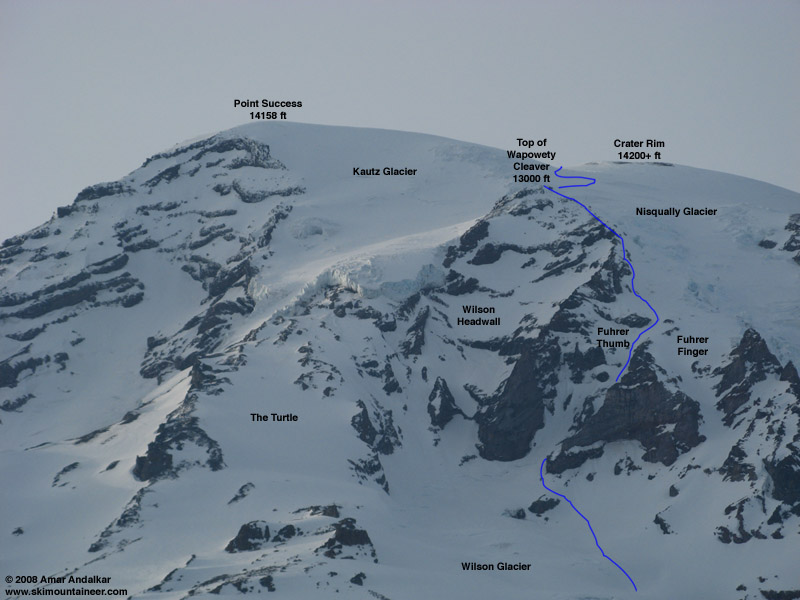 Fuhrer Thumb and Finger area, with our ascent route in blue. | 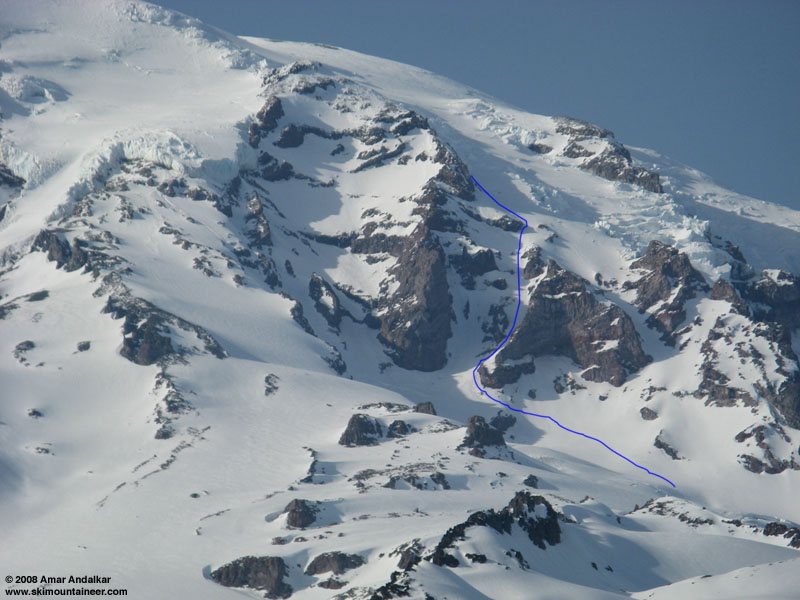 Zoomed view with a better angle of the Fuhrer Thumb. |
Details: We set off to ski the Fuhrer Thumb on the south side of Mount Rainier, a nicely steep couloir of 40-45 degrees, narrower but with a more sustained fall-line than its better-known neighbor the Fuhrer Finger. The forecast called for mostly sunny skies and 7500-8000 ft freezing levels on both Sunday and Monday, so we planned a one-day push overnight with light packs. We registered just before the Jackson Visitor Center closed at 6pm on Sunday May 4, with the park rangers remarking at our lack of gear, but trusting that with 40 Rainier summits between the two of us, we knew what we were doing. We started skinning uphill at 9pm, hoping to summit (9000+ ft of gain) in about 12 hours + nap breaks. We ascended the Nisqually on skis to about 7600 ft and eventually switched to booting with crampons as the slopes steepened and became hard-frozen near the Wilson Glacier. Routefinding through the one major crevassed area was complicated somewhat by the new moon and near-total darkness, but this area is easily avoided by heading up a gentler ramp to its right (if you can see). Yet the dark night sky was also brilliant with stars, and punctuated several times by the brief blazes of meteors. We reached the foot of the Thumb at 10200 ft at 3am and took a lengthy sitting nap break under a rock overhang, at the base of a steep cliff on the couloir's right side, just a few feet from the small bergschrund marking the head of Wilson Glacier.
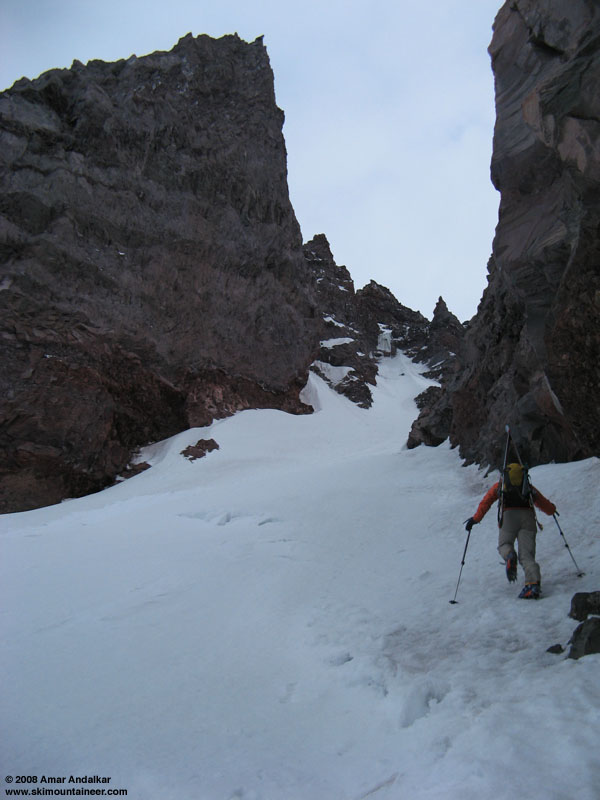 Starting up the Fuhrer Thumb just above our nap spot, with the Wilson Glacier bergschrund just to the left. | 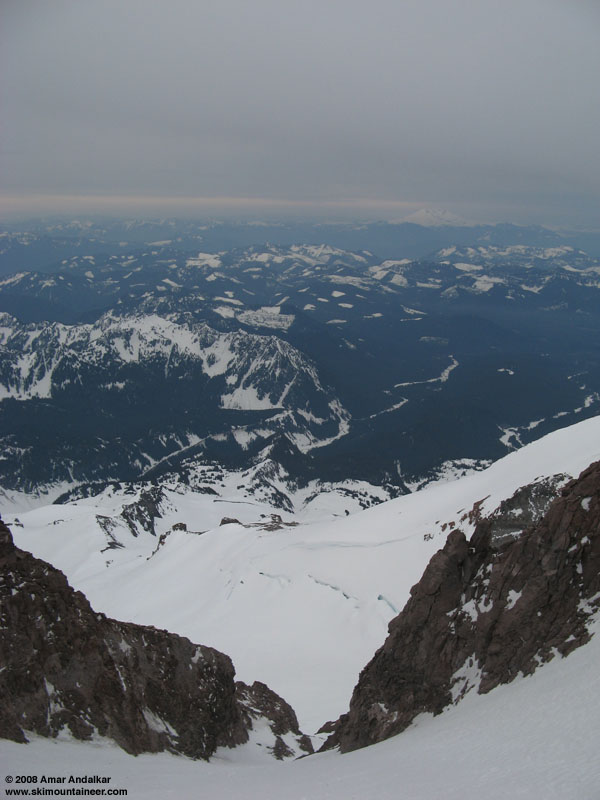 Steep views down the Thumb, with Mt St Helens in the distance. |
We awoke at dawn to find unexpectedly gray skies and thick high clouds, but despite the weather concerns we eventually started up the steep slopes of the Thumb at 6am. Snow conditions were a mix of nice supportive crust perfect for cramponing and arduous breakable crust, causing postholes up to a foot deep. We each climbed using Whippets on our ski poles (two for me, one for my partner), and the single ice axe we'd each brought stayed on our packs throughout the climb. Above the top of the Thumb (11400 ft), we continued directly up the eastern edge of Wapowety Cleaver, avoiding the eastward traverse onto the Nisqually Glacier which looks quite broken up around 12000 ft, with crevasse navigation issues likely. The downside of choosing the crevasse-free Wapowety is that there are several sections of steep 50-55 degree sidehill snow slopes from 12200-12500 ft, which are arduous and exposed in spots, perched above rocky cliffs with a long drop down onto the Nisqually. In the midst of these steep sections the weather worsened around 9am, with light snowfall, gusty winds, and a large lenticular cloud enveloping the entire summit plateau. We took another break on a small flat spot near 12300 ft, which turned into a long nap for my ski partner after we debated whether to just pull the plug and ski down. We decided to at least wait a bit and see, and the weather did improve within a couple of hours, brightening to mostly sunny skies and much lighter winds with only wispy fragments of the lenticular remaining. I fired up the Jetboil to make about 2.5 liters of water, easily enough to see us through to the top. So at noon we headed upward once more, hoping to polish off the last 1900 vertical to reach 14158 ft Point Success, the second highest of Rainier's three 14000 ft peaks, in a couple of hours.
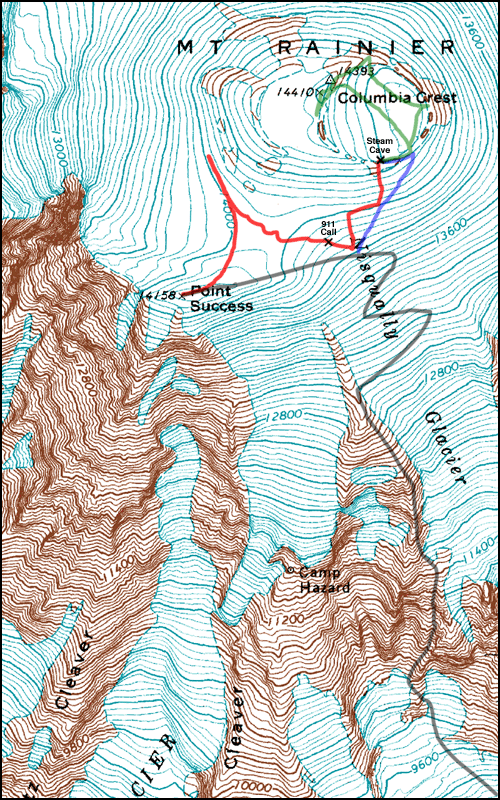 | Map of routes: Gray: Our ascent route; the switchbacks on the Nisqually are very approximate in location and number. Red: My initial ski route and subsequent reascent to the crater rim (also approximate). Green: Travels around the crater rim the next morning. Blue: My ski descent from the rim to rejoin the ascent route, the rest of the ski descent followed the ascent route. |
The next 200 vert above our nap spot were the steepest of the entire route, and we split the exhausting post-holing duties, diagonaling up the sun-softened slopes. Atop the flat summit of Wapowety Cleaver at 13000 ft, we took another break to switch back to skins, since the slopes above were not very steep and it looked to be no problem to skin all the way to Point Success. We zigzagged left and right through a field of large crevasses, but by 13400 ft the powdery snow atop a firm crust on the upper Nisqually Glacier was making skinning difficult for my partner. She switched to booting on foot and headed more directly towards Point Success, while I continued skinning a switchbacking track with ski crampons providing occasional support. My last glimpse of her was just after 2pm, as I headed out of sight around a minor rib on a long rightward switchback. The weather remained mostly sunny with light winds as I made the final leftward switchback, and I snapped a photo of Point Success from about 200 yards away along the ridge at 2:40pm.
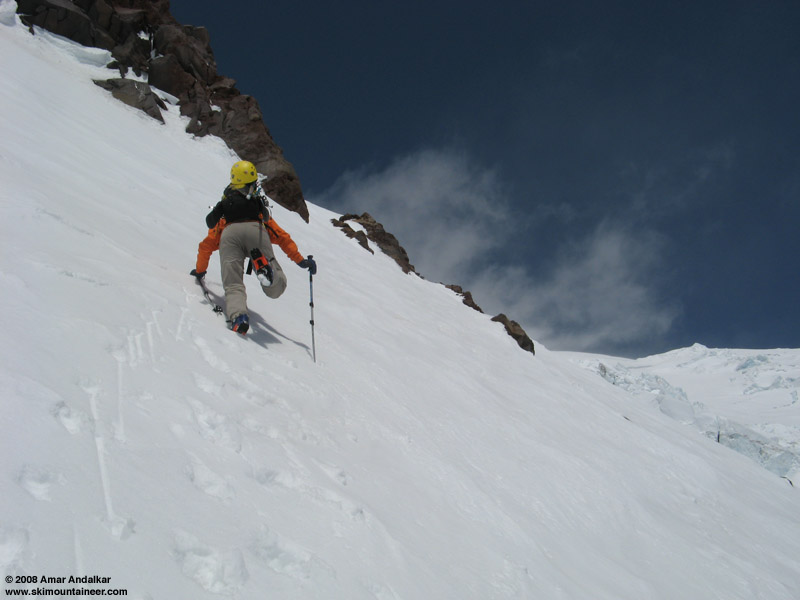 Hard work ascending the steepest part of the route on Wapowety Cleaver. | 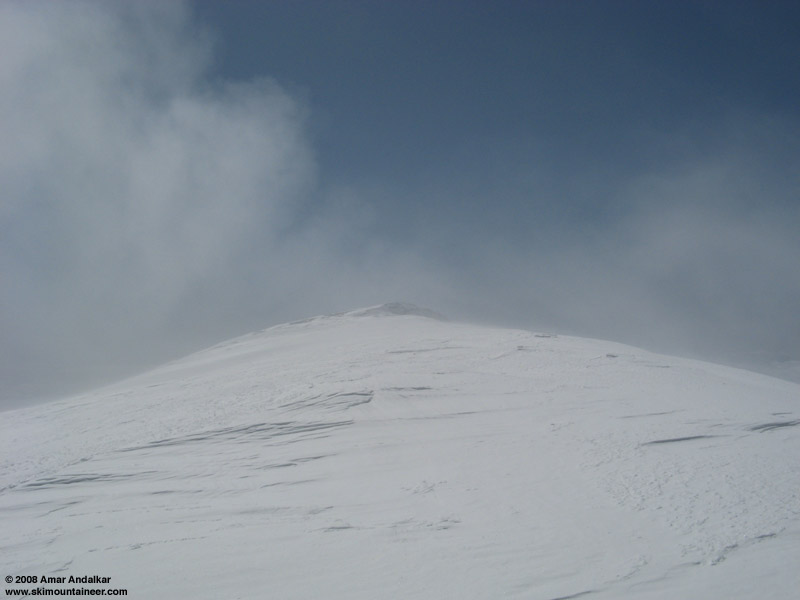 The last bit of ridge to Point Success, still mostly sunny at 2:40pm. |
Six minutes later, I stood atop the peak in a sudden whiteout and strong gusty winds. The temperature was 14 F, winds 30+ mph from the west, and my altimeter read 14220 (+62 error). There was nowhere to hide from the elements atop the narrow summit crest, so I stood with my back to the wind and waited. And waited. Occasionally shapes which looked like human form, complete with skis on pack, appeared through the mist along the ridge to the east, and I yelled my partner's name each time, but in vain as all turned out to be illusions in the drifting fog. Wind-driven rime was rapidly coating my pack and clothing, so I switched over to ski mode and skied back down my skin track after about 20 minutes atop the peak. I assumed my ski partner must have turned around when the winds and whiteout hit, and I thought that I'd be able to ski down and cross paths with her soon. Little did I know that my friend would arrive only minutes later atop the ridge to find my skin track leading to an empty summit, and a partner who had abandoned her.
Things got much worse from here. My skin track down the ridge was rapidly filling with wind-driven snow, and following it down became impossible, as visibility for snow features was less than 10 ft. I navigated by altimeter and dead-reckoning, trying to hold a 14060+ contour (including a mental correction for altimeter error) which would put me at the saddle separating Point Success from the summit craters, and from which I could easily ski down the fall line to intersect my ascent route. Unfortunately, I made a nearly-catastrophic navigational error. I held a contour just a bit too low, probably only 20 vertical feet low, but that's hundreds of feet of horizontal error in the flat featureless vicinity of the saddle. The distance I had skied was hard to gauge in the whiteout and strong tailwind pushing me along. I suddenly halted as a dark black feature appeared about 50 feet to my right. What?!? I realized that I must have overshot the saddle and was now on the uppermost Tahoma Glacier, standing just below a gaping bergschrund. The sudden fear and panic of being lost in an unknown field of crevasses in a whiteout was gripping me. I pulled my seldom-used compass out of the bottom of my pack, turned 180, and began following my track back away from the crevasses. It was painfully ironic to know that my two GPS units were sitting warm and dry at home while I was lost and freezing in a whiteout at 14000 ft. At least I had a nice waterproof topo map of the summit region, and could attempt to navigate by compass.
I eventually found the 14000+ ft saddle (or is it really closer to 14040 ft?), an extremely windswept spot marked by numerous exposed rocks. The west wind was now about 40-50 mph, and I spotted a small snow-cave like shelter, about the volume of an office desk. I considered crawling inside for relief from the wind, but nearly an hour had already passed since I left Point Success. I decided it would be best to simply ski across the saddle and try to descend the Nisqually to reach our ascent track, and hopefully reunite with my ski partner. I thought the winds might ease on the opposite side of the saddle, but they didn't. I continued downhill to about 13900 ft, pushed from behind by the relentless wind as I held a wide snowplow stance to maintain walking speed, and unable to see much beyond my ski tips. The fear of plunging into a gaping crevasse, the same ones I had switchbacked around during the ascent, was overpowering me. I stopped and sat down. I knew that I was in very serious trouble, and for the first time in my life, realized that I might actually freeze to death, my life thrown away uselessly, lost in a featureless plain surrounded by crevasses which I could not see.
There had to be a way out, I couldn't die here. I pulled out my cell phone, thankfully warm in an inside pocket and switched off to preserve its battery, and discovered upon turning it on that I had 2-3 bars of signal. I tried the MRNP number at 4:15pm, but couldn't connect. Next, 911, and it went through! Such a relief. I explained my location and predicament in great detail, several times to make sure that elevation and position had been recorded correctly, and the operator told me to stay put and that Mt Rainier National Park would call me back. Then nothing for a while, so I called my ski partner's phone, connecting to her voicemail after 3 attempts and leaving a detailed message with my location, apologizing for my foolish summit fever which had put us in this situation, and wishing that she was doing well. I then saw that I had new voicemail, and discovered a message: "Amar, this is David Gottlieb, climbing ranger at Mount Rainier. My number is 360-569-2211 x6028. Get back to us. Talk to you soon. OK, bye." I had met David a couple of times at high camps, and even remembered talking with him in July 1999 at Camp Schurman about the various routes he had skied. At least the rangers knew about my dire predicament, including the detailed location info I had given 911 (or so I thought at the time: it turns out they did not get the 911 recording, and the only info they got from 911 was that I was at "15000 ft on Mount Rainier". Ridiculous.) Over the next day, I would make a total of 49 cell phone call attempts, including 30+ to MRNP, several to voicemail, and several to another friend hoping that he could contact the park. Of that, only these 3 successfully connected, all between 4:15 and 4:30pm on May 5. By turning the phone off between each set of 3-4 call attempts and keeping it warm with body heat, I still had about 2/3 battery life remaining afterwards.
I thought about my ski partner a lot, probably caught just like me somewhere out in the storm. The decisions we had made beforehand about gear and going lightweight, the way we had pushed each other onward and upward when either of us had lagged, and my final overwhelming push and desire to summit, even when it was clear that she was much more tired than me and just wanted to turn around and ski back down. She's the best and most inspiring ski partner I've ever met, and I knew that I had let her down.
But the immediate issue was hypothermia, and worse, severe frostbite or actually freezing to death. I'm not very tolerant of cold at all, with poor circulation in the extremities, and I doubted that I could survive an exposed bivy with minimal gear at 13900 ft, in 40-50 mph winds with temperatures dropping below 10F overnight. My clothing consisted of top/bottom lightweight Capilene long underwear, soft-shell pants (REI Acme), and microfleece top (TNF Aurora). Insulation included a thick fleece vest, a newly-bought hooded puffy (Montbell Thermawrap Parka), and my super-warm Feathered Friends Volant down jacket with hood (still inside my pack). Shells consisted of Arc'teryx Theta SK bib pants and an Arc'teryx Alpha LT jacket. And thankfully, I did have lots of gloves and hats: 2 fleece hats, a fleece helmet liner, a thin balaclava, OR Alti Mitts (heavily insulated and waterproof, with insulated liner), OR Couloir ski gloves (insulated waterproof), OR Omni gloves, and 2 pairs of OR PL 100 liner gloves. A lot of clothing for sure, but not enough for me to survive overnight in that situation unless I kept moving or found shelter from the wind.
There were only two options: descend the climbing route as best I could and hope to drop below the whiteout before falling in a crevasse, or climb back up to the crater rim and try to find a steam cave to bivy inside of. I tried option 1, trying at first to slowly ski down but realizing that I would have to switch to cramponing on foot. This would reduce the risk of skiing into a gaping crevasse, but greatly increase the risk of plunging into a hidden one. Around 13800 ft, I decided to turn around and climb back up, 400+ vertical to the rim. I headed due north, hoping to reach the Nisqually bergschrund, and then traverse rightward along it to a safe-enough crossing, providing access to the crater rim. I reached the schrund at 5:30, a huge opening about 20-30 ft high, with enough room for many to camp inside, but the wind was whipping through its length and powdery snow was flying everywhere. So traverse along it I did, and as expected it narrowed farther eastward, eventually becoming only a foot or two wide with numerous snow bridges across it. I crawled across one of them, and I could see exposed rocks just beyond. At least I was now safe, but it was time to get warm and fast.
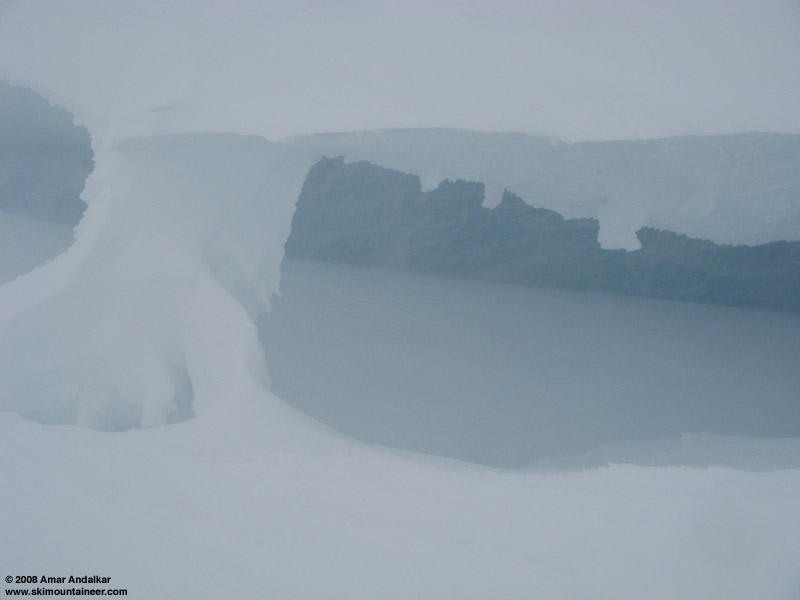
The bergschrund at the head of the Nisqually Glacier.
I reached the crater rim around 6:20pm, a bit over 14200 ft, and immediately found an entrance leading to a large steam cave. I descended 15 ft into a first chamber, large but barely tall enough to stand up in, and then slithered and crawled through 3-4 ft high passages another 20 feet down, reaching an excellent large chamber with several hot fumaroles along one side and a steep passage angling directly back up to the surface about 30 ft above, providing a welcome glimpse of daylight without letting too much weather inside. Definitely home for the night, and maybe much longer if the weather did not improve. I went back to the surface to retrieve my gear and planted my skis in an X outside the entrance, hoping that any climbing parties that might reach the rim the next morning would see it.
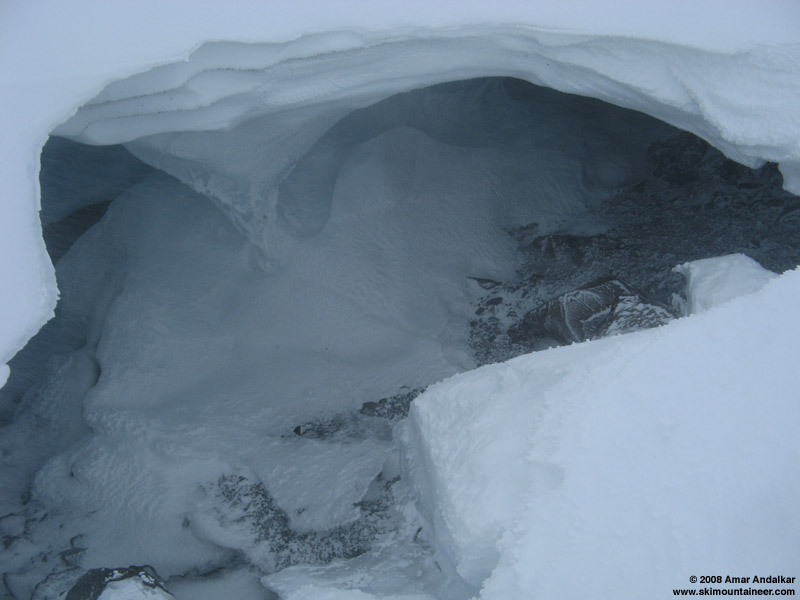 The steam cave just inside the crater rim, looking down the first entrance. | 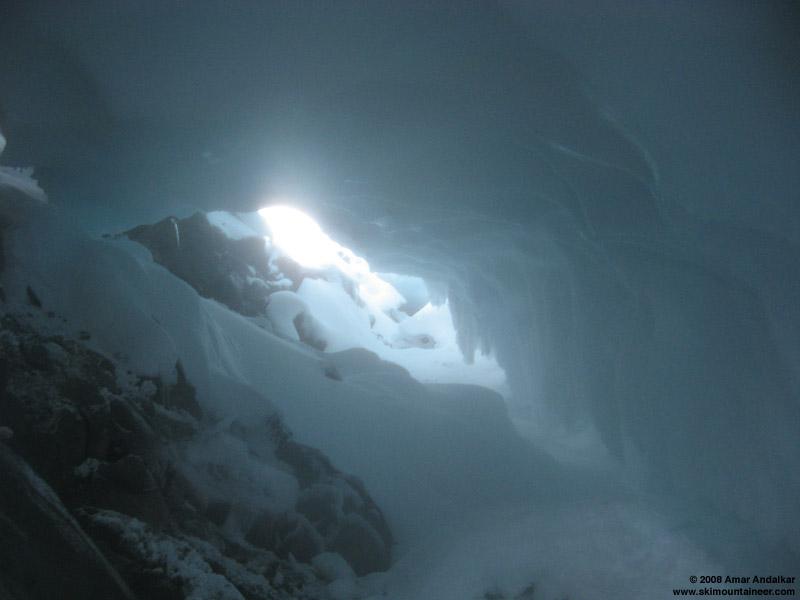 The interior of the upper part of the steam cave. |
I set up the Jetboil to melt snow for water, but within seconds I had tipped it over, dousing its flame completely and unable to relight it due to all the snow packed into the burner. This was a potential disaster: without a way to make liquid water, I would probably get hypothermia if I kept eating snow even within the relatively warm (almost freezing) steam cave. But then an idea: I filled the Jetboil cup with snow, put the lid on, and sat it against the hottest nearby fumarole. This one sounded like a camping stove, hissing out a powerful jet of steam and gas which was intolerably hot to the touch and thankfully nearly odorless. I suspected its temperature was close to the boiling point of water, about 185 F at 14000 ft. I knew that volcanic gases typically include H[sub]2[/sub]O, CO[sub]2[/sub] (carbon dioxide), SO[sub]2[/sub] (sulfur dioxide), CO (carbon monoxide), and H[sub]2[/sub]S (hydrogen sulfide). The latter three are all poisonous, with CO being odorless and thus quite insidious, SO[sub]2[/sub] having a noticeable pungent smell, and H[sub]2[/sub]S with a noxious rotten eggs smell, so prevalent on other Cascade volcanoes such as Mt Baker and Mt Hood. I knew that this fumarole had almost none of the stinky sulfurous gases, and hoped that any CO would be minimal to avoid any effects of carbon monoxide poisoning.
NOTE: Exceeded maximum allowed length of 20000 characters, so split and continued in next post . . .
Within a few minutes, the snow had melted in the Jetboil cup, and 15-20 minutes produced half-liter quantities of water as hot as tea. I was stoked: As miserably wet and humid as the cave was, I had found a source of both unlimited warmth and unlimited hot water at the summit of Mount Rainier. I knew I could survive for days if necessary with no fear of either hypothermia or dehydration. But food was another story: a quick inventory revealed only 1 pack of 4 Nutter Butter cookies (250 cal), 1 pack M&Ms peanut (250 cal), 1 pack M&Ms plain (240 cal), 1 Chewy Dipps granola bar (140 cal), 1 Chewy granola bar (100 cal), and 1 Kudos bar (100 cal) = 1080 calories. I decided not to eat any of it that night, saving it all for the next day. Although I knew I needed food, especially after the exertion of climbing nearly 10000 vertical feet in the past 21 hours, for some reason I was just not very hungry.
Also, I realized with relief that I felt no discernible effects from the altitude. I've always felt so lucky that I handle altitude better than most people, and in numerous previous trips from sea level to 14000+ feet in under 24 hours, I had never once experienced any altitude-related illness. I'm very fortunate in that regard, and the majority of people would experience some symptoms of AMS for sure under a forced bivy at 14000 ft less than a day after leaving sea level, with HAPE or HACE a real possibility for a smaller fraction.
So darkness came and I cuddled up next to the fumarole, still always brewing another batch of hot water in the Jetboil cup and making sure to drink plenty. I tried turning my headlamp off at first, but realized that I needed the small comfort of being able to see around me in such an alien environment and so I kept it on most of the rest of the night. LED headlamps are great, I knew I had dozens of hours of battery life remaining. My clothes were already soaked, as the rate of condensation on any exposed surface was the most rapid I've ever seen. Any object would be dripping wet within a minute or less. Nevertheless, being hot and damp was much better than cold and damp, and so I kept rotating various sides of my body close to the fumarole, using my crampon bag as a deflector to reduce or re-aim the stream of hot gases in a needed direction. When my feet got cold inside my ski boots, I could just place them directly atop the fumarole and they'd be back warm within 10-15 minutes.
I was wearing all my clothes except the down jacket, which I tried to carefully preserve inside its Sil-Nylon stuffsack within my pack. The down would be useless within the steam cave environment, rapidly turning into a heavy sodden mess, but it might be essential to my survival the next day outside on the mountain and so I had to keep it dry. Despite the heat from the fumarole, I shivered constantly through most of the night, with relief usually only for a few minutes after drinking a cup of hot water. My hands stayed nicely warm and dry for several hours inside the insulated waterproof Alti Mitts, but eventually they soaked through too and my fingers soon looked like prunes.

My soaking wet fingers the next morning.
I slept fitfully, mostly not well at all, and had my longest nap from 4am to 5:30. I awoke on Tuesday May 6 to a shocking surprise: there was daylight visible out through the opening of the cave! Given the forecast for deteriorating weather throughout the week, I could not believe my good luck. With nice weather, I thought that climbers and especially guided parties would certainly be reaching the rim shortly. I planned to ask them for food and for assistance in descending via whatever route they had climbed. I also probably needed some dry clothes, since my sodden garments would quickly freeze into a stiff suit of armor outside in the expected 10 F cold.

Looking up the second entrance from home sweet home.
It took me forever to get ready, eat some of my food, and prepare to go outside. I shook out my wet outer layers, donned the mercifully still-dry down jacket, and climbed out to the surface just after 7am. Partly sunny, cold but not too cold, and winds light, W 10-15 mph, with visibility past Mt Adams.

WOW. The crater rim in the morning.
I realized that my cave was about 100 yards west of where the normal climbing routes reach the low point in the crater rim, so it was important to leave a message over there for the climbers who would surely be arriving shortly. So I walked over to the low point, which was marked with 2 wands, and scratched out the words, "Help! 100 yds west", in a smooth patch of snow with my ski pole. I also moved my crossed skis from the original cave entrance to the second entrance, which was closer to the low point. I tried several more cell phone call attempts to MRNP, to no avail. As expected, my outer layers had frozen stiff in the cold air, so I retreated to the steam cave to thaw them out.

Looking down into my cave, with the west part of the East Crater rim in the distance.
By 9am it was time to head back out again. I thought for sure that climbers must be getting up there already, but in any case I decided that I'd walk around the inside of the crater rim and try to place cell phone calls in each different direction, hoping to get a stronger signal. To avoid the hazard of accidentally falling into thinly snow-covered steam cave entrances, it is best not to walk too close to the inside of the rim, so I walked in arcs passing through the middle of the crater and connecting to points on the east and north rims, and forcefully probed with both ski poles just in case. The floor of the crater was scoured to bare blue glacial ice in many spots, cut in a couple places by thin, 6-12" wide snow-filled cracks that were deeper than I could probe.
Each time I reached the rim, still no luck with the cell. By now, I was almost at Columbia Crest, the true 14411 ft summit of Mt Rainier. I walked over to the summit register, located in a steaming area of fumarolic bare ground just below the summit, and thumbed through the old entries. The last entries were from April 17, and before that from autumn of 2007. At 9:50am, I added my own lengthy page, describing what had happened and my worries about my ski partner and about how I would make it down. I climbed up to the Crest, took in the grand views once again, and made several more unsuccessful cell attempts.

Columbia Crest, with the West Crater rim beyond.
The day was becoming gloriously warm and sunny, with winds dropping to nearly calm and temps rising to near 20 F. Nothing at all like the NWS forecast. My clothes were drying on my body, and I felt really good despite the lack of food and sleep, with no ill effects from the previous day's exertion. So I decided to set myself a deadline: if no climbers or helicopter had appeared by noon, I would simply ski down the upper Nisqually to rejoin our ascent route, and ski the Thumb as originally planned. I hoped that by noon, the snow on the steepest parts of Wapowety Cleaver (50-55 degree SE facing slopes) would be softened enough to hold an edge. If I could get past that crux safely in my probably somewhat weakened condition, the rest of the run down the Thumb and Wilson Glacier would be cake in any snow conditions, even if parts were still breakable crust.
At 10:45am, I headed back across the crater to my cave, and carefully repacked all my gear. Everything was disgustingly wet, and much of it covered in a muddy hydrothermally-altered clay which forms the soil within the steam caves. I melted and drank a final liter of water, and planned to eat snow as needed to stay hydrated during the ski descent. If everything went well, I should be able to ski out to Paradise in about 2 hrs, even including the short climb back up to Glacier Vista.

12:10 pm: My pack and gear are all back at the surface, with skis still crossed above the cave entrance.
By noon I was back out on the surface with my pack and gear, making final preparations to ski down. But wait - - - I heard a helicopter! And there it was, climbing upwards towards the rim from far below me. It quickly approached and circled around me twice, as I waved a single hand to let them know I was OK. I assumed that it would land in the crater, but then it took off down the mountain, so I thought that maybe the rangers think I'm OK and don't need a ride. Only later would I be told that the chopper had an engine malfunction light of some sort come on, and was forced to descend without me, while MRNP staff scrambled to locate a backup chopper in case it was needed.

12:19 pm: The MRNP rescue helicopter circling around me.
So back to peace and silence on the rim. I'd had the summit all to myself for nearly a day, and still no climbers had appeared. As I prepared to click into my bindings, I noticed that the Dynafit fittings on my boots were clogged completely with mud. I used a Leatherman tool to chip the mud out of my boot fittings, which was very difficult since it appeared that the hydrothermally-altered clay had set into something as hard as plaster. Given the steepness of parts of the descent, I could take no chances with the typical Dynafit accidental pre-release bullshit, so I made sure the fittings were super clean and then locked the toes too for good measure.

Looking across at Point Success from high on the Nisqually Glacier. (Sorry, bad photo, camera was fogging up.)
I skied down the Nisqually Glacier at 12:40pm, a completely surreal feeling given the events of the previous 22 hours. I crossed the bergschrund somewhere near where I had crawled across it the evening before, and quickly located portions of the skin track of our ascent route. The 1-2 inches of new snow during the storm had been heavily windblown, and so only obscured small portions of the track. The ski down to 12500 ft was easy, albeit on an unpleasant mix of crust, windpacked powder, and a few patches of bare glacial ice. Unfortunately, the steepest parts of Wapowety Cleaver had not softened enough, and I was forced to sideslip much of the most exposed parts, using my uphill (right) Whippet as an anchor at times. The steepest step, only about 10 ft high but that had to be 55+ degrees, required sidestepping carefully while anchored with the uphill hand. And then I was safe, or so it seemed. But far below, a marine layer had filled the valleys to well over 8000 ft, and it was thickening. I hoped to avoid another whiteout on the glaciers below.

Looking down the vertiginous Fuhrer Thumb, with Wilson Glacier and the marine layer clouds far below.
The snow improved greatly below 12000 ft, becoming almost corn-like in spots. In the Fuhrer Thumb, the previous day's breakable crust had solidified enough to hold a skier's weight, and the descent was thoroughly enjoyable on a mix of edgeable crust and proto-corn. Hitting the Wilson Glacier at 10200 ft, I found the nicest snow of the day, fine spring corn on the cruising rolls down to 9000 ft and the edge of the marine layer. This whiteout was as dense as the one on the summit yesterday, but with nearly dead-calm winds and no real problems. I followed footsteps back to the Nisqually, and then the huge cattle-stampede track of a crevasse rescue class back to the moraine and Glacier Vista. Snow conditions were complete mushy glop in the whiteout, but I didn't care one bit. I had made it down off the mountain, alive and well.

Corn and ski tracks on the Wilson Glacier.
I reached the ski dorm at the edge of the parking lot at 3pm, and a single thoroughly-sodden packet of M&Ms still remained uneaten. I had survived my first major epic, and now I was desperate to make sure my ski partner had, too. To my great relief, there was a note on my car from climbing ranger Thomas Payne, informing me that she was safely off the mountain and that I should contact David Gottlieb at Longmire as soon as I got back.

The ski dorm at Paradise. Safe at last.
I drove down to Longmire, and went through a lengthy debriefing and interview process with the climbing rangers, a necessary bureaucratic process since an official search-and-rescue mission had been launched. They told me my ski partner had downclimbed the Kautz Glacier from Point Success on foot, in harrowing whiteout conditions down to 12000 ft, and then skied the Turtle back to the Nisqually Glacier and Paradise by 8:15pm the night before, and stayed at the ski dorm overnight. They said I could see her, but only after the interview and timeline of events was complete. As I was finishing my signed statement of events leading to the SAR, she finally walked in and we were both so relieved and overjoyed to see each other again, both safe and sound.
[hr">
I'm not sure what will happen to me going forward from now on. It's going to take some time for me to process what happened and decide if I need to make some changes in my mountain travel habits and my degree of acceptable risk. Certainly I think the GPS is going back in my pack, for any trip of significant size. The only other thing that would have helped in the whiteout is being roped up the entire time, which is certainly worth considering for any such trips in the future.
And at least I lost some weight during the trip: From the morning of May 3 through this afternoon on May 7, my weight has decreased from 144.4 lbs to 140.0, with body fat decreasing from 14.9% to 12.3%. This equals a loss of 4.3 lbs of body fat, which would supply about 17000 calories, and luckily it appears that I managed not to burn a significant amount of muscle mass. That would have changed for sure had I been forced to spend longer up there with no more food.
Thanks to David Gottlieb, Chris Olson, Matt Hendrickson, Joe Franklin, and all the other climbing rangers and staff at MRNP who assisted in the planning and execution of my SAR mission. Although I made it down safely without assistance this time, it was only because of an unexpected lucky break in the weather, and my situation would have otherwise become increasingly desperate had the foul weather continued.
And thanks most of all to my trusty ski partner and dear friend, for forgiving me and for still wanting to go skiing with me after this. I'm so glad you got down safely. "Hey dude, where are we skiing tomorrow?"
[hr">[tt">MOUNT RAINIER RECREATIONAL FORECAST
NATIONAL WEATHER SERVICE SEATTLE WA
345 AM PDT SUN MAY 4 2008
SYNOPSIS...AN UPPER LEVEL RIDGE WILL BUILD OVER WESTERN WASHINGTON
TODAY. SKIES WILL CLEAR AND THE AIR MASS WILL WARM TODAY. THE RIDGE
SHOULD PERSIST INTO MONDAY. ONSHORE FLOW WILL INCREASE MONDAY NIGHT
AND TUESDAY AS A WEATHER SYSTEM REACHES THE AREA. AN UPPER LEVEL
TROUGH WILL DEVELOP OVER THE REGION MIDWEEK.
SUN SUN MON MON TUE
NIGHT NIGHT
SUMMIT (14411 FT) 11 15 15 14 9
E 9 W 25 W 30 W 28 W 35
CAMP MUIR(10188 FT) 25 27 27 28 20
SE 10 W 14 W 20 W 11 W 25
SUNDAY...MOSTLY SUNNY. FREEZING LEVEL 7500 FEET.
SUNDAY NIGHT...PARTLY CLOUDY. FREEZING LEVEL 8500 FEET.
MONDAY...MOSTLY SUNNY. FREEZING LEVEL 8000 FEET.
MONDAY NIGHT...MOSTLY CLOUDY. FREEZING LEVEL 8000 FEET.
TUESDAY...MOSTLY CLOUDY WITH SCATTERED SHOWERS. SNOW LEVEL 5500 FEET.
TUESDAY NIGHT...MOSTLY CLOUDY WITH SCATTERED SHOWERS. SNOW LEVEL 4500 FEET.
WEDNESDAY AND WEDNESDAY NIGHT...MOSTLY CLOUDY. SCATTERED SNOW SHOWERS AND
NUMEROUS SHOWERS. SNOW LEVEL 3500 FEET.
THURSDAY AND THURSDAY NIGHT...MOSTLY CLOUDY WITH A CHANCE OF SHOWERS. SNOW LEVEL 3500 FEET.
FRIDAY AND FRIDAY NIGHT...MOSTLY CLOUDY. A CHANCE OF SHOWERS. SNOW LEVEL 5000 FEET.
[/tt">
Also, I realized with relief that I felt no discernible effects from the altitude. I've always felt so lucky that I handle altitude better than most people, and in numerous previous trips from sea level to 14000+ feet in under 24 hours, I had never once experienced any altitude-related illness. I'm very fortunate in that regard, and the majority of people would experience some symptoms of AMS for sure under a forced bivy at 14000 ft less than a day after leaving sea level, with HAPE or HACE a real possibility for a smaller fraction.
So darkness came and I cuddled up next to the fumarole, still always brewing another batch of hot water in the Jetboil cup and making sure to drink plenty. I tried turning my headlamp off at first, but realized that I needed the small comfort of being able to see around me in such an alien environment and so I kept it on most of the rest of the night. LED headlamps are great, I knew I had dozens of hours of battery life remaining. My clothes were already soaked, as the rate of condensation on any exposed surface was the most rapid I've ever seen. Any object would be dripping wet within a minute or less. Nevertheless, being hot and damp was much better than cold and damp, and so I kept rotating various sides of my body close to the fumarole, using my crampon bag as a deflector to reduce or re-aim the stream of hot gases in a needed direction. When my feet got cold inside my ski boots, I could just place them directly atop the fumarole and they'd be back warm within 10-15 minutes.
I was wearing all my clothes except the down jacket, which I tried to carefully preserve inside its Sil-Nylon stuffsack within my pack. The down would be useless within the steam cave environment, rapidly turning into a heavy sodden mess, but it might be essential to my survival the next day outside on the mountain and so I had to keep it dry. Despite the heat from the fumarole, I shivered constantly through most of the night, with relief usually only for a few minutes after drinking a cup of hot water. My hands stayed nicely warm and dry for several hours inside the insulated waterproof Alti Mitts, but eventually they soaked through too and my fingers soon looked like prunes.
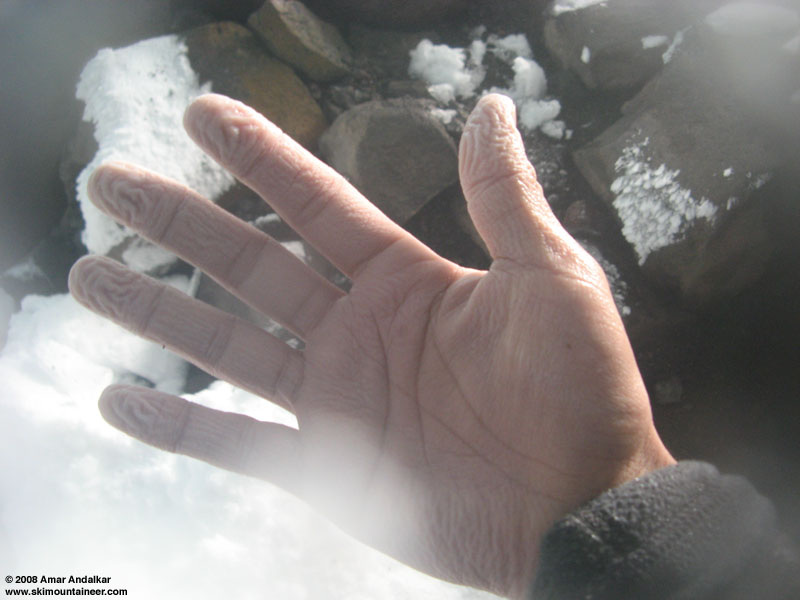
My soaking wet fingers the next morning.
I slept fitfully, mostly not well at all, and had my longest nap from 4am to 5:30. I awoke on Tuesday May 6 to a shocking surprise: there was daylight visible out through the opening of the cave! Given the forecast for deteriorating weather throughout the week, I could not believe my good luck. With nice weather, I thought that climbers and especially guided parties would certainly be reaching the rim shortly. I planned to ask them for food and for assistance in descending via whatever route they had climbed. I also probably needed some dry clothes, since my sodden garments would quickly freeze into a stiff suit of armor outside in the expected 10 F cold.
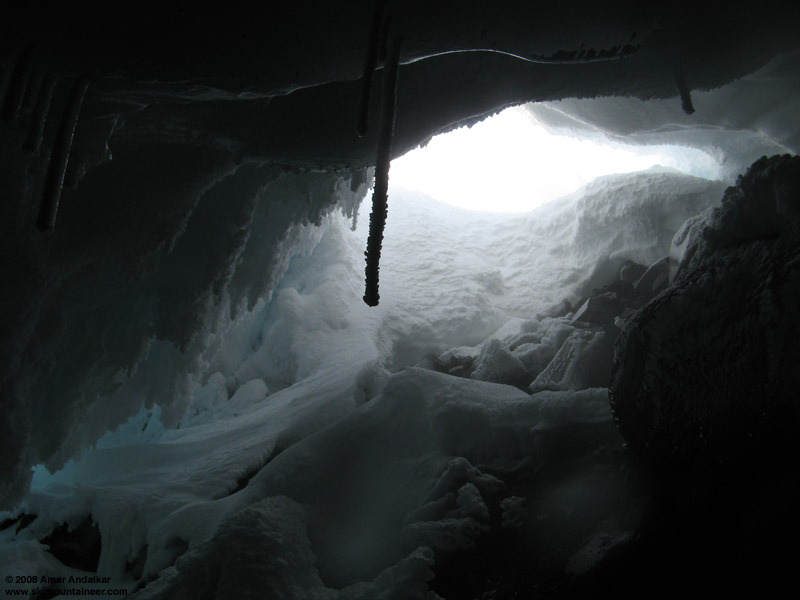
Looking up the second entrance from home sweet home.
It took me forever to get ready, eat some of my food, and prepare to go outside. I shook out my wet outer layers, donned the mercifully still-dry down jacket, and climbed out to the surface just after 7am. Partly sunny, cold but not too cold, and winds light, W 10-15 mph, with visibility past Mt Adams.
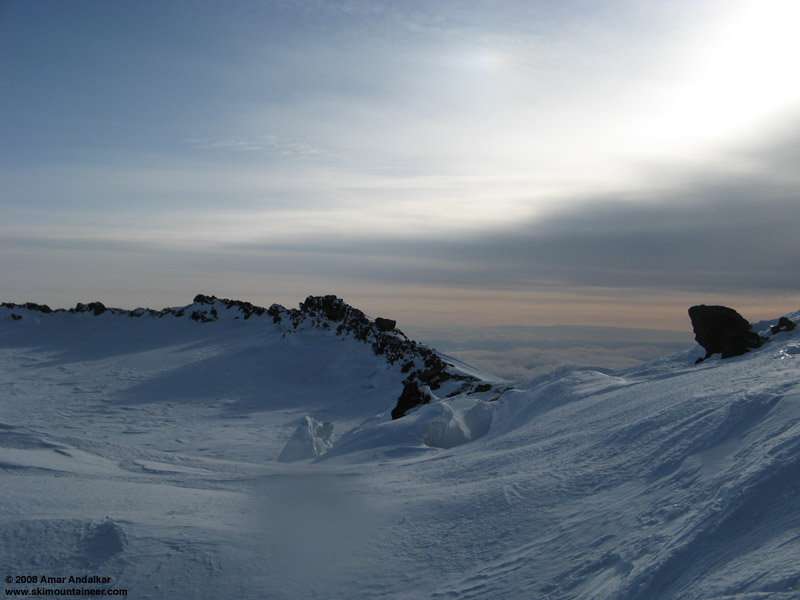
WOW. The crater rim in the morning.
I realized that my cave was about 100 yards west of where the normal climbing routes reach the low point in the crater rim, so it was important to leave a message over there for the climbers who would surely be arriving shortly. So I walked over to the low point, which was marked with 2 wands, and scratched out the words, "Help! 100 yds west", in a smooth patch of snow with my ski pole. I also moved my crossed skis from the original cave entrance to the second entrance, which was closer to the low point. I tried several more cell phone call attempts to MRNP, to no avail. As expected, my outer layers had frozen stiff in the cold air, so I retreated to the steam cave to thaw them out.
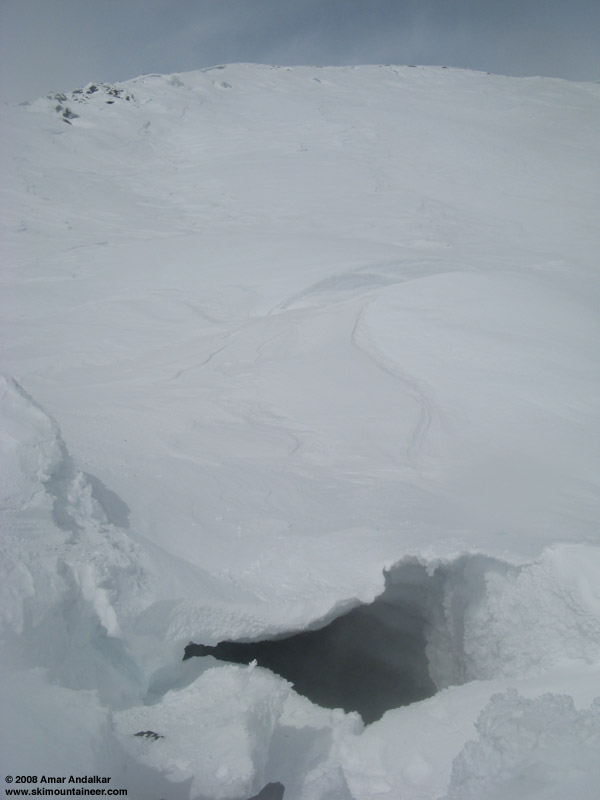
Looking down into my cave, with the west part of the East Crater rim in the distance.
By 9am it was time to head back out again. I thought for sure that climbers must be getting up there already, but in any case I decided that I'd walk around the inside of the crater rim and try to place cell phone calls in each different direction, hoping to get a stronger signal. To avoid the hazard of accidentally falling into thinly snow-covered steam cave entrances, it is best not to walk too close to the inside of the rim, so I walked in arcs passing through the middle of the crater and connecting to points on the east and north rims, and forcefully probed with both ski poles just in case. The floor of the crater was scoured to bare blue glacial ice in many spots, cut in a couple places by thin, 6-12" wide snow-filled cracks that were deeper than I could probe.
Each time I reached the rim, still no luck with the cell. By now, I was almost at Columbia Crest, the true 14411 ft summit of Mt Rainier. I walked over to the summit register, located in a steaming area of fumarolic bare ground just below the summit, and thumbed through the old entries. The last entries were from April 17, and before that from autumn of 2007. At 9:50am, I added my own lengthy page, describing what had happened and my worries about my ski partner and about how I would make it down. I climbed up to the Crest, took in the grand views once again, and made several more unsuccessful cell attempts.
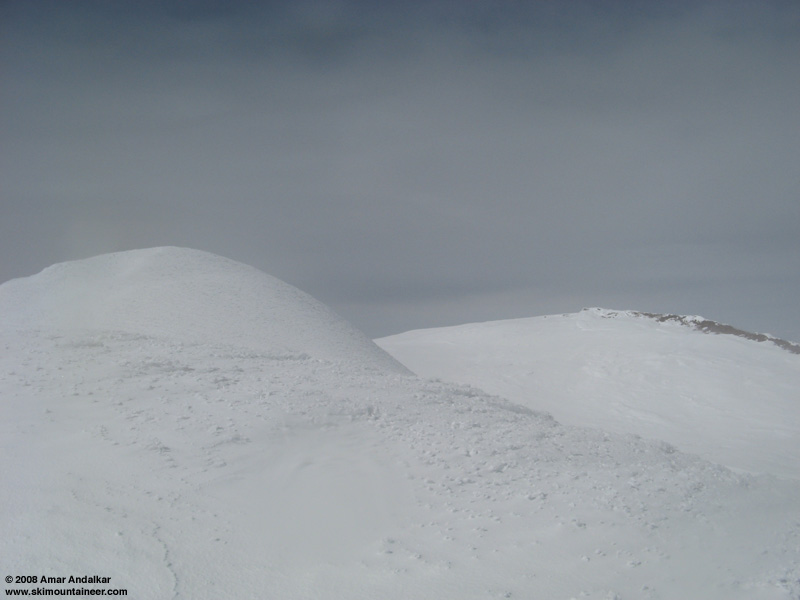
Columbia Crest, with the West Crater rim beyond.
The day was becoming gloriously warm and sunny, with winds dropping to nearly calm and temps rising to near 20 F. Nothing at all like the NWS forecast. My clothes were drying on my body, and I felt really good despite the lack of food and sleep, with no ill effects from the previous day's exertion. So I decided to set myself a deadline: if no climbers or helicopter had appeared by noon, I would simply ski down the upper Nisqually to rejoin our ascent route, and ski the Thumb as originally planned. I hoped that by noon, the snow on the steepest parts of Wapowety Cleaver (50-55 degree SE facing slopes) would be softened enough to hold an edge. If I could get past that crux safely in my probably somewhat weakened condition, the rest of the run down the Thumb and Wilson Glacier would be cake in any snow conditions, even if parts were still breakable crust.
At 10:45am, I headed back across the crater to my cave, and carefully repacked all my gear. Everything was disgustingly wet, and much of it covered in a muddy hydrothermally-altered clay which forms the soil within the steam caves. I melted and drank a final liter of water, and planned to eat snow as needed to stay hydrated during the ski descent. If everything went well, I should be able to ski out to Paradise in about 2 hrs, even including the short climb back up to Glacier Vista.
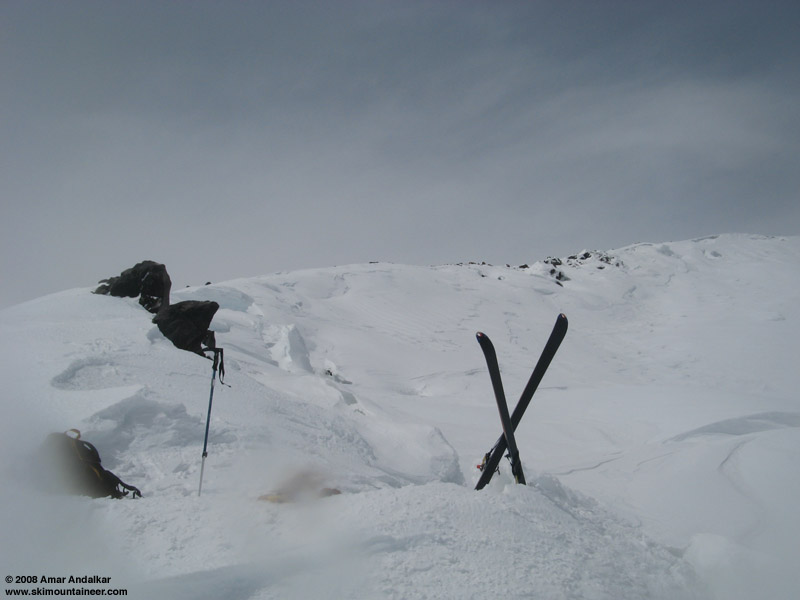
12:10 pm: My pack and gear are all back at the surface, with skis still crossed above the cave entrance.
By noon I was back out on the surface with my pack and gear, making final preparations to ski down. But wait - - - I heard a helicopter! And there it was, climbing upwards towards the rim from far below me. It quickly approached and circled around me twice, as I waved a single hand to let them know I was OK. I assumed that it would land in the crater, but then it took off down the mountain, so I thought that maybe the rangers think I'm OK and don't need a ride. Only later would I be told that the chopper had an engine malfunction light of some sort come on, and was forced to descend without me, while MRNP staff scrambled to locate a backup chopper in case it was needed.
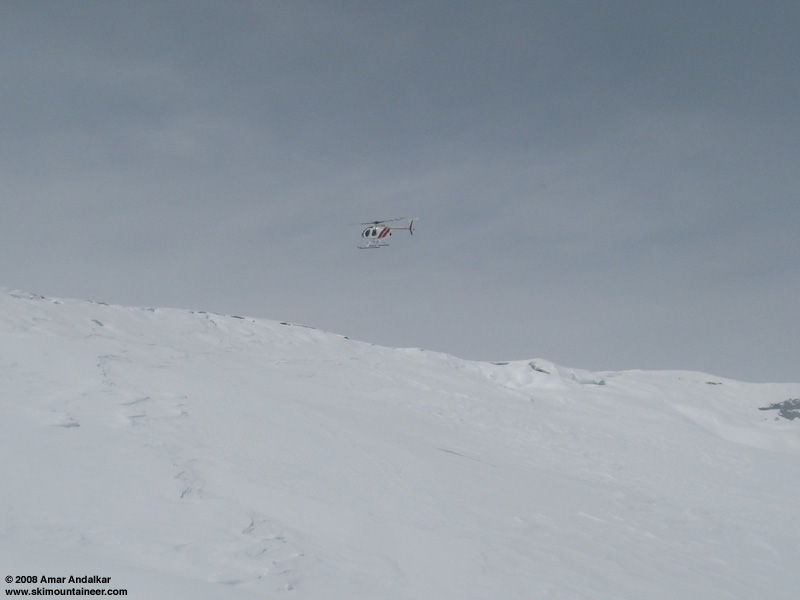
12:19 pm: The MRNP rescue helicopter circling around me.
So back to peace and silence on the rim. I'd had the summit all to myself for nearly a day, and still no climbers had appeared. As I prepared to click into my bindings, I noticed that the Dynafit fittings on my boots were clogged completely with mud. I used a Leatherman tool to chip the mud out of my boot fittings, which was very difficult since it appeared that the hydrothermally-altered clay had set into something as hard as plaster. Given the steepness of parts of the descent, I could take no chances with the typical Dynafit accidental pre-release bullshit, so I made sure the fittings were super clean and then locked the toes too for good measure.
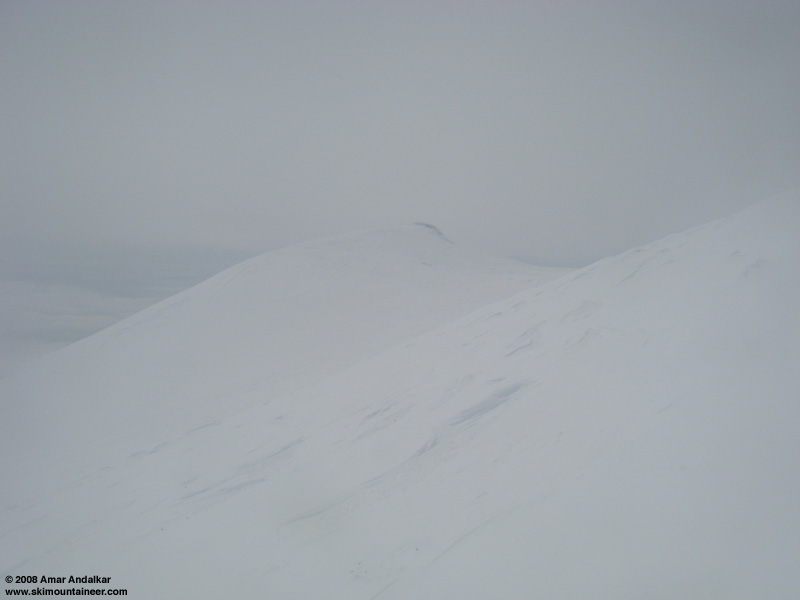
Looking across at Point Success from high on the Nisqually Glacier. (Sorry, bad photo, camera was fogging up.)
I skied down the Nisqually Glacier at 12:40pm, a completely surreal feeling given the events of the previous 22 hours. I crossed the bergschrund somewhere near where I had crawled across it the evening before, and quickly located portions of the skin track of our ascent route. The 1-2 inches of new snow during the storm had been heavily windblown, and so only obscured small portions of the track. The ski down to 12500 ft was easy, albeit on an unpleasant mix of crust, windpacked powder, and a few patches of bare glacial ice. Unfortunately, the steepest parts of Wapowety Cleaver had not softened enough, and I was forced to sideslip much of the most exposed parts, using my uphill (right) Whippet as an anchor at times. The steepest step, only about 10 ft high but that had to be 55+ degrees, required sidestepping carefully while anchored with the uphill hand. And then I was safe, or so it seemed. But far below, a marine layer had filled the valleys to well over 8000 ft, and it was thickening. I hoped to avoid another whiteout on the glaciers below.
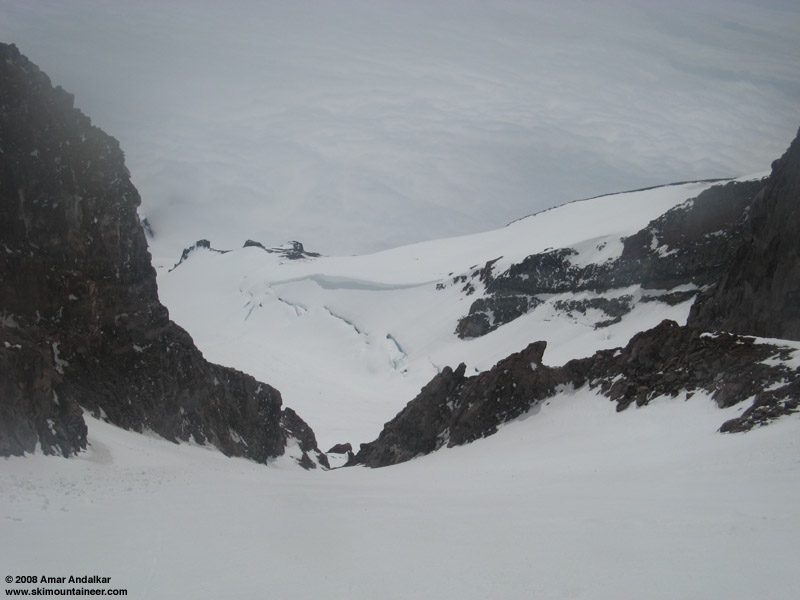
Looking down the vertiginous Fuhrer Thumb, with Wilson Glacier and the marine layer clouds far below.
The snow improved greatly below 12000 ft, becoming almost corn-like in spots. In the Fuhrer Thumb, the previous day's breakable crust had solidified enough to hold a skier's weight, and the descent was thoroughly enjoyable on a mix of edgeable crust and proto-corn. Hitting the Wilson Glacier at 10200 ft, I found the nicest snow of the day, fine spring corn on the cruising rolls down to 9000 ft and the edge of the marine layer. This whiteout was as dense as the one on the summit yesterday, but with nearly dead-calm winds and no real problems. I followed footsteps back to the Nisqually, and then the huge cattle-stampede track of a crevasse rescue class back to the moraine and Glacier Vista. Snow conditions were complete mushy glop in the whiteout, but I didn't care one bit. I had made it down off the mountain, alive and well.
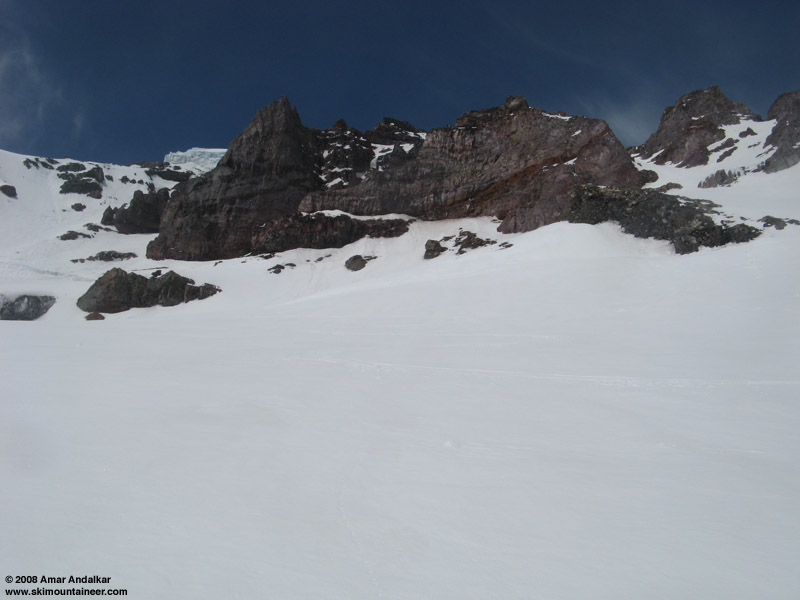
Corn and ski tracks on the Wilson Glacier.
I reached the ski dorm at the edge of the parking lot at 3pm, and a single thoroughly-sodden packet of M&Ms still remained uneaten. I had survived my first major epic, and now I was desperate to make sure my ski partner had, too. To my great relief, there was a note on my car from climbing ranger Thomas Payne, informing me that she was safely off the mountain and that I should contact David Gottlieb at Longmire as soon as I got back.
The ski dorm at Paradise. Safe at last.
I drove down to Longmire, and went through a lengthy debriefing and interview process with the climbing rangers, a necessary bureaucratic process since an official search-and-rescue mission had been launched. They told me my ski partner had downclimbed the Kautz Glacier from Point Success on foot, in harrowing whiteout conditions down to 12000 ft, and then skied the Turtle back to the Nisqually Glacier and Paradise by 8:15pm the night before, and stayed at the ski dorm overnight. They said I could see her, but only after the interview and timeline of events was complete. As I was finishing my signed statement of events leading to the SAR, she finally walked in and we were both so relieved and overjoyed to see each other again, both safe and sound.
[hr">
I'm not sure what will happen to me going forward from now on. It's going to take some time for me to process what happened and decide if I need to make some changes in my mountain travel habits and my degree of acceptable risk. Certainly I think the GPS is going back in my pack, for any trip of significant size. The only other thing that would have helped in the whiteout is being roped up the entire time, which is certainly worth considering for any such trips in the future.
And at least I lost some weight during the trip: From the morning of May 3 through this afternoon on May 7, my weight has decreased from 144.4 lbs to 140.0, with body fat decreasing from 14.9% to 12.3%. This equals a loss of 4.3 lbs of body fat, which would supply about 17000 calories, and luckily it appears that I managed not to burn a significant amount of muscle mass. That would have changed for sure had I been forced to spend longer up there with no more food.
Thanks to David Gottlieb, Chris Olson, Matt Hendrickson, Joe Franklin, and all the other climbing rangers and staff at MRNP who assisted in the planning and execution of my SAR mission. Although I made it down safely without assistance this time, it was only because of an unexpected lucky break in the weather, and my situation would have otherwise become increasingly desperate had the foul weather continued.
And thanks most of all to my trusty ski partner and dear friend, for forgiving me and for still wanting to go skiing with me after this. I'm so glad you got down safely. "Hey dude, where are we skiing tomorrow?"
[hr">[tt">MOUNT RAINIER RECREATIONAL FORECAST
NATIONAL WEATHER SERVICE SEATTLE WA
345 AM PDT SUN MAY 4 2008
SYNOPSIS...AN UPPER LEVEL RIDGE WILL BUILD OVER WESTERN WASHINGTON
TODAY. SKIES WILL CLEAR AND THE AIR MASS WILL WARM TODAY. THE RIDGE
SHOULD PERSIST INTO MONDAY. ONSHORE FLOW WILL INCREASE MONDAY NIGHT
AND TUESDAY AS A WEATHER SYSTEM REACHES THE AREA. AN UPPER LEVEL
TROUGH WILL DEVELOP OVER THE REGION MIDWEEK.
SUN SUN MON MON TUE
NIGHT NIGHT
SUMMIT (14411 FT) 11 15 15 14 9
E 9 W 25 W 30 W 28 W 35
CAMP MUIR(10188 FT) 25 27 27 28 20
SE 10 W 14 W 20 W 11 W 25
SUNDAY...MOSTLY SUNNY. FREEZING LEVEL 7500 FEET.
SUNDAY NIGHT...PARTLY CLOUDY. FREEZING LEVEL 8500 FEET.
MONDAY...MOSTLY SUNNY. FREEZING LEVEL 8000 FEET.
MONDAY NIGHT...MOSTLY CLOUDY. FREEZING LEVEL 8000 FEET.
TUESDAY...MOSTLY CLOUDY WITH SCATTERED SHOWERS. SNOW LEVEL 5500 FEET.
TUESDAY NIGHT...MOSTLY CLOUDY WITH SCATTERED SHOWERS. SNOW LEVEL 4500 FEET.
WEDNESDAY AND WEDNESDAY NIGHT...MOSTLY CLOUDY. SCATTERED SNOW SHOWERS AND
NUMEROUS SHOWERS. SNOW LEVEL 3500 FEET.
THURSDAY AND THURSDAY NIGHT...MOSTLY CLOUDY WITH A CHANCE OF SHOWERS. SNOW LEVEL 3500 FEET.
FRIDAY AND FRIDAY NIGHT...MOSTLY CLOUDY. A CHANCE OF SHOWERS. SNOW LEVEL 5000 FEET.
[/tt">
WOW! Glad you're safe! Incredible effort!
Way to stay calm through the ordeal. Glad everything turned out alright again!
Thanks for sharing your experience. Roundtrips are mandatory but sometimes they're difficult. Things happen and its how we handle adversity that matters. I am pleased to hear you're both still with us. There are much easier ways to lose weight. ;)
Amar, Great job keeping your head in such a harrowing situation!! Glad to hear that you and your partner made it out safely!!
Thanks for shareing, not too many people would have known how to, or could of handled that situation. That must have been a hell of a rough night in the cave. Glad everything worked out.
Amar - it takes a very special person to publicly share an experience like that and one with a very rare talent to do such a great job in sharing it. Thank you.
What an epic!! Glad you and Hanna managed to keep it together while being separated. Thanks for sharing the details of your experience. Most importantly, glad you both are ok. What an ordeal.
Thanks for telling your story, Amar. You've given us a lot to think about. Congratulations to both of you for getting through this ordeal so well.
Thanks for being able to share such an incredible event in your life! As I read your story it was hard to not try and put myself in your position and get a glimpse of the thoughts and fears you experienced. Very powerful and well written. Certainly nothing near what you and your partner experienced, but significant enough for me to always remember who's the boss in the mountains. The thoughts/guilt going on after the separation had to have been most difficult, along with what you had to do to survive yourself.
Three cheers to both of your survivals!
As Zap said, "Round trips are mandatory."
I appreciate the courage it takes to survive and more so the humility to share your experiences.
Thanks,
Joe
Three cheers to both of your survivals!
As Zap said, "Round trips are mandatory."
I appreciate the courage it takes to survive and more so the humility to share your experiences.
Thanks,
Joe
Way to get out safe Amar!!! I always remember cracking on you for having a GPS saying, "I know this place, I know exactly where we are. Follow me." Ha. And I was wrong and you were right :).
Being lost in the fog is a scary deal, especially with crevasses and such. I'm glad you and hannah managed on your seperate ways.
Being lost in the fog is a scary deal, especially with crevasses and such. I'm glad you and hannah managed on your seperate ways.
Wow -- thanks for sharing. Glad you both made it down safely.
Quite the epic Amar. I'm glad you both made it out safely to tell the story!
Glad you and Hanna are safe. What a read. I learnt a lot reading it and congratulate you on your calm thinking and the good decisions you made once you where in the thick of it.
Mandatory reading for all those thinking of any eary season summit attempt.
You're having an exciting spring so far!
Scotty.
Mandatory reading for all those thinking of any eary season summit attempt.
You're having an exciting spring so far!
Scotty.
Wow- that was a harrowing experience to say the least! It reminded me of the John Muir story where he got stuck on the summit of Shasta and spent the night lying next to a fumarole.
Really glad that you're both all right
Coming from someone as technically savvy as you, BOO.
typical Dynafit accidental pre-release bullshit
Coming from someone as technically savvy as you, BOO.
Amar, thanks for sharing your story, glad that you and Hanna made it off the mountain fine. Good job keeping yourself focused.
Amar, first I am happy everyone made it off safe and sound.
Because I have heard so many reports of cell phone utility up high in our mountains, I was surprised that yours worked so intermittently apparently considering what appeared to be a good signal and connectivity. Of greatest value would have been to communicate with your partner once you had split up and then sought to contact her. Probably even more important than the ability to contact mountain rescue. The reason I say that is my guess that had you been able to rejoin your partner in a timely manner the outcome would have been very different. Partly because of joint decision making and partly because time would not have been lost seeking each other out.
I am curious as to who carries radios on similar outings. I am sure they carry their own problems as well.
Glad you are healthy and hope that you get back up on the horse soon.
Alan
Because I have heard so many reports of cell phone utility up high in our mountains, I was surprised that yours worked so intermittently apparently considering what appeared to be a good signal and connectivity. Of greatest value would have been to communicate with your partner once you had split up and then sought to contact her. Probably even more important than the ability to contact mountain rescue. The reason I say that is my guess that had you been able to rejoin your partner in a timely manner the outcome would have been very different. Partly because of joint decision making and partly because time would not have been lost seeking each other out.
I am curious as to who carries radios on similar outings. I am sure they carry their own problems as well.
Glad you are healthy and hope that you get back up on the horse soon.
Alan
I'm just pissed that Amar got to ski the Thumb and I didn't! ;)
Hannah
Hannah
Compelling reading, Amar, thanks. Glad you both made it down. Who's your cell phone provider?
Thanks for a gripping story, and reminder to watch it out there. Climb/ski at this level for many years and an epic of some kind is inevitable. It often starts with what in retrospect is a mistake (pushing hard for the summit past your partner in this case) but how you handle it is what counts in the end and you and your partner obviously managed quite well. Epics are very worthwhile to remind us of the power of the mountains, the fickleness of fate, and how tough and resourceful we can be when up against it. Thanks for putting yourself out there and sharing it so we can all learn (or relearn) the lesson vicariously. You are a diehard photographer to keep documenting the experience!
Buddha told a parable in a sutra:
"A man traveling across a field encountered a tiger. He fled, the tiger after him. Coming to a precipice he caught hold of the root of a wild vine and swung himself down over the edge. The tiger sniffed at him from above. Two mice, one white and one black, little by little began to gnaw away the vine. The man saw a luscious strawberry near him. He plucked the berry with one hand. How sweet it tasted!"
You and your partner should share a big bowl.
Buddha told a parable in a sutra:
"A man traveling across a field encountered a tiger. He fled, the tiger after him. Coming to a precipice he caught hold of the root of a wild vine and swung himself down over the edge. The tiger sniffed at him from above. Two mice, one white and one black, little by little began to gnaw away the vine. The man saw a luscious strawberry near him. He plucked the berry with one hand. How sweet it tasted!"
You and your partner should share a big bowl.
Thanks everyone for the kind words and support.
;D ;D ;D ;D
Sprint, and the phone is a Sanyo Katana, which is a tri-mode phone capable of operating on both digital and analog networks. However, the nationwide analog cell phone network was shut down on Feb 18, 2008, and so this essential service was lost to the public (see e.g. author=BigSnow link=topic=10009.msg40303#msg40303 date=1210275637">
I am curious as to who carries radios on similar outings. I am sure they carry their own problems as well.
I've considered buying a set of two-way radios more times than I can count. They're so cheap, I might as well buy a pair and bring them along. The main thing stopping me thus far is that all the nice, compact ones seem to use proprietary battery packs, while I'd much prefer something which uses AA batteries since I carry those anyway for camera, GPS, etc. Any recommendations?
author=Pandora link=topic=10009.msg40304#msg40304 date=1210275714">
I'm just pissed that Amar got to ski the Thumb and I didn't! ;)
Hannah
;D ;D ;D ;D
author=gregL link=topic=10009.msg40305#msg40305 date=1210276876">
Who's your cell phone provider?
Sprint, and the phone is a Sanyo Katana, which is a tri-mode phone capable of operating on both digital and analog networks. However, the nationwide analog cell phone network was shut down on Feb 18, 2008, and so this essential service was lost to the public (see e.g. author=BigSnow link=topic=10009.msg40303#msg40303 date=1210275637">
I am curious as to who carries radios on similar outings. I am sure they carry their own problems as well.
I've considered buying a set of two-way radios more times than I can count. They're so cheap, I might as well buy a pair and bring them along. The main thing stopping me thus far is that all the nice, compact ones seem to use proprietary battery packs, while I'd much prefer something which uses AA batteries since I carry those anyway for camera, GPS, etc. Any recommendations?
Wow Amar, quite an epic. Glad you made it through fine. You've had a rather "spicy" few weeks! How many people can say they've spent a night in a steam cave??
I've had multiple trips where two-way radios would have made an enormous difference; probably worth the weight.
I've had multiple trips where two-way radios would have made an enormous difference; probably worth the weight.
My two-way talkabout radios have the 'proprietary' batteries...but these can be taken out and replaced with simple AA, which I frequently do.
All my friends with similiar radios can do this too.
I'll add my bit of opinion: Yes, an epic. I'm grateful to get to share your experience. It was 'awesome' in the older sense of the english word: full of awe. Also, good narrative style.
-Jayme
All my friends with similiar radios can do this too.
I'll add my bit of opinion: Yes, an epic. I'm grateful to get to share your experience. It was 'awesome' in the older sense of the english word: full of awe. Also, good narrative style.
-Jayme
author=Amar Andalkar link=topic=10009.msg40307#msg40307 date=1210278443">
Thanks everyone for the kind words and support.
;D ;D ;D ;D
Sprint, and the phone is a Sanyo Katana, which is a tri-mode phone capable of operating on both digital and analog networks. However, the nationwide analog cell phone network was shut down on Feb 18, 2008, and so this essential service was lost to the public (see e.g.
Or, the Scottish/British interpretation of awesome, which is awful, or appalling. When I'd tell my grandma about something I had enjoyed, she used to respond by saying that's not awesome!
Thanks for the detailed report, I'm glad it turned out ok!!
I know that I often travel at a different speed than my partner(s), and this has led to trouble multiple times...so after hearing about your experience, I wonder if the best solution might be to keep a group traveling together (or at least in pairs) rather than bringing radios?
author=Amar Andalkar link=topic=10009.msg40307#msg40307 date=1210278443]I've considered buying a set of two-way radios more times than I can count. They're so cheap, I might as well buy a pair and bring them along. The main thing stopping me thus far is that all the nice, compact ones seem to use proprietary battery packs, while I'd much prefer something which uses AA batteries since I carry those anyway for camera, GPS, etc. Any recommendations?
I know that I often travel at a different speed than my partner(s), and this has led to trouble multiple times...so after hearing about your experience, I wonder if the best solution might be to keep a group traveling together (or at least in pairs) rather than bringing radios?
Amar-
Thanks for your humility and of course, excellent photos and trip narration.
RE: cell phones on Rainier- in 2005 high on Liberty Ridge- we had ourselves a mini-epic (stormy conditions/running out of food and fuel) and all 3 of our cell phones sucked! carriers were then AT&T/Cingular and Verizon. We could see civilization below us, but couldn't make any calls.
Re: groups staying together, this is the obvious choice and negates need for radios, and something I just believe in, but is sometimes hard to stick to.
Thanks for your humility and of course, excellent photos and trip narration.
RE: cell phones on Rainier- in 2005 high on Liberty Ridge- we had ourselves a mini-epic (stormy conditions/running out of food and fuel) and all 3 of our cell phones sucked! carriers were then AT&T/Cingular and Verizon. We could see civilization below us, but couldn't make any calls.
Re: groups staying together, this is the obvious choice and negates need for radios, and something I just believe in, but is sometimes hard to stick to.
I don't think "staying together" is hard to follow if you've got proper group dynamics & a mutual understanding/agreement when faced with more severe circumstances.
author=David_Coleman link=topic=10009.msg40317#msg40317 date=1210287064]
I don't think "staying together" is hard to follow if you've got proper group dynamics & a mutual understanding/agreement when faced with more severe circumstances.
Completely agree. Just my opinion, no disrespect to anyone intended: The guy that I tour with the most; we never split - no matter how determined we were or crushed we become. I also have a pair of Motorola talkabouts - we use them only to navigate each other when we plan to drop a line that we need a visual on. One will maintain visual and guide, and then vise versa. But the "staying together" after many experiences has become our #1 rule in the bc...and we bluntly remind each other of that when we sometimes try to break it.
Also, being a former cell tower installation tech, if you want the best bet on your cell system, go Verizon.
Just in the interest of discussion I would agure that staying together doesn't seem that easy to me in the conditions that Amar describes. In those conditions you could actually be "together", or at least as together as you'd be on a clear calm day and still not be able to see or hear each other because of whiteout & wind. At that point even slight divergences can easily lead people apart.
Of course there is nothing wrong with having a plan for what to do in those situations as Dave mentions but we all know about the best laid plans sometimes.
I have used 2-way radios before and it's my experience that bettery life can be a real problem, especially in extreme cold conditions. maybe there are better ones out there now, and of course it's not as much of a problem on day trips.
Of course there is nothing wrong with having a plan for what to do in those situations as Dave mentions but we all know about the best laid plans sometimes.
I have used 2-way radios before and it's my experience that bettery life can be a real problem, especially in extreme cold conditions. maybe there are better ones out there now, and of course it's not as much of a problem on day trips.
What an epic...... way to keep it together!!!!!!
So very happy you both made it out ok, but shame on you for leaving us in such suspense regarding the outcome of your partner! It took nearly all day reading through this, bit by bit at work, but great documentation and writing. Been there, nearly done that, so I really felt your fear and pain. Certainly some of our best lessons are learned from these difficult situations.
Lost my dog, Joe, in a moat and learned: "Don't ever come home without the dog!"
Fell off a cornice in a white-out and learned: "Don't ever disappear like that again!"
Summitted Rainier in a white-out and learned: "Finding the summitt register is not always the best idea" Actually became very disoriented and like Amar was saved by the compass; not a big fan of GPS, but always have the compass with me and has saved my ass more than once. We were underclothed and climbed into one of the steamy caves to get out of the weather long enough to get the compass out. orient, and get the heck down.
The bad: don't ever separate in bad or potentially bad weather. Don't travel unroped on glaciers. I loath carrying a rope, but my partner makes me and I know we need to, period.
The good: way to keep your wits about you and getting a plan together without roaming around aimlessly.
In hind-site, would I have done anything different other than turn around sooner? The only thing that comes to mind is to have hiked or skied down the Ingraham or DC route at first light. It's probably wanded and you'd have a chance of meeting help sooner or making it to Muir.
Finally, I'm sure you had hugs and apologies at the ranger station, but in order to get back up there and put this behind you both, Hannah, you need to smack Amar around a little. Believe me, you'll both feel better. ;D
Oh, and Hannah, I would love to hear your side of the story, esp. why your route down the Kautz instead of your route up?
Lost my dog, Joe, in a moat and learned: "Don't ever come home without the dog!"
Fell off a cornice in a white-out and learned: "Don't ever disappear like that again!"
Summitted Rainier in a white-out and learned: "Finding the summitt register is not always the best idea" Actually became very disoriented and like Amar was saved by the compass; not a big fan of GPS, but always have the compass with me and has saved my ass more than once. We were underclothed and climbed into one of the steamy caves to get out of the weather long enough to get the compass out. orient, and get the heck down.
The bad: don't ever separate in bad or potentially bad weather. Don't travel unroped on glaciers. I loath carrying a rope, but my partner makes me and I know we need to, period.
The good: way to keep your wits about you and getting a plan together without roaming around aimlessly.
In hind-site, would I have done anything different other than turn around sooner? The only thing that comes to mind is to have hiked or skied down the Ingraham or DC route at first light. It's probably wanded and you'd have a chance of meeting help sooner or making it to Muir.
Finally, I'm sure you had hugs and apologies at the ranger station, but in order to get back up there and put this behind you both, Hannah, you need to smack Amar around a little. Believe me, you'll both feel better. ;D
Oh, and Hannah, I would love to hear your side of the story, esp. why your route down the Kautz instead of your route up?
Wow Amar, powerful experience. I too thank you for sharing it as it provides many lessons, and provides a good opportunity to discuss with partners. Great job to both of you for keeping it together and getting home.
-Paresh
-Paresh
Amar,
Thank you so much for telling your story. It is good to be reminded how conditions can change and cause survival situations to arise quickly.
I left Paradise with Monika several weeks ago for the same route. At midnight, before dropping down to the Nisqually, I pulled the plug because I was freaked out about the big summit cap that formed up as we were climbing. Having had one epic getting off Sunset Ridge many years ago I easily recalled what it is like up there when the weather changes. You can always go back.
Great job holding it together.
Gregg
Thank you so much for telling your story. It is good to be reminded how conditions can change and cause survival situations to arise quickly.
I left Paradise with Monika several weeks ago for the same route. At midnight, before dropping down to the Nisqually, I pulled the plug because I was freaked out about the big summit cap that formed up as we were climbing. Having had one epic getting off Sunset Ridge many years ago I easily recalled what it is like up there when the weather changes. You can always go back.
Great job holding it together.
Gregg
Sounds like you kept it pretty cool up there. I think that I (I don't want to speak for anyone else) would find it hard to fight the 'Down Now' instinct, even if didn't truly know where I was going.
Hey, would you mind sending me your tracklog, and a waypoint for that steam cave bivy? ;D j/k (Seriously though, I love GPS, no matter how bad people try to make me feel about it.)
Hey, would you mind sending me your tracklog, and a waypoint for that steam cave bivy? ;D j/k (Seriously though, I love GPS, no matter how bad people try to make me feel about it.)
Just heard about your ordeal Amar. I'm glad you (and Hannah) made it thru unharmed. And thanks for being so open about your experience
Wow, glad you guys came out unscathed, and thanks for sharing the story! Way to keep your head on straight! I think I was napping in the sun at Washington Pass while you were beginning your epic...
Amar,
It's all been said but I, too, am very glad you shared such an incredible and humbling ordeal with us. It is a testament to your physical and emotional strength that everything turned out safe. I would also like to hear how Hannah's solo descent out went. That must have been quite challenging in its' own right. Glad you both are out safe!
John
It's all been said but I, too, am very glad you shared such an incredible and humbling ordeal with us. It is a testament to your physical and emotional strength that everything turned out safe. I would also like to hear how Hannah's solo descent out went. That must have been quite challenging in its' own right. Glad you both are out safe!
John
Thanks for such an instructive and honest survival story.
There have been several mentions of things that "could have" greatly improved the situation such as radios, GPS, and roping up. But, gear and precautions slow you down 100% of the time to protect against the much smaller percent chance of a given situation. Being slowed down creates its own hazards. Is there a clear lesson here that simply says, 100% of the time, "Okay, I'm throwing in the towel - now I will always take or do ..."?
The one that leaps out at me is about local radio communication. In non-emergency situations I have repeatedly seem how cell phones fail in the mountains, yet people are happily chatting on their radios to people a mile or more away. So happily and at length that sometimes it's annoying, and you wish they would stop (such as talking up and down a pitch in a rock climbing area). For utility in an emergency, this is the one that, per unit weight (and because it does not slow you down when you choose not to use it), seems to me to be the winner.
There have been several mentions of things that "could have" greatly improved the situation such as radios, GPS, and roping up. But, gear and precautions slow you down 100% of the time to protect against the much smaller percent chance of a given situation. Being slowed down creates its own hazards. Is there a clear lesson here that simply says, 100% of the time, "Okay, I'm throwing in the towel - now I will always take or do ..."?
The one that leaps out at me is about local radio communication. In non-emergency situations I have repeatedly seem how cell phones fail in the mountains, yet people are happily chatting on their radios to people a mile or more away. So happily and at length that sometimes it's annoying, and you wish they would stop (such as talking up and down a pitch in a rock climbing area). For utility in an emergency, this is the one that, per unit weight (and because it does not slow you down when you choose not to use it), seems to me to be the winner.
I have a pair of Vertex VX 170 radios - they are VHF radios. I use the normal and whip antennae. In most areas in BC I have access or proximity to a radio repeater for contact with partner and also for contact with outside world (eg. logging companies, heliski ops, ski lift areas). I haven't had to use it for SAR purposes yet but I also have channels pre-programmed for SAR in whatever area I usually travel.
- I also have the battery pack for the radio so can use AA batteries in a pinch
- They are waterproof.
- I've left the radio on for 72 hours before battery discharges
- the radio is field-programmable
- bulkier then talkabouts or FRS radios but have better range
http://www.yaesu.com/indexVS.cfm?cmd=DisplayProducts&ProdCatID=111&encProdID=7A3213027D790BCFC558E51B3306C192&DivisionID=65&isArchived=0
You can get the VX 7R for more $ if you want to also get FRS reception in one radio - the VX 170 is $ 150 or so - the VX 7R is $ 300 or so. http://www.yaesu.com/indexVS.cfm?cmd=DisplayProducts&ProdCatID=111&encProdID=8D3254BFC69FB172D78647DC56EFB0E9&DivisionID=65&isArchived=0
- I also have the battery pack for the radio so can use AA batteries in a pinch
- They are waterproof.
- I've left the radio on for 72 hours before battery discharges
- the radio is field-programmable
- bulkier then talkabouts or FRS radios but have better range
http://www.yaesu.com/indexVS.cfm?cmd=DisplayProducts&ProdCatID=111&encProdID=7A3213027D790BCFC558E51B3306C192&DivisionID=65&isArchived=0
You can get the VX 7R for more $ if you want to also get FRS reception in one radio - the VX 170 is $ 150 or so - the VX 7R is $ 300 or so. http://www.yaesu.com/indexVS.cfm?cmd=DisplayProducts&ProdCatID=111&encProdID=8D3254BFC69FB172D78647DC56EFB0E9&DivisionID=65&isArchived=0
author=korup link=topic=10009.msg40310#msg40310 date=1210280664">
Wow Amar, quite an epic. Glad you made it through fine. You've had a rather "spicy" few weeks! How many people can say they've spent a night in a steam cave??
I've had multiple trips where two-way radios would have made an enormous difference; probably worth the weight.
The rather "spicy" few weeks, specifically the crevasse punch-through on April 26 (see other TR), certainly influenced my decision-making in a powerful way. As I said in that TR, I had grown pretty confident and cavalier about travelling unroped on skis on glaciers, but that incident produced a great deal of fear and caution (although clearly not enough of either to prevent me from continuing to travel unroped). But lost in the whiteout, unable to find my uptrack, it was the fear of a crevasse fall, a terrible deep gripping fear and dread and trepidation, that finally overpowered me, and led to my overwhelming feeling of despair and hopelessness and certain death just prior to making the 911 call. Without that fear, i.e. if the Shuksan incident had not happened, I probably would have continued skiing down the Nisqually, and either escaped below the whiteout or died in a crevasse. This trip report might either have been very different or never written at all.
author=savegondor link=topic=10009.msg40311#msg40311 date=1210281584">
My two-way talkabout radios have the 'proprietary' batteries...but these can be taken out and replaced with simple AA, which I frequently do.
All my friends with similiar radios can do this too.
Somehow, despite looking at two-way radios so many times at REI over the years, the ability to use AA batteries in place of the battery packs was never evident to me. The Motorola radio packages say something like it can use alkaline or NiMH rechargeable battery packs, which I took to mean disposable or rechargeable battery packs. Nowhere does it say AA, although carefully looking at the specs on their website it does say so. The Midland radios do say on the package that they can use AA, so clearly I was just being dumb and not seeing that fact over the years.
I did buy a pair of Midland GXT800 VP4 radios yesterday, on sale at REI. Anyone have experience with that model? They have the most power and range of anything on display at the store. I can always return it and buy another brand if they're no good. I might also want something much smaller, although the range would certainly suffer.
author=David_Coleman link=topic=10009.msg40317#msg40317 date=1210287064">
I don't think "staying together" is hard to follow if you've got proper group dynamics & a mutual understanding/agreement when faced with more severe circumstances.
Dave, as my long-time ski partner and friend with whom I've shared dozens of ski trips over the past 6 years, you know very well how strongly I feel about staying together with my partner or partners. Especially in sharp contrast to most (not all) of those in our extended ski group, for whom staying together is almost never a priority or concern. (I apologize if that statement offends any of you in the group, but it is simply an observational fact based on many trips over that same 6 year period.)
But when a pair of partners are ascending a slope using different travel modes (one skinning in switchbacks, one booting straight up), then a variable and oscillating degree of party separation is unavoidable, as the skin track repeatedly intersects and diverges from the boot path. In this case however on the uppermost Nisqually Glacier, the most-logical skinning track went way right of the straighter line which seems best for booting. So unfortunately, the two paths no longer intersected anywhere on the slope, until the boot path finally met the skin track atop the ridge a few hundred yards east of Point Success.
I do deeply regret getting separated from Hannah, but it was purely accidental and not due to poor group dynamics. Hannah and I had probably never been farther apart than 100 yards at any time since leaving the parking lot until about 2pm on May 5 (40+ minutes before I reached Point Success), and our average separation while moving was probably 5-10 yards. We are usually well-matched in uphill speed and fitness, with her being a bit ahead of me on both counts, but me being the faster downhill skier. This was our 11th backcountry ski trip together in the past 7 weeks, along with several more lift-served trips. But for the first time on this trip, I had a significant and noticeable edge in speed and stamina, which surprised me a bit. She may have still been fighting off the last vestiges of a cold, since she still had occasional symptoms (cough) during our May 1 and 2 ski trips together. Reducing the weight of my skis and gear certainly helped me, too. On this trip, I used my ultralight Volkl Mtn Norbert Joos skis (8 lbs 5 oz with Dynafit Comforts including brakes and leashes) for the first time since February, versus the K2 Mt Baker Superlights (9 lbs 5 oz with Dynafit Vertical FT including brakes and leashes) which I had used on all other trips since March with Hannah. Even right after leaving the parking lot, I remarked to her how light and fast the skis felt on my feet.
author=Boot link=topic=10009.msg40329#msg40329 date=1210294819">
So very happy you both made it out ok, but shame on you for leaving us in such suspense regarding the outcome of your partner!
But that's the same feeling I had regarding her fate, although it was much much worse and often gnawing away at me. I'm glad my writing could convey some hint of that feeling.
author=Boot link=topic=10009.msg40329#msg40329 date=1210294819">
In hind-site, would I have done anything different other than turn around sooner? The only thing that comes to mind is to have hiked or skied down the Ingraham or DC route at first light. It's probably wanded and you'd have a chance of meeting help sooner or making it to Muir.
This is a very important point, since others have asked me the same question in person. Unfortunately, the DC is unclimbed this year, and the Ingraham only a couple of times, with most ascents via Gibraltar Ledges. No bootpack is in place at all or visible from the rim, and although there were two wands crossed at the crater rim, I could not see the next wand downhill or any other wands along the normal route. So I would have had to routefind an unknown route (I've never climbed Gib Ledges, and done Ingraham Direct only to about 11600 ft), in heavily crevassed terrain. The Ingraham is reported to be very sketchy, the route barely went through as of mid-April and there was a scary snowbridge which would require straitlining on skis. They thought the route might not go much longer into the season, either. As for Gib Ledges, I don't think I'd enjoy downclimbing that route, my downclimbing skills in mixed snow/ice/rock terrain are very limited (mainly because I never do so, since I'm usually skiing down).
When I awoke in the morning, completely soaked, I thought I would be unable to descend without some assistance, namely dry clothing and a bit more food. I fully expected climbers to reach the rim soon, and so it seemed much better to just wait for them rather than foolhardily descend alone. Until I reached the summit register hours later, I had no idea that almost no one had summited since April 17 (the last entries). It was only because the weather improved so dramatically and unexpectedly, warming to near 20 F and with light winds, that my clothing managed to dry out substantially during my long walk about the crater rim. I also began to feel much better and much stronger throughout that glorious morning, for reasons which remain unknown to me. The difference in my physical and psychological state between 5:30am (when I saw first light out the cave entrance) and noon was quite remarkable.
If an obvious bootpack had been visible leading down from the rim, I would have certainly taken that way down via Camp Muir instead of skiing down our ascent route. But I'm OK with the way things worked out, and obviously I'm happy to have now skied one of the nicer lines on Rainier. But I'm much happier just to be alive and well.
author=Boot link=topic=10009.msg40329#msg40329 date=1210294819">
Finally, I'm sure you had hugs and apologies at the ranger station, but in order to get back up there and put this behind you both, Hannah, you need to smack Amar around a little. Believe me, you'll both feel better. ;D
We both laughed out loud as we read that statement together yesterday evening. I'm not sure if that's a good idea or not.
author=Boot link=topic=10009.msg40329#msg40329 date=1210294819">
Oh, and Hannah, I would love to hear your side of the story, esp. why your route down the Kautz instead of your route up?
I'll go ahead and paraphrase what she told me, maybe she'll add more:
She intended to angle ESE from Point Success to rejoin our ascent route atop Wapowety Cleaver at 13K, as we had seen a nearly crevasse-free line connecting those locations while taking our break there. We had talked about skiing down that direct line instead of our ascent. But in the whiteout, she went more directly downhill (SSE) than she intended, and ended up downclimbing parts of the Kautz Headwall adjacent to the Kautz Glacier, trying to stay within sight of rocks for safety in the whiteout. She dropped below the whiteout around 12K, traversed all the way east across the Kautz on skis to the ice cliff, then back west and downclimbed the icy frozen Kautz Chute on foot (the same chute which she had skied on April 12, see TR). From the bottom of the Chute, she reached the fixed line at 11200 which climbs back up to the Turtle. She descended from there on skis to Paradise.
By the way, I also want to thank Hannah for her editorial help and insights as I was finishing the trip report, she made a number of significant improvements to the final version.
Amar- first and foremost, I would like to echo the gratitude and congratulation on your survival and humble recollection of what you experienced on Mt. Rainier.
Since you put it out there and others are commenting/advising. I though I might contribute as well, with hopes that this input is constructive and of value and provides for a means of reflection and discussion, as I think we have and can all benefit from learning of your experience.
Most all accidents/incidents in the mountains are not due to a single mistake, it is almost always multiple mistakes/decisions/conditions that cascade into trouble. Another way of putting it would be that it is not breaking a single rule, but breaking a number of them that get people into trouble.
To begin with, a set of rules need to be established, we each have our own. The most common set of rules is “The Climbing Code” as established by the Mountaineers.
While the Mounties post it as a code, I consider it more of a set of guidelines. I personally break at least one of these every time I go out into the mountains, but I strive to know every time I break a rule, such that I can adjust other decisions to ensure that they do not cascade as each broken rule makes the margin for error smaller.
Frequently, when experienced people get into trouble, it is not because they broke “one of the rules”, it is almost always because they broke a number of the rules. Often they only realize that they broke the last of the rules and were unaware that they broke 2 or 3 proceeding rules. When rules are broken, it must be realized and other factors must come into play in order to not “get bit”. In practice, I generally scale back objectives and act more conservatively as I break more and more of the guidelines in the climbing code.
In reading of your experience, it appears to me that the following rules were broken.
1. You were traveling un-roped on Glacier
2. You were not together as a group.
3. Non-skiers would think that 2:30 PM is way too late be that night on Mt. Rainier, prior to my ski career, I would have agreed. See below for skiers challenges. Speaks to Established practices.
4. Letting “summit fever” have the upper hand.
By breaking these rules, all of them together, your tolerance for adversity (in this case, poor weather) was much less than if you had simply broken any 3 of the above rules. It is the cumulative effect that caused the incident, coupled with a little bit of adversity, poor weather. In the comments, much has been said about the whiteout and the use of radios.
To look at it another way, add in another broken rule and you would have likely perished, such as not having enough clothing or food. Or climbing beyond ability or knowledge, which in this case, would be something along the lines of descending in a whiteout, solo on glaciated terrain.
I was reminded by a post relating to a crevasse fall on the Spearhead, stating that skiers need to rope up like climbers. I think skiers have a number of things that are working against them, and a couple working for them. Roped travel is far less common, which by itself is not a positive. The desire to ski soft snow, rather than avoid it, meaning later start times/summit times and less daylight for margin of error. Frequently, though not always, a non-climbing/big mountain background/culture/attitude (i.e.-coming from the lift areas, not the roped climbing set). On the plus side, skis work better on crevasses. Skis allow for quicker retreat, particularly in soft snow. Generally, skiers have a stronger appreciation and ability in regards to avalanche prediction and management in relation to climbers.
I believe the key, again is understanding the weaknesses, and mitigating them whenever possible.
Much of the intervening comments on this thread concern technology. Technology fails, period. Those radios don’t work sometimes, I have a nice, light set that turn themselves on and burn out batteries until you need them. When I did a solo ski down up and down the Emmons last year, my GPS, which I was hoping would provide another layer of safety by leaving “breadcrumbs” inexplicably turned itself off, rendering it totally worthless. Ultimately it is up to the judgment of the climber to survive, not techno-crutches, it worked for Amar, it works for everyone with good mountain sense.
I hope this does not come off as preachy or condescending. I hope my post compliments Amar’s thoughts and narrative to hopefully contribute to the avoidance epics for all who read.
Thank you again Amar, and I would be up for another trip on the Thumb/Finger if you are looking for a partner.
Respectfully-
Justin
Since you put it out there and others are commenting/advising. I though I might contribute as well, with hopes that this input is constructive and of value and provides for a means of reflection and discussion, as I think we have and can all benefit from learning of your experience.
Most all accidents/incidents in the mountains are not due to a single mistake, it is almost always multiple mistakes/decisions/conditions that cascade into trouble. Another way of putting it would be that it is not breaking a single rule, but breaking a number of them that get people into trouble.
To begin with, a set of rules need to be established, we each have our own. The most common set of rules is “The Climbing Code” as established by the Mountaineers.
While the Mounties post it as a code, I consider it more of a set of guidelines. I personally break at least one of these every time I go out into the mountains, but I strive to know every time I break a rule, such that I can adjust other decisions to ensure that they do not cascade as each broken rule makes the margin for error smaller.
Frequently, when experienced people get into trouble, it is not because they broke “one of the rules”, it is almost always because they broke a number of the rules. Often they only realize that they broke the last of the rules and were unaware that they broke 2 or 3 proceeding rules. When rules are broken, it must be realized and other factors must come into play in order to not “get bit”. In practice, I generally scale back objectives and act more conservatively as I break more and more of the guidelines in the climbing code.
In reading of your experience, it appears to me that the following rules were broken.
1. You were traveling un-roped on Glacier
2. You were not together as a group.
3. Non-skiers would think that 2:30 PM is way too late be that night on Mt. Rainier, prior to my ski career, I would have agreed. See below for skiers challenges. Speaks to Established practices.
4. Letting “summit fever” have the upper hand.
By breaking these rules, all of them together, your tolerance for adversity (in this case, poor weather) was much less than if you had simply broken any 3 of the above rules. It is the cumulative effect that caused the incident, coupled with a little bit of adversity, poor weather. In the comments, much has been said about the whiteout and the use of radios.
To look at it another way, add in another broken rule and you would have likely perished, such as not having enough clothing or food. Or climbing beyond ability or knowledge, which in this case, would be something along the lines of descending in a whiteout, solo on glaciated terrain.
I was reminded by a post relating to a crevasse fall on the Spearhead, stating that skiers need to rope up like climbers. I think skiers have a number of things that are working against them, and a couple working for them. Roped travel is far less common, which by itself is not a positive. The desire to ski soft snow, rather than avoid it, meaning later start times/summit times and less daylight for margin of error. Frequently, though not always, a non-climbing/big mountain background/culture/attitude (i.e.-coming from the lift areas, not the roped climbing set). On the plus side, skis work better on crevasses. Skis allow for quicker retreat, particularly in soft snow. Generally, skiers have a stronger appreciation and ability in regards to avalanche prediction and management in relation to climbers.
I believe the key, again is understanding the weaknesses, and mitigating them whenever possible.
Much of the intervening comments on this thread concern technology. Technology fails, period. Those radios don’t work sometimes, I have a nice, light set that turn themselves on and burn out batteries until you need them. When I did a solo ski down up and down the Emmons last year, my GPS, which I was hoping would provide another layer of safety by leaving “breadcrumbs” inexplicably turned itself off, rendering it totally worthless. Ultimately it is up to the judgment of the climber to survive, not techno-crutches, it worked for Amar, it works for everyone with good mountain sense.
I hope this does not come off as preachy or condescending. I hope my post compliments Amar’s thoughts and narrative to hopefully contribute to the avoidance epics for all who read.
Thank you again Amar, and I would be up for another trip on the Thumb/Finger if you are looking for a partner.
Respectfully-
Justin
In reading of your experience, it appears to me that the following rules were broken.
1. You were traveling un-roped on Glacier
2. You were not together as a group.
3. Non-skiers would think that 2:30 PM is way too late be that night on Mt. Rainier, prior to my ski career, I would have agreed. See below for skiers challenges. Speaks to Established practices.
4. Letting “summit fever” have the upper hand.
In my humble opinion I think that this is a poor list, and is especially deficient due to the omission of what seem to be the most significant factor of this epic, which I think is the underestimation and/or mis-assessment of weather conditions/trends (despite the presence of some blue sky over Point Success at 2:40).
But maybe I am just particularly skeptical about the notion of a "climbing code" or any attempt to apply general rules to ever-different circumstances.
Thanks for speaking for me, Amar.
That afternoon when I finally reached Point Success, I could see faint tracks that seemed to indicate Amar's changeover from uphill to downhill mode. My assumption was that he skied down his skin track. I did wait for a few minutes to see if the clouds would lift at all, and tried calling his cell phone before deciding to head down myself.
Downclimbing seemed a much better option than skiing what I couldn't see, and the wildly varying snow/ice required a number of switches between booting and cramponing. I was drawn to the rocks because they were the only thing giving definition to the slope besides the odd crevasse. At that point I wasn't sure where I was, but knew if I continued I would eventually recognize some feature, which ended up being the Kautz Headwall to my right. I realized I was following the rocky rib separating the KH from the Kautz Glacier, and knew where I needed to go from there.
The rest is much as Amar says. My experience was clearly less stressful and harrowing than his: I never thought I was going to die or was even very scared, more frustrated than anything else. For a while it seemed I might end up spending the night out if I wasn't able to ditch the lenticular, but it seemed totally reasonable to keep descending until I got where I wanted to go. And I got lots of crust skiing practice between Hazard and Paradise.
That afternoon when I finally reached Point Success, I could see faint tracks that seemed to indicate Amar's changeover from uphill to downhill mode. My assumption was that he skied down his skin track. I did wait for a few minutes to see if the clouds would lift at all, and tried calling his cell phone before deciding to head down myself.
Downclimbing seemed a much better option than skiing what I couldn't see, and the wildly varying snow/ice required a number of switches between booting and cramponing. I was drawn to the rocks because they were the only thing giving definition to the slope besides the odd crevasse. At that point I wasn't sure where I was, but knew if I continued I would eventually recognize some feature, which ended up being the Kautz Headwall to my right. I realized I was following the rocky rib separating the KH from the Kautz Glacier, and knew where I needed to go from there.
The rest is much as Amar says. My experience was clearly less stressful and harrowing than his: I never thought I was going to die or was even very scared, more frustrated than anything else. For a while it seemed I might end up spending the night out if I wasn't able to ditch the lenticular, but it seemed totally reasonable to keep descending until I got where I wanted to go. And I got lots of crust skiing practice between Hazard and Paradise.
Ash_j, yes, weather was a factor, but only one factor. In some ways, the stage was set for the weather.
Using Amar's experience as fodder for this discussion, weather would have been fatal if Amar were climbing in a Speedo. Why did he have other clothing, because he wanted a margin of safety provided by extra clothing.
Had he perished in a Speedo, due to hypothermia, would we blame the weather?
The same logic can be applied to what went right and what went wrong.
Yes, it is overly simplified to believe that a set of rules will keep you safe in the mountains.
However, I believe that one needs a system of some sort to assist in evaluating when a person is "hanging it out" more and more. A set of guidelines, in my opinion assists in evaluating risk. The idea is not to follow all rules, it is to know when you are breaking them, and making sure you are comfortable/able to accept the outcome, knowing that each broken rule increases your risk factors.
Using Amar's experience as fodder for this discussion, weather would have been fatal if Amar were climbing in a Speedo. Why did he have other clothing, because he wanted a margin of safety provided by extra clothing.
Had he perished in a Speedo, due to hypothermia, would we blame the weather?
The same logic can be applied to what went right and what went wrong.
Yes, it is overly simplified to believe that a set of rules will keep you safe in the mountains.
However, I believe that one needs a system of some sort to assist in evaluating when a person is "hanging it out" more and more. A set of guidelines, in my opinion assists in evaluating risk. The idea is not to follow all rules, it is to know when you are breaking them, and making sure you are comfortable/able to accept the outcome, knowing that each broken rule increases your risk factors.
Much of the intervening comments on this thread concern technology. Technology fails, period. Those radios don’t work sometimes, I have a nice, light set that turn themselves on and burn out batteries until you need them. When I did a solo ski down up and down the Emmons last year, my GPS, which I was hoping would provide another layer of safety by leaving “breadcrumbs” inexplicably turned itself off, rendering it totally worthless. Ultimately it is up to the judgment of the climber to survive, not techno-crutches, it worked for Amar, it works for everyone with good mountain sense.
I think I understand your point here. That leaning too hard on any one technology is dangerous? That stretching the limit of safety because someone carries a piece of technology is inherently risky?
I somewhat agree, but the fact is just about everything we carry on a trip is technology. Our clothes, our skis, beacons, etc.
Fact is, in reading Amar's comments on how and why they separated, it was not intentional or expected that they would not remain in contact except for very brief interludes on one rather short section. A simple short radio communication likely would have solved huge issues while Amar was awaiting his partner at the top of point success.
Given the 5% chance radio batteries can go dead, would it have been worth carrying one?
Given the added weight (8-10 oz) (which is not insignificant), of a radio to be carried on every outing for the rest of your climbing/skiing career, possibly never to be used in a critical situation and likely never to be used at all, is it worth carrying one?
Is this not similar to the use of avalanche beacons?
Those are for each person/party to answer.
However, given the type of trip done in this case, the location and elevation, I do not think what transpired was so uncommon. First off, while the weather report was for fair weather, lenticular clouds form on this mountain very often in what the lowlands see as fair weather. This phenomenon is more tied to upper winds and moisture than to cloudy weather systems that the weather service slants their forecasts to.
I would argue that this situation, regardless of anticipated conditions, lent itself to significant objective hazards (which I am sure Amar and his partner were well aware of and were happy to experience) that trouble could occur. Given that point, objective hazards like avalanches, one would not argue that leaving the beacons behind because the batteries can fail is a smart thing to do. And I know that was not the point you were making!
On a related point, and likely the point that you were making, just having the technology should not induce people to put themselves in a position of extreme danger. Beacons don't make it that much safer to ski under extremely hazardous avalanche conditions. They do not prevent broken backs or skulls.
Alan
Great discussion here, thanks for starting it with such a well thought out TR, Amar (and Hannah).
While I would have turned back long before, the thing that jumped out at me was the choice to continue skinning while Hannah was booting. In good weather, or on a slope where the path for either mode of travel is roughly similar, I can see sticking with what's working for you. In that terrain, with questionable weather, I'd switch to booting to stay near my partner, or ask them to do the same for me if I was having trouble with the skin track. I think this is one of those points that Justin's talking about, where a small choice snowballed into a more complicated situation.
Still, you both were clearly able to handle yourselves solo, with skill, preparation and some degree of luck. Thanks for making it back to the car.
**EDIT
In case it's not clear enough, by no means am I trying to point fingers. Y'all both did a great job keeping your shit together and getting down safely.
While I would have turned back long before, the thing that jumped out at me was the choice to continue skinning while Hannah was booting. In good weather, or on a slope where the path for either mode of travel is roughly similar, I can see sticking with what's working for you. In that terrain, with questionable weather, I'd switch to booting to stay near my partner, or ask them to do the same for me if I was having trouble with the skin track. I think this is one of those points that Justin's talking about, where a small choice snowballed into a more complicated situation.
Still, you both were clearly able to handle yourselves solo, with skill, preparation and some degree of luck. Thanks for making it back to the car.
**EDIT
In case it's not clear enough, by no means am I trying to point fingers. Y'all both did a great job keeping your shit together and getting down safely.
I don't want to point any fingers or say what I would've/Amar should've done, because I hate that kind of speculative crap. He made it down the mountain alive - good job, dude. And bravo to Hannah for using her intimate knowledge of the mountain to her advantage.
But in all the discussion here, why such a heavy emphasis on technology? Even with the phone contact Amar managed, technology did him no good. The chopper had to abort. Perhaps if he weren't waiting for the rangers, he would've been more focussed to descend quicker that morning? GPS doesn't know where crevasses are; neither do radios. Self-reliance is the only answer in the wild.
But in all the discussion here, why such a heavy emphasis on technology? Even with the phone contact Amar managed, technology did him no good. The chopper had to abort. Perhaps if he weren't waiting for the rangers, he would've been more focussed to descend quicker that morning? GPS doesn't know where crevasses are; neither do radios. Self-reliance is the only answer in the wild.
author=skykilo link=topic=10009.msg40357#msg40357 date=1210358811]
I don't want to point any fingers or say what I would've/Amar should've done, because I hate that kind of speculative crap. He made it down the mountain alive - good job, dude. And bravo to Hannah for using her intimate knowledge of the mountain to her advantage.
I really agree with this. In all the talk of what Amar could've done better I think it's important to point out that there's a lot of things he could've done worse. In my view he did pretty f-n good.
But in all the discussion here, why such a heavy emphasis on technology? Even with the phone contact Amar managed, technology did him no good. The chopper had to abort. Perhaps if he weren't waiting for the rangers, he would've been more focussed to descend quicker that morning? GPS doesn't know where crevasses are; neither do radios. Self-reliance is the only answer in the wild.
Since I am the first to have brought up the issue of a radio, I guess I will answer this point.
First of all there is very little "heavy" emphasis on technology in this thread so far. I am certain that no one who has posted so far would suggest that any form of technology is the full solution to backcountry troubles. Nor would most want it to be. Otherwise were would all be taking sight seeing tours of the mountains instead of hoofing it.
Remember, Amar is the one who spent some time in his original post regarding the use of his cell phone. This is a very pertinent point because a lot of people believe that their cell phone is a great link to the outside world when the head into the mountains.
I think Amar posted for a number of reasons and certainly would have expected some suggestions to a help him and others in the future. He seems to be taking the suggestions to heart graciously, I would hope all the readers do so as well.
Your point is well taken with me, though. I remember on a climbing trip (long ago) sitting near the trail at the base of the crags, when two "climbers" probably in their early 20s walked by. They had tons of gear, all brand new without a scratch on it, probably purchased the night before at REI. Upon heading down the trail I noted to my party how odd it was when I saw in the distance what I thought was these two on a climb. The lead was on a very long rising traverse, probably out more than 50ft. from his partner, carrying all that new gear. Problem was he wasn't placing any of it. Some time after we passed we heard the fall. It was a very long fall, he hit his head on a ledge below before continuing to fall. Luckily he wore a helmet, but he was still hurt pretty bad.
Alan
Perhaps I misused heavy; that's my personal bias creeping into my post because I hate carrying anything I deem unnecessary.
Sky - i was just answering Amar's question.
The situation I was thinking where a radio would be very useful was when I was into day 2 of a planned 4 day traverse. We were pinned down by weather. I wanted to tent and stick it out for another couple of days and we had enough food and gas and fuel to do so. But we had no means of alerting the outside world that all was well.
Having the radio and being able to tell someone that we're just fine would have been nice - I don't want SAR to come out for me. I don't want my wife or parents or family to worry about me if I'm fine and dandy in a tent holed up somewhere.
As it was we bailed early as I didn't want a search triggered or family to worry. A radio would have helped there.
Later that month I researched and bought the Vertex's. I find them really useful when communicating with people out of line of sight in couloirs - eg are you clear of run-out and all that other stuff I used to yell
The situation I was thinking where a radio would be very useful was when I was into day 2 of a planned 4 day traverse. We were pinned down by weather. I wanted to tent and stick it out for another couple of days and we had enough food and gas and fuel to do so. But we had no means of alerting the outside world that all was well.
Having the radio and being able to tell someone that we're just fine would have been nice - I don't want SAR to come out for me. I don't want my wife or parents or family to worry about me if I'm fine and dandy in a tent holed up somewhere.
As it was we bailed early as I didn't want a search triggered or family to worry. A radio would have helped there.
Later that month I researched and bought the Vertex's. I find them really useful when communicating with people out of line of sight in couloirs - eg are you clear of run-out and all that other stuff I used to yell
Amar - wow wow wow. I only finally saw your post late this morning. So glad to hear you and Hannah make it out ok. I can imagine your concern and then relief over your partner. Congrats for keeping your head and getting down ok. You have given us a lot to chew on. I think party separations can happen more easily than many of us realize. It seems there is nothing more grounding than the notion that one might die soon. Thanks for the thorough write up and the comments of all.
author=skykilo link=topic=10009.msg40357#msg40357 date=1210358811]
GPS doesn't know where crevasses are
But GPS can know where you knew crevasses were when you could see where you were going, within a reasonable level of accuracy (provided that it was on during the ascent). It is a lot easier to follow a GPS track than a ski track in a whiteout. But that may not be what skiing is about. ;D
Amar, as all of the others have said, thanks for sharing your story and I'm glad it all worked out in the end. It's certainly made me think about how I would handle that situation. I hope that I could stay as level headed as you did. Also, It's good to see the TAY crowd go back and forth and have good discussion.
I agree with Sky on both points, it seems like there has been a lot of talk about technological solutions. Further, I don't want to point fingers and talk about would I would've done, but it seems like had Amar been roped to his partner then they wouldn't have gotten separated and what became an epic could have likely been an uneventful walk off in crappy weather. I know that's been said before but maybe not in quite the same way.
I wonder how many climbers venture up Rainier without skis and forgo roping up? I haven't done too much mountaineering but I was always under the impression that everyone ropes up on glaciers unless they're soloing. I certainly do, even when it's probably not necessary (South side of Mt Hood comes to mind). It seems like the standard of practice in the ski mountaineering community is, 'when in skis, don't rope up' (maybe I'm wrong about that). Certainly descending on skis while roped isn't an option and completely defeats the purpose but I'd like to know how many of you use a rope while skiing, what the circumstances are and what your reasoning is?
I agree with Sky on both points, it seems like there has been a lot of talk about technological solutions. Further, I don't want to point fingers and talk about would I would've done, but it seems like had Amar been roped to his partner then they wouldn't have gotten separated and what became an epic could have likely been an uneventful walk off in crappy weather. I know that's been said before but maybe not in quite the same way.
I wonder how many climbers venture up Rainier without skis and forgo roping up? I haven't done too much mountaineering but I was always under the impression that everyone ropes up on glaciers unless they're soloing. I certainly do, even when it's probably not necessary (South side of Mt Hood comes to mind). It seems like the standard of practice in the ski mountaineering community is, 'when in skis, don't rope up' (maybe I'm wrong about that). Certainly descending on skis while roped isn't an option and completely defeats the purpose but I'd like to know how many of you use a rope while skiing, what the circumstances are and what your reasoning is?
Amar - while you beat yourself up for the mistakes, don't loose sight of the good decisions and experienced judgments that led to surviving. Thanks for sharing in such detail, so we can all add to our bag of survival tricks. You never know when passing on your information/experience could end up saving someone else. - Russ
That's the most well written trip report/incident report I've read. I learned a lot from it. Glad your ski partner forgave you and that you both made it out. An awesome ski partner is hard to come by....
Thanks for sharing!
Thanks for sharing!
One recently introduced piece of technology that may have come in handy to signal for rescue is the SPOT Satellite Personal Tracker. It works where cells fail in North America. Fortunately I haven't had to use the Help or 911 features on mine yet, but I know that my family was comforted by the OK messages that I sent from it while traveling around the country in April.
The Tr was a great read, Amar. You might want to submit it to Explore or Outside magazines .
The Tr was a great read, Amar. You might want to submit it to Explore or Outside magazines .
In his book "Extreme Alpinism," Mark Twight writes about how you need to be extra careful about weather on a light and fast ascent. In his first chapter he writes, "Depending on the margin of safety, the slightest potential problem with weather or psyche could mandate retreat..." This seems like a good idea to keep in in mind, especially if you're used to pushing through marginal conditions during "heavy and slow" climbs. When you have little backup and you're trying to move fast, be prepared to retreat fast if conditions deteriorate from the ideal.
Again, I would like to echo the words of the many posters preceding me- WOW!
Thanks for sharing and yes, I do appreciate the courage to share such a remarkable story with the community, it is why I keep reading the posts on this site and not others- there is always so much more you can learn. Thanks for teaching a newbie thru your eloquent reenactment of words. Your story has inspired me to buy a bivy, which I bought tonight and plan on using in a non- emergency situation, but I sure will be prepared for the worst.
Again, thanks for sharing and spreading the word of wiser mortals than myself.
Chris
Thanks for sharing and yes, I do appreciate the courage to share such a remarkable story with the community, it is why I keep reading the posts on this site and not others- there is always so much more you can learn. Thanks for teaching a newbie thru your eloquent reenactment of words. Your story has inspired me to buy a bivy, which I bought tonight and plan on using in a non- emergency situation, but I sure will be prepared for the worst.
Again, thanks for sharing and spreading the word of wiser mortals than myself.
Chris
Amar, I agree with Telemon's comment about submitting the story to various publications: Backcountry,... plus various media/broadcasting outlets. Think outside the backcountry skiing community. In fact being an ole marketing guy, you might be surprised with the interest expressed by some product manufacturers whose products were helpful during the event. Most of us have read or attended presentations by individuals retelling their experiences of some tragic event.
I have forwarded your TR to a few friends who are not backcountry skiers/riders and all of them have responded about the quality of the writing. The photos add to the readers experience. The trip had a "happy ending" and there is a lot of valuable insight in the story.
My only request is that you don't give up your day job and please remember the little people before you became famous. ;)
I have forwarded your TR to a few friends who are not backcountry skiers/riders and all of them have responded about the quality of the writing. The photos add to the readers experience. The trip had a "happy ending" and there is a lot of valuable insight in the story.
My only request is that you don't give up your day job and please remember the little people before you became famous. ;)
Yeah Amar, don't give up that day job!! Good to see you both the other night; glad you're safe.
Wow. Just wow.
Fascinating, inspiring, scary, gripping, sobering, educational, trip report.
Glad you two are OK.
Fascinating, inspiring, scary, gripping, sobering, educational, trip report.
Glad you two are OK.
Climbing Magazine runs an EPICS issue every year . It think Amar's TR would make a worthy contribution. You should submit it as the other's have said.
I heard about your adventure the other night but hadn't had time to read it. Well told Amar....glad you two are safe. Maybe we should climb back up there with my video camera and do one of those cheesy re-enactments 8).... again glad your safe ... Jerry
PS... I have Motorola radios and use lithium AA's... they work great ...four to six ski days per set with the radios on for the trip.
PS... I have Motorola radios and use lithium AA's... they work great ...four to six ski days per set with the radios on for the trip.
Trying to get some closure on this week's events, I headed up to Camp Muir for a quick afternoon ski run on Friday, May 9. It was important for me to get back on the Mountain as soon as possible, and Friday had the best weather forecast of the week. Left the parking lot at 2pm, at Muir by 4:20pm--it's nice to be fit, light, and well-acclimated, I'd never skinned up in under 3 hours before. Sunny, calm, and beautiful weather.
Hung out for a couple of hours and talked to various climbers, including a guided team of 7 which descended through Cathedral Gap just before 5pm. They had summited via Ingraham Direct, and the route is now well-wanded, but still has several sketchy crevasse crossings and the guides think it may not go much longer. I asked them if there were any entries in the summit register the past few days, and they said none since May 6, so apparently they were the first climbers to summit since me. I asked what they thought of that entry, and the guides remarked that it was very interesting. They realized my questions were odd, so I revealed that I had written the entry. It turns out one of the guides had taken a photo of the entry, and he offered to email it to me after he gets off the mountain. They'd already heard about the incident from other guides and climbing rangers, and wanted details, so I filled them in a bit.
Skied down just after 6pm. The snow was remarkably good, a bit crusty up high (would have been perfect an hour earlier), but mostly nice corn, even below Pan Point and all the way down to just a couple hundred feet above the parking lot before it got mushy. It was an awesome experience to look up at the Mountain and relive the events of only a few days earlier, and to appreciate its power with a deeper degree of respect than ever before.
NOTE: also posted as a separate TR for easier searching in the future: May 9, 2008, Mt Rainier, Muir Snowfield
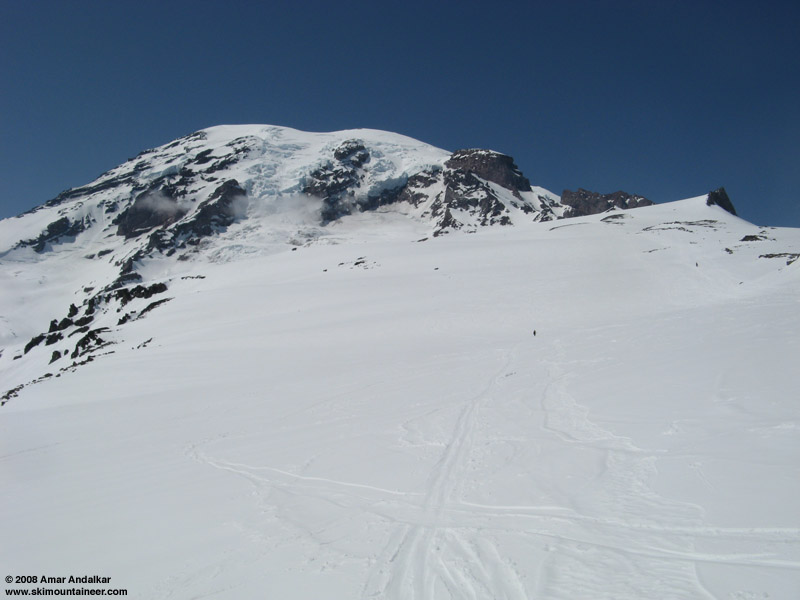 Skinning up the Muir Snowfield. | 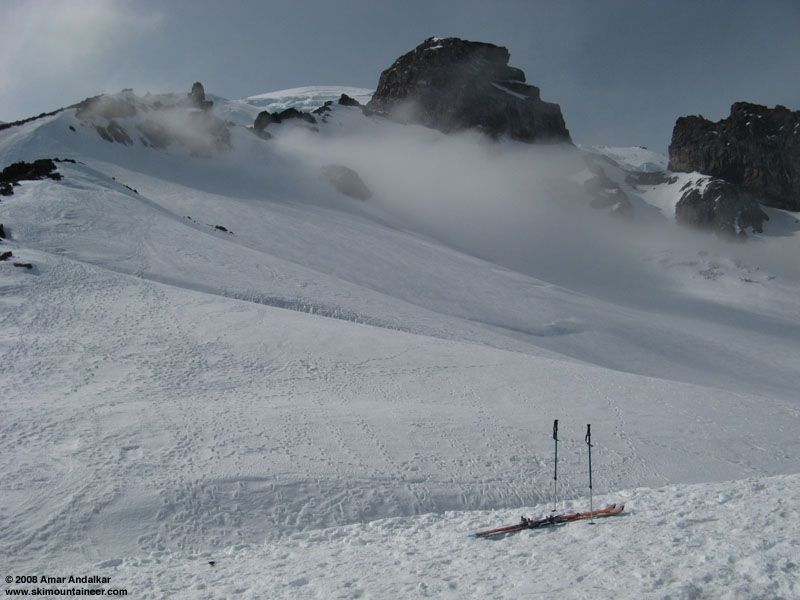 Looking upward at the summit dome, my home on Monday night. |
Hung out for a couple of hours and talked to various climbers, including a guided team of 7 which descended through Cathedral Gap just before 5pm. They had summited via Ingraham Direct, and the route is now well-wanded, but still has several sketchy crevasse crossings and the guides think it may not go much longer. I asked them if there were any entries in the summit register the past few days, and they said none since May 6, so apparently they were the first climbers to summit since me. I asked what they thought of that entry, and the guides remarked that it was very interesting. They realized my questions were odd, so I revealed that I had written the entry. It turns out one of the guides had taken a photo of the entry, and he offered to email it to me after he gets off the mountain. They'd already heard about the incident from other guides and climbing rangers, and wanted details, so I filled them in a bit.
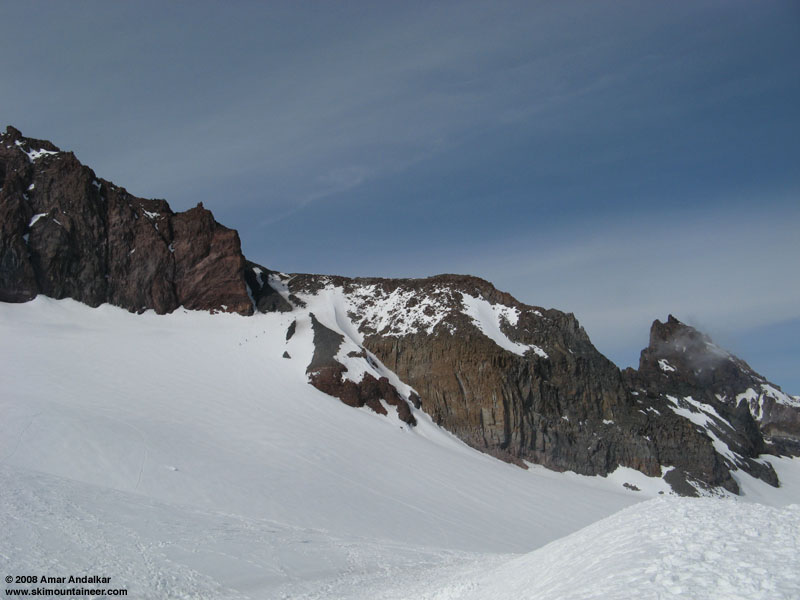 Rope teams descending through Cathedral Gap, after summiting via Ingraham Direct. | 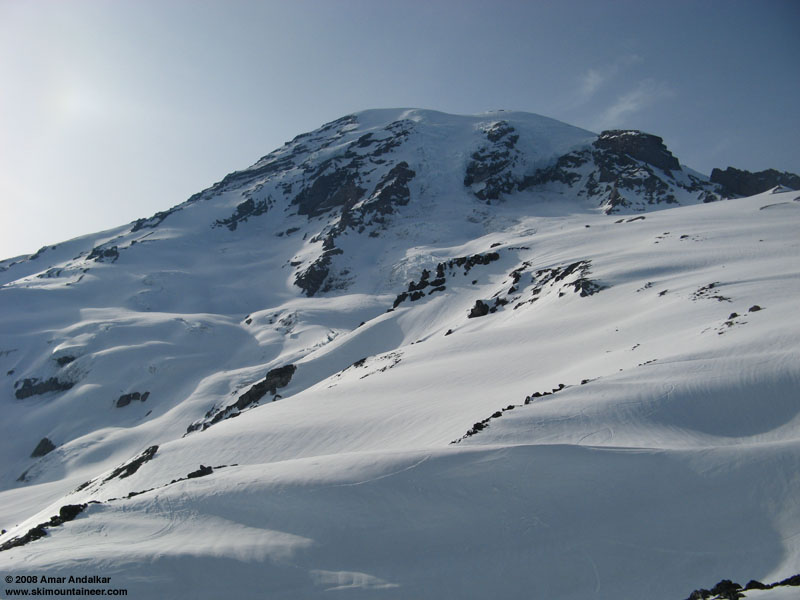 Evening light on the Mountain. |
Skied down just after 6pm. The snow was remarkably good, a bit crusty up high (would have been perfect an hour earlier), but mostly nice corn, even below Pan Point and all the way down to just a couple hundred feet above the parking lot before it got mushy. It was an awesome experience to look up at the Mountain and relive the events of only a few days earlier, and to appreciate its power with a deeper degree of respect than ever before.
NOTE: also posted as a separate TR for easier searching in the future: May 9, 2008, Mt Rainier, Muir Snowfield
Thanks for sharing your experience, Amar.
I suspect most if not all of us would have total confidence in you as a partner due to your obvious ability to keep it together throughout such an ordeal.
It's always tempting, upon reading such an account, to say "but I wouldn't have done this or that, so I don't think that would happen to me." E.g with the "Gooch Epic on Baker" (I didn't live here then, but a pal claims that despite what Gooch has written, the forecast was for a significant storm coming in - seemed somewhat predictable*; plus this pal had climbed a bit with Gooch beforehand but quit due to concerns about widely different approaches to risk management), or the story (also from the early '90s) of those Aspen skiers who were heading to a hut towards Pearl Pass who ended up rescued by snowmobilers near Taylor Reservoir, if memory serves (horrible group dynamic, other apparent errors). I've only skied with you once (with Silas up at the Pass last winter), but I was impressed with your approach to risk and overall trip management, even on that wimpy tour. So it's harder to come up with a deflection strategy for your story. JD-Climber's notions of concsiously thinking about cascade of broken "rules" (guidelines?) strikes me as a great risk managment technique, but nevertheless, for me, your story strongly reinforces jd's comments on odds of epics and Sky's comments on the importance of self-reliance.
Strong second to Zap's comments on making some hay with the story now that you've survived.
* [edited to add:"> I don't know one way or another which account of the forecast for this old incident is correct, so my point is not to pass judgment on the Gooch party, but rather to note my own (and I suspect many others') tendency to say "not me" when I read accounts of noteworthy epics or accidents.
I suspect most if not all of us would have total confidence in you as a partner due to your obvious ability to keep it together throughout such an ordeal.
It's always tempting, upon reading such an account, to say "but I wouldn't have done this or that, so I don't think that would happen to me." E.g with the "Gooch Epic on Baker" (I didn't live here then, but a pal claims that despite what Gooch has written, the forecast was for a significant storm coming in - seemed somewhat predictable*; plus this pal had climbed a bit with Gooch beforehand but quit due to concerns about widely different approaches to risk management), or the story (also from the early '90s) of those Aspen skiers who were heading to a hut towards Pearl Pass who ended up rescued by snowmobilers near Taylor Reservoir, if memory serves (horrible group dynamic, other apparent errors). I've only skied with you once (with Silas up at the Pass last winter), but I was impressed with your approach to risk and overall trip management, even on that wimpy tour. So it's harder to come up with a deflection strategy for your story. JD-Climber's notions of concsiously thinking about cascade of broken "rules" (guidelines?) strikes me as a great risk managment technique, but nevertheless, for me, your story strongly reinforces jd's comments on odds of epics and Sky's comments on the importance of self-reliance.
Strong second to Zap's comments on making some hay with the story now that you've survived.
* [edited to add:"> I don't know one way or another which account of the forecast for this old incident is correct, so my point is not to pass judgment on the Gooch party, but rather to note my own (and I suspect many others') tendency to say "not me" when I read accounts of noteworthy epics or accidents.
author=jdclimber link=topic=10009.msg40352#msg40352 date=1210353648]
Ash_j, yes, weather was a factor, but only one factor. In some ways, the stage was set for the weather.
Using Amar's experience as fodder for this discussion, weather would have been fatal if Amar were climbing in a Speedo. Why did he have other clothing, because he wanted a margin of safety provided by extra clothing.
Had he perished in a Speedo, due to hypothermia, would we blame the weather?
The same logic can be applied to what went right and what went wrong.
Well, weather can be fatal no matter what one chooses to wear. But I suppose I misspoke if it sounds like I said that weather was the only factor. Of course, logically, the only 'rule' that will guarantee that you won't have a problem on a climbing trip is not to go on the climbing trip at all. ;)
Yes I think we're mostly on the same page here. I think it is all about being dynamically aware of one's weaknesses and exposure. These are constantly changing and always situation-dependent. I think that the danger in expecting any given set of rules to apply for longer than an instant, is that faith in a static set of rules can and does lead to insensitivity to the dynamic nature of moving through a risky environment. 'Rules' can be good mnemonics, but there is always the risk that they will replace actual thought to a lesser or greater extent. One need only consider the common misconceptions that many mountain-hikers have about the use and efficacy of rope, and the tragic accidents that have been compounded by such misconceptions. I would argue that this is an example of where the adherence to a rule ('always rope up' ) encourages some climbers to simply obey the rule without thinking critically, which sometimes leads to tragic mistakes due either to overconfidence while roped, or accidents caused or aggravated directly by the rope itself. If roping up were not promoted as a 'rule,' then new climbers would instead be forced to figure out for themselves just how and when a rope will be useful for them, and also when it will present its own risks. If done wisely, this self-enlightenment (by which I don't mean to preclude learning technical and judgmental skills from experts) should make them 'safer' and more effective climbers in the end. Then if/when problems occur, the useful lessons to be learned are about the specific thought processes and choices made that led to an unexpected situation, potentially including but certainly not limited to whether a standard protocol was followed.
Yes, it is overly simplified to believe that a set of rules will keep you safe in the mountains.
However, I believe that one needs a system of some sort to assist in evaluating when a person is "hanging it out" more and more. A set of guidelines, in my opinion assists in evaluating risk. The idea is not to follow all rules, it is to know when you are breaking them, and making sure you are comfortable/able to accept the outcome, knowing that each broken rule increases your risk factors.
ps. I'm not trying to be antagonistic or anything, I just find it interesting to mull over this stuff once in a while.
Amar and Hannah, thank you for responding to the couple of questions I had. I hope you realize my query about going down the DC or Ingraham was not a "what you should have done" comment. I was exploring what my own decision path may have been in that scenario and you hit the nail on the head with the comment about route familiarity. Having done the Fuhrer and DC it may have been a toss-up, with the familiarity of going down what I just climbed up maybe having the edge, unless I felt strongly there would be somebody headed up the DC that day. Anyway, good to hear Hannah's story, glad you got back up yesterday, and very happy I was able to make you both laugh a bit about it (I still say one good slug with a "don't ever do that again" is helpful; seems it makes us guys remember stuff like that better ;) )
author=Boot link=topic=10009.msg40407#msg40407 date=1210465689]
I hope you realize my query about going down the DC or Ingraham was not a "what you should have done" comment.
I don't think anyone is saying "what [Amar] should have done". The past is done - the reason to explore hypotheticals is entirely forward looking. Patterns emerge and they are extremely valuable in helping future trip planning. I assume that a big reason for the extremely detailed TR is to promote safety discussion and learning, and to that end the TR is a really valuable service.
If someone comes to believe, for instance, that both party members having a radio that was verified to be operating would have mitigated the situation, then that's a potentially useful interpretation. It's one data point. If you keep reading incident reports and keep making that same interpretation in other cases, take the hint. It means that for your approach and style, radios are a good idea.
A while ago I read the compendium of all avalanches in Canada from 1984 to 1996 at http://avalancheinfo.net/Newsletters%20and%20Articles/Articles/AvalancheAccidentsV4.pdf (big link 8 MB). After reading and interpreting every incident report, I concluded that wearing a ski helmet would have saved a significant number of lives (especially if they also basic avy gear as well). For my approach and style, a ski helmet is now mandatory. It's not a statement about people or events in the past, just going-forward planning.
author=Amar Andalkar link=topic=10009.msg40273#msg40273 date=1210226218]
And at least I lost some weight during the trip: From the morning of May 3 through this afternoon on May 7, my weight has decreased from 144.4 lbs to 140.0, with body fat decreasing from 14.9% to 12.3%. This equals a loss of 4.3 lbs of body fat, which would supply about 17000 calories, and luckily it appears that I managed not to burn a significant amount of muscle mass. That would have changed for sure had I been forced to spend longer up there with no more food.
Wow -4.3lbs of body fat in a couple of days. I think you'll be invited on Oprah, and shortly after that we'll be seeing a rash of celebrities on the "Amazing Amar Fumarale Diet".
So glad you both survived! What a great story - I agree with many others - your writing is gripping, and I think it's publishable. Very inspiring in that what you lacked in gear you made up for with knowledge and good instincts. Thanks for sharing it with us.
Don
author=Amar Andalkar link=topic=10009.msg40394#msg40394 date=1210447998">I asked them if there were any entries in the summit register the past few days, and they said none since May 6, so apparently they were the first climbers to summit since me. I asked what they thought of that entry, and the guides remarked that it was very interesting. They realized my questions were odd, so I revealed that I had written the entry. It turns out one of the guides had taken a photo of the entry, and he offered to email it to me after he gets off the mountain.
Thanks to Jeff Street for sending me this photo of my summit register entry. I was worried that I might have written something too embarrassing to post, but it looks OK. I think the entry gives some more insight into my state of mind on the summit, and how uncertain my situation still was, only 2-3 hours before I eventually skied down on my own.
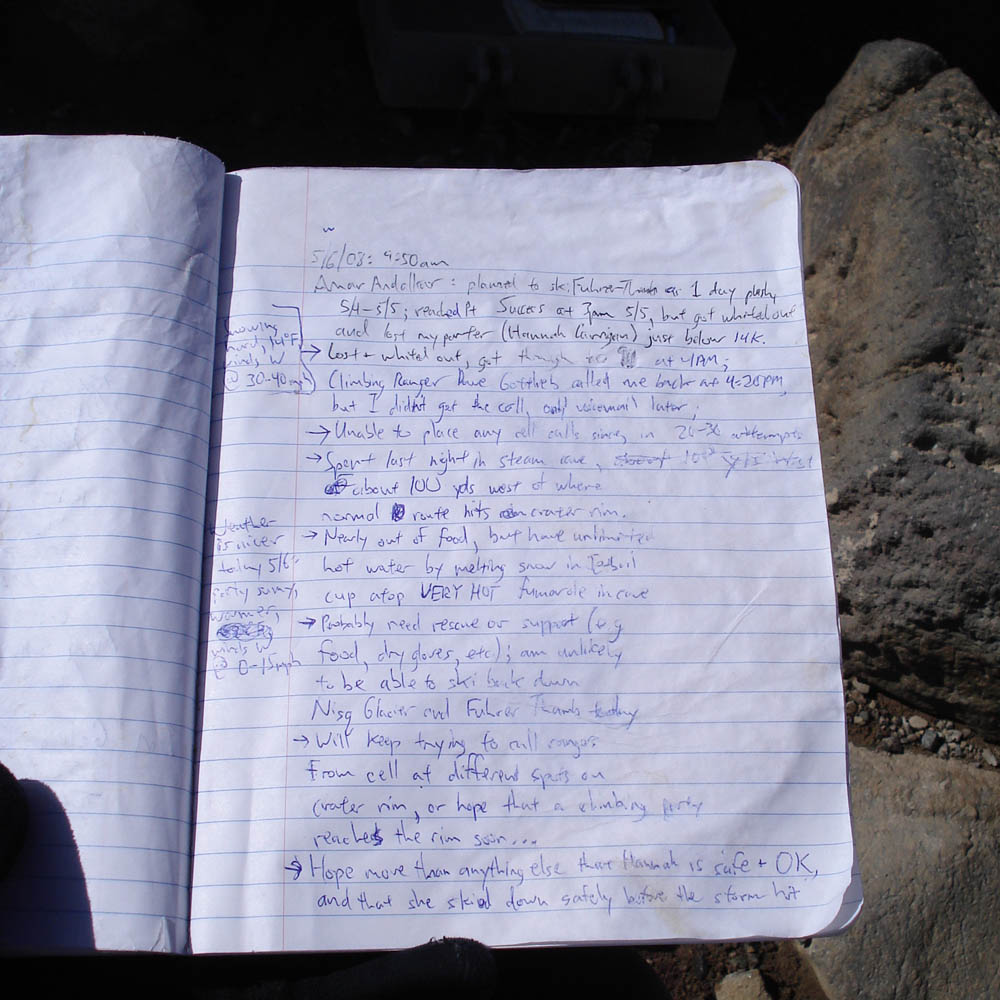
(Click to enlarge.)
Amar and Hannah,
I'm so glad that you both escaped a potentially awful situation. These sorts of things make me realize that TAY is a community that cares about one another.
Larry
I'm so glad that you both escaped a potentially awful situation. These sorts of things make me realize that TAY is a community that cares about one another.
Larry
Thanks again Amar for such a thorough and selfless deconstruction of your saga. I want to compliment the community (as it pertains to those who've posted) for being so responsible, and respectful of Amar and Hannah, in participating in this important process. For good reason, we leave our "other lives" out of these chats, just like we do when we're in the mountains. However, I want to mention that since my other life is as an interventional cardiologist, I really appreciate your efforts here to let us all reflect through your experience and the questions and input of others so that each of us hopefully becomes a little less likely to make a life changing mistake in the future doing what we all love. In medicine, we call it "morbidity and mortality" - reviewing in conference format what went wrong whenever there is a bad outcome; the idea is that far fewer mistakes (bad things happening to patients) have to happen when we collectively learn from each individual bad outcome. Incidentally, those also typically are a chain of small errant decisions (or failure to recognize a piece of data for the decision-changer it is) leading up to an outcome change. It involves humility and soul baring, but everyone respects it for how we all benefit. I see that happening here, and it feels good.
A comment, and a question:
If you want to profit from the experience (and who could blame ya), sell your story to Outside or Time Warner or David Geffen; but know that your story will be changed so that you look reckless (because it sells copy) and you will be judged negatively by lay people who have no idea what they are talking about. If you want your story to reach a wider segment of the backcountry/ski mountaineering community, choose a much less profitable directed audience, like Backcountry Magazine and the Alpine Clubs of America and Canada. Although it's not an avalanche story, you would make a terrific and very important presentation at the Northwest Avalanche Summit next year.
The question is about something not discussed yet. How did you know the fumarole (or any fumarole) would be safe to stay in despite the absence of odor? We all know stories of people weathering storms in them, and people dying in them. Personally, I would have been too concerned about carbon monoxide poisoning to allow myself the lifesaving option you alertedly chose. Your knowledge of fumaroles is far greater than mine, so I'm interested to know.
A comment, and a question:
If you want to profit from the experience (and who could blame ya), sell your story to Outside or Time Warner or David Geffen; but know that your story will be changed so that you look reckless (because it sells copy) and you will be judged negatively by lay people who have no idea what they are talking about. If you want your story to reach a wider segment of the backcountry/ski mountaineering community, choose a much less profitable directed audience, like Backcountry Magazine and the Alpine Clubs of America and Canada. Although it's not an avalanche story, you would make a terrific and very important presentation at the Northwest Avalanche Summit next year.
The question is about something not discussed yet. How did you know the fumarole (or any fumarole) would be safe to stay in despite the absence of odor? We all know stories of people weathering storms in them, and people dying in them. Personally, I would have been too concerned about carbon monoxide poisoning to allow myself the lifesaving option you alertedly chose. Your knowledge of fumaroles is far greater than mine, so I'm interested to know.
Amar,
Thanks for sharing, and as everyone else has said, I'm glad you both made it out unscathed. One thing that came to mind, and that you have only mentioned in passing was wands:
"they had summited via Ingraham Direct, and the route is now well-wanded, but still has several sketchy crevasse crossings and the guides think it may not go much longer"
I have been up Rainier a few times, and even in mid summer with ideal weather conditions, I carry and use wands, unless I am traveling on a previously wanded route. They really help establishing landmarks where there are none, mark creavasses, turns, etc. GPS, radios, cell phones are all great, but on a big mountain, a compass, mechanical altimeter and wands are the only things that you can count on. I also make notes on waterproof paper on longer routes, even multiday routes, leaving a wand at key spots along the way....breadcrumbs in the forest (flagging tape works well in the woods) so I can find my way home. Many feel that wands are big, bulky and a pain in the ass. I think even a half dozen well placed wands could have made your ordeal much less of one. Many a time I have felt great relief at seeing the wand I was searching for on my way back down after the weather changes or was never that good in the first place.
That's my 2 cents worth, and again, thanks for sharing your story and getting this discussion going.
Thanks for sharing, and as everyone else has said, I'm glad you both made it out unscathed. One thing that came to mind, and that you have only mentioned in passing was wands:
"they had summited via Ingraham Direct, and the route is now well-wanded, but still has several sketchy crevasse crossings and the guides think it may not go much longer"
I have been up Rainier a few times, and even in mid summer with ideal weather conditions, I carry and use wands, unless I am traveling on a previously wanded route. They really help establishing landmarks where there are none, mark creavasses, turns, etc. GPS, radios, cell phones are all great, but on a big mountain, a compass, mechanical altimeter and wands are the only things that you can count on. I also make notes on waterproof paper on longer routes, even multiday routes, leaving a wand at key spots along the way....breadcrumbs in the forest (flagging tape works well in the woods) so I can find my way home. Many feel that wands are big, bulky and a pain in the ass. I think even a half dozen well placed wands could have made your ordeal much less of one. Many a time I have felt great relief at seeing the wand I was searching for on my way back down after the weather changes or was never that good in the first place.
That's my 2 cents worth, and again, thanks for sharing your story and getting this discussion going.
Hey Amar. Thanks for sharing a gripping account of your ordeal. Well managed. Hats off to you and Hannah for getting down safely.
I sometimes carry wands, but my experience with them on Rainier's summit plateau in a cloud cap was that, in order to rely on wands to find your way down to safety, you'd need in excess of a hundred. I could not see the wands we placed until they were about 20 feet away. If they had been easier to see, by definition they would have been unnecessary. I agree they can help, but not when things get really tough, unless you're traveling expedition style.
author=Mr.Doober link=topic=10009.msg40416#msg40416 date=1210525371]
I think even a half dozen well placed wands could have made your ordeal much less of one. Many a time I have felt great relief at seeing the wand I was searching for on my way back down after the weather changes or was never that good in the first place.
I sometimes carry wands, but my experience with them on Rainier's summit plateau in a cloud cap was that, in order to rely on wands to find your way down to safety, you'd need in excess of a hundred. I could not see the wands we placed until they were about 20 feet away. If they had been easier to see, by definition they would have been unnecessary. I agree they can help, but not when things get really tough, unless you're traveling expedition style.
At the risk of beating a dead horse...
Wands and compasses are themselves technologies in a certain sense. But perhaps what people really mean when they say 'technology' is 'electronics' or 'it takes batteries.'
GPS is simply a 20th century version of wands and a compass. The two methods need not be mutually exclusive, but in my opinion one of them has the potential to be far more effective in whiteout conditions, should you end up in that situation. Personally I'm making a mental note to never leave the handy little bugger behind any time I'm heading above treeline in questionable weather, based both upon my own experiences and this one. Not because I need it, nor because I plan to depend on it, but because it can give me information in a way that nothing else can, in the worst weather conditions.
But certainly that's not a complete, nor the only, retrospective armchair solution to the whole story here. I could also just try my best not to get whited-out, which has mostly worked so far.
Wands and compasses are themselves technologies in a certain sense. But perhaps what people really mean when they say 'technology' is 'electronics' or 'it takes batteries.'
GPS is simply a 20th century version of wands and a compass. The two methods need not be mutually exclusive, but in my opinion one of them has the potential to be far more effective in whiteout conditions, should you end up in that situation. Personally I'm making a mental note to never leave the handy little bugger behind any time I'm heading above treeline in questionable weather, based both upon my own experiences and this one. Not because I need it, nor because I plan to depend on it, but because it can give me information in a way that nothing else can, in the worst weather conditions.
But certainly that's not a complete, nor the only, retrospective armchair solution to the whole story here. I could also just try my best not to get whited-out, which has mostly worked so far.
Thanks everyone for the continued kind words, support, and ongoing discussion. There is much to learn from all of it.
Most of those who know me well are aware that I've had a fairly serious weight-gain issue for the past decade. There's a fat couch potato trapped within my body, just waiting for another chance to get out. Any major reduction in my frequency of ski mountaineering or hiking trips or other exercise, while eating a normal diet, results in rapid weight gain as fast as 5-10 lbs per month which continues until I reach my body's natural setpoint of 165-170 lbs (at 5' 7" height), after which it semi-stabilizes and only slowly increases further. As recently as Thanksgiving 2006, I weighed 170 lbs, and I managed to lose 30 lbs in 30 weeks through late June 2007 by a combination of a very severe diet (often 1 meal per day, sometimes salad only, at 5pm, plus fruit for snacks) from January to April followed by lots of big ski mountaineering trips from May onward. I don't think Oprah or her viewers could benefit much from either that diet plan or the new steam cave plan. ;) Obviously, I'd advise no one to attempt either of them.
Thanks for mentioning this. I've actually never used wands myself, although I have been on a couple of Rainier climbs long ago where party members did bring them. There are two major reasons I don't even consider using wands: first and foremost, they are incompatible with ski ascents and ski descents. It is not easy to place wands efficiently during a ski ascent (since both hands are holding poles, not one hand free as on foot with an axe). And there is no way to retrieve wands during a ski descent, so no point in carrying them unless you are planning to abandon your wands in place (i.e. create mountain trash and have to replace them after every single trip). Obviously, the situation is totally different while on foot.
The second major reason is that they are incompatible with 2-person rope teams or unroped travel. It is only feasible to place wands every rope length apart at most, so you can always find the next one in a whiteout, and even then you'd need several hundred to navigate a major glacier route. But rope lengths vary: for a 2-person team on a 37 m (120 ft) glacier rope, the two people would be roped only 40 ft apart and carrying the rest in two 40 ft coils. There's no way you could ever carry enough wands in that case. If unroped (i.e. solo or not bringing a rope), then the wands would have had to be about 20 feet apart at most for me to have successfully navigated this particular whiteout. I'm not sure where I could have placed a half-dozen wands to help me out, and since I was never planning to ski down the skin track exactly, I would have been abandoning them. The "digital wands" (full track and waypoints on a GPS) are far superior to real wands in these cases, and the only realistic choice for ski descents and 2-person or solo travel. Wands are certainly a good option for rope teams of 3 or more, travelling on foot.
I've read and researched extensively about steam caves and fumaroles since at least 2002, and this knowledge was certainly useful to me. I'd read that only the West Crater steam caves contained some H2S gas, but even so not enough to be harmful. In both craters, SO2 is almost undetectable, while CO levels are generally minimal and CO2 never even close to high enough to cause suffocation. In fact, the one comprehensive gas analysis ever done in the caves (see 2000 paper below) found that the air within the caves was almost identical in composition to ambient air outside, with volcanic gases significant only right at the fumaroles. The same paper states that the two craters of Mt Rainier "contain the world’s largest volcanic ice-cave system."
But I wasn't thinking at all about those scientific papers when I was desperately seeking shelter from the wind this time. I just assumed the steam cave I found was safe to enter because I have never heard of anyone being harmed or dying in Rainier's steam caves (does anyone know of an incident?), and because I had entered the steam caves briefly during a few earlier Rainier summits, including my previous ascent, another one-day overnight push with Hannah and Sky on August 1-2, 2007. That was on foot via the Ingraham-Emmons route variation right of Disappointment Cleaver and we left skis at Muir, but ski conditions looked quite good still on the Emmons. That time, we hung out about 10 ft below the surface in a steam cave entrance for maybe a half-hour or longer, to stay out of the wind. That cave was located just a few yards east of the low point on the crater rim, and no hot steaming fumaroles were evident in the uppermost chamber. We did not have any inclination to explore further down that time.
However, I've been trying (unsuccessfully) for many years to get a group together to camp up in the crater for 2-3 days, which would give enough time to explore the caves more thoroughly. I especially would like to visit the lake located deep under the ice of the West Crater, which is the highest in the USA (see Mammoth Ski Patrol Tragedy).
One interesting note about steam caves: to the best of my knowledge, they have been documented on only 6 volcanoes worldwide, and four are in the Cascade Range: Mt Rainier, Mt Baker, Mt St Helens, Mt Hood (now vanished), Mt Wrangell (Alaska), and Mt Erebus (Antarctica). However, it is very likely that similar steam cave systems exist on a number of volcanoes in southern Chile and in Kamchatka, which are the two volcanic arcs most similar to the Cascades in latitude, altitude, and most importantly the present degree of glaciation. But I have been unable to find any published information, online or in print.
Interesting reading online:
Mt Rainier Glacier Caves Index:
Mt Baker Crater Steam Caves:
Mt St Helens Crater Firn Caves:
The News Tribune: [url=http://www.thenewstribune.com/1012/story/174171.html">Exploring Rainier's summit steam caves including photo of lake, July 1998
Outside Magazine: [url=http://outside.away.com/peaks/rainier/index.html">Rainier's Steam Caves, July-August 1996
Some published scientific papers:
Kiver, Eugene P., and Mumma, Martin D. "Summit Firn Caves, Mount Rainier, Washington." Science, [b">173[/b">:3994, p. 320-322 (1971)
Kiver, Eugene P., and Steele, William K. "Firn Caves in the Volcanic Craters of Mount Rainier, Washington." The NSS Bulletin, [b">37[/b">:3, p. 45-55 (1975) [url=http://caves.org/pub/journal/PDF/V37/v37n3-Kiver.htm">abstract only; this paper has a nice map of the cave passages as they existed back then, plus contour maps of the crater floor
Kiver, Eugene P., Snavely, Jack, and Snavely, Donna F. "Hydrogen Sulfide Fumes at the Summit of Mount Rainier Volcano, Washington." Northwest Science, [b">51[/b">:1, p. 31-35 (1977) [url=http://www.vetmed.wsu.edu/org_nws/NWSci%20journal%20articles/1970-1978/1977%20vol%2051/51-1/v51%20p31%20Kiver%20et%20al.PDF">free PDF
Zimbelman-D-R; Rye-R-O; Landis-G-P. "Fumaroles in ice caves on the summit of Mount Rainier; preliminary stable isotope, gas, and geochemical studies." Journal of Volcanology and Geothermal Research, [b">97[/b">:1-4, p. 457-473 (2000)
Kiver, Eugene P. "The First Exploration of Mount Baker Ice Caves." Explorers Journal, [b">53[/b">:2, p. 84-87 (1975)
Kiver, Eugene P. "Mount Baker's changing fumaroles." The Ore Bin, [b">40[/b">:8, p. 133-145 (1978) [url=http://www.oregongeology.com/sub/publications/OG/OBv40n08.pdf">free PDF
Anderson, Charles H., Jr., et al. "Crater Firn Caves of Mount St. Helens, Washington." Journal of Cave and Karst Studies, [b">60[/b">:1, p. 44-50 (1998) [url=http://www.caves.org/pub/journal/PDF/V60/V60N1-Anderson.pdf">free PDF
Anderson, Charles H., Jr., and Vining, Mark R. "Observations of Glacial, Geomorphic, Biologic, and Mineralogic Developments in the Crater of Mount St. Helens, Washington." Washington Geology, [b">27[/b">:2/3/4, p. 9-19 (1999) [url=http://www.dnr.wa.gov/Publications/ger_washington_geology_1999_v27_no2-3-4.pdf">free PDF
author=Rusty Knees link=topic=10009.msg40411#msg40411 date=1210481253">
Wow -4.3lbs of body fat in a couple of days. I think you'll be invited on Oprah, and shortly after that we'll be seeing a rash of celebrities on the "Amazing Amar Fumarale Diet".
So glad you both survived! What a great story - I agree with many others - your writing is gripping, and I think it's publishable. Very inspiring in that what you lacked in gear you made up for with knowledge and good instincts. Thanks for sharing it with us.
Don
Most of those who know me well are aware that I've had a fairly serious weight-gain issue for the past decade. There's a fat couch potato trapped within my body, just waiting for another chance to get out. Any major reduction in my frequency of ski mountaineering or hiking trips or other exercise, while eating a normal diet, results in rapid weight gain as fast as 5-10 lbs per month which continues until I reach my body's natural setpoint of 165-170 lbs (at 5' 7" height), after which it semi-stabilizes and only slowly increases further. As recently as Thanksgiving 2006, I weighed 170 lbs, and I managed to lose 30 lbs in 30 weeks through late June 2007 by a combination of a very severe diet (often 1 meal per day, sometimes salad only, at 5pm, plus fruit for snacks) from January to April followed by lots of big ski mountaineering trips from May onward. I don't think Oprah or her viewers could benefit much from either that diet plan or the new steam cave plan. ;) Obviously, I'd advise no one to attempt either of them.
author=Mr.Doober link=topic=10009.msg40416#msg40416 date=1210525371">
I have been up Rainier a few times, and even in mid summer with ideal weather conditions, I carry and use wands, unless I am traveling on a previously wanded route. They really help establishing landmarks where there are none, mark creavasses, turns, etc. GPS, radios, cell phones are all great, but on a big mountain, a compass, mechanical altimeter and wands are the only things that you can count on. I also make notes on waterproof paper on longer routes, even multiday routes, leaving a wand at key spots along the way....breadcrumbs in the forest (flagging tape works well in the woods) so I can find my way home. Many feel that wands are big, bulky and a pain in the ass. I think even a half dozen well placed wands could have made your ordeal much less of one. Many a time I have felt great relief at seeing the wand I was searching for on my way back down after the weather changes or was never that good in the first place.
Thanks for mentioning this. I've actually never used wands myself, although I have been on a couple of Rainier climbs long ago where party members did bring them. There are two major reasons I don't even consider using wands: first and foremost, they are incompatible with ski ascents and ski descents. It is not easy to place wands efficiently during a ski ascent (since both hands are holding poles, not one hand free as on foot with an axe). And there is no way to retrieve wands during a ski descent, so no point in carrying them unless you are planning to abandon your wands in place (i.e. create mountain trash and have to replace them after every single trip). Obviously, the situation is totally different while on foot.
The second major reason is that they are incompatible with 2-person rope teams or unroped travel. It is only feasible to place wands every rope length apart at most, so you can always find the next one in a whiteout, and even then you'd need several hundred to navigate a major glacier route. But rope lengths vary: for a 2-person team on a 37 m (120 ft) glacier rope, the two people would be roped only 40 ft apart and carrying the rest in two 40 ft coils. There's no way you could ever carry enough wands in that case. If unroped (i.e. solo or not bringing a rope), then the wands would have had to be about 20 feet apart at most for me to have successfully navigated this particular whiteout. I'm not sure where I could have placed a half-dozen wands to help me out, and since I was never planning to ski down the skin track exactly, I would have been abandoning them. The "digital wands" (full track and waypoints on a GPS) are far superior to real wands in these cases, and the only realistic choice for ski descents and 2-person or solo travel. Wands are certainly a good option for rope teams of 3 or more, travelling on foot.
author=peteyboy link=topic=10009.msg40415#msg40415 date=1210522697">
The question is about something not discussed yet. How did you know the fumarole (or any fumarole) would be safe to stay in despite the absence of odor? We all know stories of people weathering storms in them, and people dying in them. Personally, I would have been too concerned about carbon monoxide poisoning to allow myself the lifesaving option you alertedly chose. Your knowledge of fumaroles is far greater than mine, so I'm interested to know.
I've read and researched extensively about steam caves and fumaroles since at least 2002, and this knowledge was certainly useful to me. I'd read that only the West Crater steam caves contained some H2S gas, but even so not enough to be harmful. In both craters, SO2 is almost undetectable, while CO levels are generally minimal and CO2 never even close to high enough to cause suffocation. In fact, the one comprehensive gas analysis ever done in the caves (see 2000 paper below) found that the air within the caves was almost identical in composition to ambient air outside, with volcanic gases significant only right at the fumaroles. The same paper states that the two craters of Mt Rainier "contain the world’s largest volcanic ice-cave system."
But I wasn't thinking at all about those scientific papers when I was desperately seeking shelter from the wind this time. I just assumed the steam cave I found was safe to enter because I have never heard of anyone being harmed or dying in Rainier's steam caves (does anyone know of an incident?), and because I had entered the steam caves briefly during a few earlier Rainier summits, including my previous ascent, another one-day overnight push with Hannah and Sky on August 1-2, 2007. That was on foot via the Ingraham-Emmons route variation right of Disappointment Cleaver and we left skis at Muir, but ski conditions looked quite good still on the Emmons. That time, we hung out about 10 ft below the surface in a steam cave entrance for maybe a half-hour or longer, to stay out of the wind. That cave was located just a few yards east of the low point on the crater rim, and no hot steaming fumaroles were evident in the uppermost chamber. We did not have any inclination to explore further down that time.
However, I've been trying (unsuccessfully) for many years to get a group together to camp up in the crater for 2-3 days, which would give enough time to explore the caves more thoroughly. I especially would like to visit the lake located deep under the ice of the West Crater, which is the highest in the USA (see Mammoth Ski Patrol Tragedy).
One interesting note about steam caves: to the best of my knowledge, they have been documented on only 6 volcanoes worldwide, and four are in the Cascade Range: Mt Rainier, Mt Baker, Mt St Helens, Mt Hood (now vanished), Mt Wrangell (Alaska), and Mt Erebus (Antarctica). However, it is very likely that similar steam cave systems exist on a number of volcanoes in southern Chile and in Kamchatka, which are the two volcanic arcs most similar to the Cascades in latitude, altitude, and most importantly the present degree of glaciation. But I have been unable to find any published information, online or in print.
Interesting reading online:
Mt Rainier Glacier Caves Index:
Mt Baker Crater Steam Caves:
Mt St Helens Crater Firn Caves:
The News Tribune: [url=http://www.thenewstribune.com/1012/story/174171.html">Exploring Rainier's summit steam caves including photo of lake, July 1998
Outside Magazine: [url=http://outside.away.com/peaks/rainier/index.html">Rainier's Steam Caves, July-August 1996
Some published scientific papers:
Kiver, Eugene P., and Mumma, Martin D. "Summit Firn Caves, Mount Rainier, Washington." Science, [b">173[/b">:3994, p. 320-322 (1971)
Kiver, Eugene P., and Steele, William K. "Firn Caves in the Volcanic Craters of Mount Rainier, Washington." The NSS Bulletin, [b">37[/b">:3, p. 45-55 (1975) [url=http://caves.org/pub/journal/PDF/V37/v37n3-Kiver.htm">abstract only; this paper has a nice map of the cave passages as they existed back then, plus contour maps of the crater floor
Kiver, Eugene P., Snavely, Jack, and Snavely, Donna F. "Hydrogen Sulfide Fumes at the Summit of Mount Rainier Volcano, Washington." Northwest Science, [b">51[/b">:1, p. 31-35 (1977) [url=http://www.vetmed.wsu.edu/org_nws/NWSci%20journal%20articles/1970-1978/1977%20vol%2051/51-1/v51%20p31%20Kiver%20et%20al.PDF">free PDF
Zimbelman-D-R; Rye-R-O; Landis-G-P. "Fumaroles in ice caves on the summit of Mount Rainier; preliminary stable isotope, gas, and geochemical studies." Journal of Volcanology and Geothermal Research, [b">97[/b">:1-4, p. 457-473 (2000)
Kiver, Eugene P. "The First Exploration of Mount Baker Ice Caves." Explorers Journal, [b">53[/b">:2, p. 84-87 (1975)
Kiver, Eugene P. "Mount Baker's changing fumaroles." The Ore Bin, [b">40[/b">:8, p. 133-145 (1978) [url=http://www.oregongeology.com/sub/publications/OG/OBv40n08.pdf">free PDF
Anderson, Charles H., Jr., et al. "Crater Firn Caves of Mount St. Helens, Washington." Journal of Cave and Karst Studies, [b">60[/b">:1, p. 44-50 (1998) [url=http://www.caves.org/pub/journal/PDF/V60/V60N1-Anderson.pdf">free PDF
Anderson, Charles H., Jr., and Vining, Mark R. "Observations of Glacial, Geomorphic, Biologic, and Mineralogic Developments in the Crater of Mount St. Helens, Washington." Washington Geology, [b">27[/b">:2/3/4, p. 9-19 (1999) [url=http://www.dnr.wa.gov/Publications/ger_washington_geology_1999_v27_no2-3-4.pdf">free PDF
I'm not saying abandon modern technology, I just think that without much effort or extra gear, you can make a return trip easier in potentially difficult conditions.
There are several ways to use wands: you can place them every ropelength, at switchbacks, or on a fall line you plane on skiing (if you are ascending roughly the same route). Let's say you place one and note the elevation and compass heading to the next, which might be 500 vertical above. Repeat for a few thousand vertical and you've backed up your battery powered technology with caveman tech. If you try this, you may find it really isn't that difficult on ascent or descent to place and retrieve wands. On a nice day, they can even help out if you place them on better snow / higher quality ski descent lines.
Going light is a major key, but a handfull of wands is good insurance when you are on featureless terrain.
There are several ways to use wands: you can place them every ropelength, at switchbacks, or on a fall line you plane on skiing (if you are ascending roughly the same route). Let's say you place one and note the elevation and compass heading to the next, which might be 500 vertical above. Repeat for a few thousand vertical and you've backed up your battery powered technology with caveman tech. If you try this, you may find it really isn't that difficult on ascent or descent to place and retrieve wands. On a nice day, they can even help out if you place them on better snow / higher quality ski descent lines.
Going light is a major key, but a handfull of wands is good insurance when you are on featureless terrain.
Wow. I feel like I just went to a conference on fumaroles! Thanks! Anybody think we can get some funding for a summer research trip to Chile?
Re the steam caves: The National Speleological Society (NSS) is the largest caving organization in the US. Most NSS activities relate to caves formed in persistent rock such as limestone. However, the NSS home page has this entry:
http://www.caves.org/io/projects.shtml
{content}
Mount Rainier Steam Caves Project
The project's primary objective is to survey and monitor the caves vicinity the summit of Mount Rainier, Washington. The caves are formed in the firn ice that is formed from consolidated snow. The firn melts at the rock substrate interface and the entire mass of firn in the crater subsides. Hot gasses escape from fumaroles and melt cave passages in the firn. Kiver reported two kilometers of passage. The continual subsidence and melting of passages apparently stays in an annual equilibrium but shows seasonal variation.
Project Director: Bill Klimack, 8995 Furrow Avenue, Ellicott City, MD 21042, (410)-461-8504, (E-mail: This email address is being protected from spambots. You need JavaScript enabled to view it.).
{end content}
I don't know Bill and don't know if this project is active. I do know that the NSS mounted a substantial effort to map the Paradise Ice Caves lower down and at one time (mostly 1970s) mapped as much as 10 miles of cave passage in one connected system there (apparently a considerable amount of it has melted away since, but more is presumably forming at the same time).
http://www.caves.org/io/projects.shtml
{content}
Mount Rainier Steam Caves Project
The project's primary objective is to survey and monitor the caves vicinity the summit of Mount Rainier, Washington. The caves are formed in the firn ice that is formed from consolidated snow. The firn melts at the rock substrate interface and the entire mass of firn in the crater subsides. Hot gasses escape from fumaroles and melt cave passages in the firn. Kiver reported two kilometers of passage. The continual subsidence and melting of passages apparently stays in an annual equilibrium but shows seasonal variation.
Project Director: Bill Klimack, 8995 Furrow Avenue, Ellicott City, MD 21042, (410)-461-8504, (E-mail: This email address is being protected from spambots. You need JavaScript enabled to view it.).
{end content}
I don't know Bill and don't know if this project is active. I do know that the NSS mounted a substantial effort to map the Paradise Ice Caves lower down and at one time (mostly 1970s) mapped as much as 10 miles of cave passage in one connected system there (apparently a considerable amount of it has melted away since, but more is presumably forming at the same time).
I'm going to add my two cents here. Amar is to be commended for sharing this tale of his misadventures and self salvation. Nothing new here as I know him as a intrepid ski mountaineer and instructor. Also to be commended is our not so little communinty here at Tay for taking this in and applying Amar's lessons to our future endeavors. Some added all learned!
ps try the ice caves under the Flett some late summer
ps try the ice caves under the Flett some late summer
Amar,
I'm really glad you two are back to tell the tale. Thank you for sharing the story and all the information. You were admirably prepared and able. Thanks to other posters, too.
I'm a firm believer in analog non-battery operated compass and altimeter and map, but as one who has been on the receiving end of one rescue on the south side and one seach on the north side of Mt R, I would not dismiss the electronics either. Any port in a storm.
On cellphones: I use an LG tri-mode from Verizon that has really good reception/transmission (and was still getting Analog coverage in Utah last week) but when I called 911 from Rainier low on the north side, I could not maintain voice contact, but the Pierce County sheriff was able to text message me. In the debriefing, he said that they can often get through texting when voice is not working at all, so that is something to try.
I'm really glad you two are back to tell the tale. Thank you for sharing the story and all the information. You were admirably prepared and able. Thanks to other posters, too.
I'm a firm believer in analog non-battery operated compass and altimeter and map, but as one who has been on the receiving end of one rescue on the south side and one seach on the north side of Mt R, I would not dismiss the electronics either. Any port in a storm.
On cellphones: I use an LG tri-mode from Verizon that has really good reception/transmission (and was still getting Analog coverage in Utah last week) but when I called 911 from Rainier low on the north side, I could not maintain voice contact, but the Pierce County sheriff was able to text message me. In the debriefing, he said that they can often get through texting when voice is not working at all, so that is something to try.
That lake looks pretty cool!

Thanks for the candid story, great writing, great pictures, and thanks to everyone for their added perspective. jamie
Two comments- first on wands. My BD Revelation pack has some great slots on the waist belt that let you drop in 10-15 wands, and allow easy access on the way up, and a simple place to stash them on the way down. I've done it several times, and it works like a charm. On something as big as the Rainier summit slopes, maybe not extremely helpful however.
Second on toxic atmospheres in the caves- I'd be tempted to test it with a candle flame or stove. If you got a stove burning bright blue by the entrance and then moved it into the cave, staying bright blue would indicate reasonably clean air, while a sooty yellow-orange would tell you to be very wary. Certainly not foolproof, but could be useful.
Second on toxic atmospheres in the caves- I'd be tempted to test it with a candle flame or stove. If you got a stove burning bright blue by the entrance and then moved it into the cave, staying bright blue would indicate reasonably clean air, while a sooty yellow-orange would tell you to be very wary. Certainly not foolproof, but could be useful.
I think the candle test is an indicator or oxygen and CO2 content, but does not help in the case of other pollutants (except highly combustible gases, in which case you may get a different kind of test result).
Yes even in the presence of normal levels of oxygen, gases such as CO and SO2 can be deadly. Oxygen is only about 20% in our atmosphere, so there is lots of room for the other gases which are poisonous outright. CO2 at elevated levels can compete for O2 in the blood, but it is the relatively much lower levels of CO that are really deadly. The reason is that CO binds to the same spot on hemoglobin as does the oxygen (and CO2) but it does so much more tightly than O2 or CO2. It comes off very slowly. So while a candle may burn just fine in an atmosphere with 20% O2, it does not see or care about the CO which could kill you. The SO2 is also poisonous, but the stench is so powerful at even low levels that a person would leave the area before it was a health issue. However, in a trapped situation, i.e. staying in a stinky warm place or go out into a deadly blizzard, it could be bad.
CO2 is less toxic relatively, but still dangerous levels of CO2 could be achieved without reducing the O2 content in a cave such that a candle would still burn fine.
A canary would be a much more appropriate test! They are living organisms! Still more technology to carry!
Alan
CO2 is less toxic relatively, but still dangerous levels of CO2 could be achieved without reducing the O2 content in a cave such that a candle would still burn fine.
A canary would be a much more appropriate test! They are living organisms! Still more technology to carry!
Alan
So, getting *way* off topic, but since CO2 does not support combustion and CO burns with a "bright blue flame" (Merck Index), I think that even with something close to normal O2 levels, a flame would do some odd things with significant CO2 or CO?
author=BigSnow link=topic=10009.msg40548#msg40548 date=1210824671]
A canary would be a much more appropriate test! They are living organisms! Still more technology to carry!
Bring on the ultralight carbon fiber backcountry fumarole survival ski canary!
Seriously though, there may be some CO detection materials that one could sensibly carry to indicate the presence of high concentrations of CO. I don't have time to research it at the moment, but it's quite possible that something like litmus paper exists to detect CO, at least at very high levels.
I know this is boring and off topic, but just to clarify, air is roughly 20% oxygen and 78% Nitrogen and a few other inert (as far as combustion goes) gases, including CO2.
Nitrogen also does not support combustion either. Substituting nitrogen for CO2 will not change the combustibility of the mix. BUT, that can't happen randomly. If you add lots of CO2, then both O2 and N2 will be reduced, effectively diluted and that could affect combustion (by dilution of the O2 to a lower level). Just being at 14,000ft. is reducing the amount of O2 available for combustion.
As for CO. It is so poisonous that if you see an affect on a candle, its concentration is way past lethal. My point being that CO likely would be poisonous at levels that would not be detectable with a simple candle flame. Reading in Wikipedia, suggests that hundreds or just one or two thousands of PPM (which is roughly 0.1%) would be rapidly lethal. Hard to imagine that 0.1% CO would induce a significant change in a candle flame.
I would think that a test, such as suggested, like litmus paper would be doable. Even for the relatively low levels that are toxic. We use the electronic ones at home, but I would think a chemical one could work also.
As for the stinky smell from volcanoes, this can also come from hydrogen sulfide, not just sulfur dioxide. Hydrogen sulfide is far more toxic, similar to hydrogen cyanide and is lethal at levels similar to CO. We are so sensitive to the smell that it would be easy and likely that a person would leave the area before toxicity was an issue. It is also flammable and could color a flame, but again at low levels, seems unlikely.
Alan
Nitrogen also does not support combustion either. Substituting nitrogen for CO2 will not change the combustibility of the mix. BUT, that can't happen randomly. If you add lots of CO2, then both O2 and N2 will be reduced, effectively diluted and that could affect combustion (by dilution of the O2 to a lower level). Just being at 14,000ft. is reducing the amount of O2 available for combustion.
As for CO. It is so poisonous that if you see an affect on a candle, its concentration is way past lethal. My point being that CO likely would be poisonous at levels that would not be detectable with a simple candle flame. Reading in Wikipedia, suggests that hundreds or just one or two thousands of PPM (which is roughly 0.1%) would be rapidly lethal. Hard to imagine that 0.1% CO would induce a significant change in a candle flame.
I would think that a test, such as suggested, like litmus paper would be doable. Even for the relatively low levels that are toxic. We use the electronic ones at home, but I would think a chemical one could work also.
As for the stinky smell from volcanoes, this can also come from hydrogen sulfide, not just sulfur dioxide. Hydrogen sulfide is far more toxic, similar to hydrogen cyanide and is lethal at levels similar to CO. We are so sensitive to the smell that it would be easy and likely that a person would leave the area before toxicity was an issue. It is also flammable and could color a flame, but again at low levels, seems unlikely.
Alan
Hi Alan, can you drop me an email? huskyrunnr"nospamplease"@msn.com
I'm using a Yaesu VX-7R. I have it set up where it can run off AA's, 1.4 Ah rechargeable LiIon packs, a 30 Ah SLA or one of those foldable solar panels. With the SLA, I can boost up to 35 Watts for several hours with a very small brick amp.
The last run with the dogs that Daniel and I made, my SPOT went belly up whereas I was making crystal clear 2M contacts through one of my hometown repeaters 120 miles away with the VX-7R. I've also made a 3-element Yagi that gives about 7dB over the Diamond whip antenna that I was using, so I expect even better performance with it. The Yagi weighs less than 3 oz.
When I get to that point, I'm going to try NVIS on 40M and 80M to get out of deep terrain holes, but that really would not apply very well to mountaineering.
We had Daniel's scout troop going up St. Helens last summer, 30 boys strung out on the mountain. We used FRS and my opinion is that they are worse than marginal compared to a 5W handheld.
I'm using a Yaesu VX-7R. I have it set up where it can run off AA's, 1.4 Ah rechargeable LiIon packs, a 30 Ah SLA or one of those foldable solar panels. With the SLA, I can boost up to 35 Watts for several hours with a very small brick amp.
The last run with the dogs that Daniel and I made, my SPOT went belly up whereas I was making crystal clear 2M contacts through one of my hometown repeaters 120 miles away with the VX-7R. I've also made a 3-element Yagi that gives about 7dB over the Diamond whip antenna that I was using, so I expect even better performance with it. The Yagi weighs less than 3 oz.
When I get to that point, I'm going to try NVIS on 40M and 80M to get out of deep terrain holes, but that really would not apply very well to mountaineering.
We had Daniel's scout troop going up St. Helens last summer, 30 boys strung out on the mountain. We used FRS and my opinion is that they are worse than marginal compared to a 5W handheld.
Well this incident made it into the annals of the AAC's Accidents in North American Mountaineering, 2009 (p71-2), while acknowledging that there was no accident.
(Every year when it arrives I read this thing cover to cover find myself getting depressed and scared.)
(Every year when it arrives I read this thing cover to cover find myself getting depressed and scared.)
Reply to this TR
Please login first: